
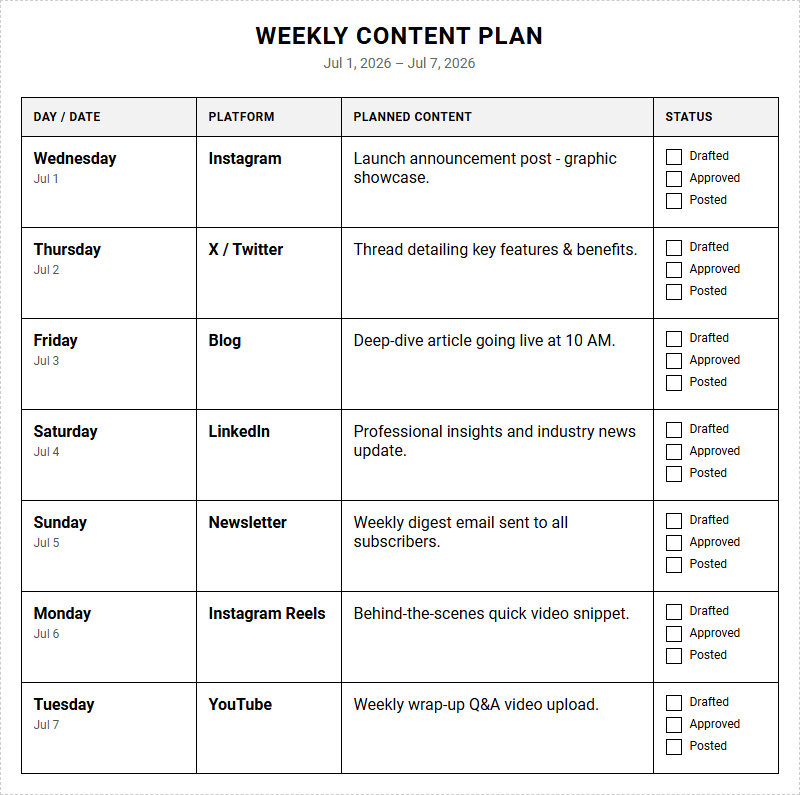
Managing a continuous content pipeline often leads to creative burnout and missed deadlines. While standard digital spreadsheets offer basic scheduling, they lack tactical focus. A dedicated printable Content and Social Media Planning Calendar grants the visual clarity needed to align daily posts with overarching marketing goals. Crucially, this system succeeds only when paired with a disciplined strategy-a method top brands use to sustain engagement. Below, we outline how to leverage this printable tool to streamline your productivity workflow.
Create Your Content and Social Media Planning Calendar
| Day / Date | Platform | Planned Content | Status |
|---|
Done customizing?
Content and Social Media Planning Calendar - Good to Know
Content Batching
Content batching is a highly productive time-management strategy where you group similar creation tasks together to execute them in one dedicated session. Instead of writing a single social media post every day, creators block out uninterrupted hours to write an entire week or month of captions at once. This method significantly reduces the cognitive load associated with context switching-the mental lag experienced when jumping between drafting, designing, filming, and scheduling.
To implement an effective batching process, consider dividing your production cycle into distinct, specialized phases:
- Ideation Phase: Brainstorming topic ideas, researching keywords, and outlining basic concepts.
- Creation Phase: Writing copy, shooting video footage, and designing graphic elements in bulk.
- Editing Phase: Refining tone, color-correcting visuals, and finalizing formatting standards.
By compartmentalizing these creative tasks, you maintain a deep flow state, resulting in higher-quality output and a much more efficient workflow.
Editorial Calendar
An editorial calendar serves as the visual roadmap for your entire brand communication strategy. It is not merely a schedule of publish dates, but a collaborative blueprint that aligns marketing initiatives, product launches, and seasonal trends with your publishing schedule. By documenting your planned outputs, team members can easily track progress, visualize gaps in coverage, and ensure a healthy mix of diverse content formats across all your active platforms.
When structuring your calendar, ensure it contains these essential structural elements:
- Publish Date & Time: Precise scheduling details to optimize audience reach.
- Distribution Channels: Identified destinations, such as your blog, newsletter, or specific social networks.
- Ownership & Status: Clear assignments indicating who is responsible and the current stage of production.
This systematic level of organization guarantees transparency, minimizes last-minute panic, and fosters long-term consistency.
Content Pillars
Content pillars, often referred to as bucket categories, are the foundational themes that define your brand's areas of expertise. These pillars anchor your content strategy, ensuring that every piece of media you produce directly reinforces your brand identity and speaks to your target audience. By establishing three to five core pillars, you avoid diluting your message and prevent creative fatigue by having predefined categories to brainstorm within.
A well-rounded brand strategy might utilize these distinct focus areas:
- Educational: Sharing actionable tutorials, industry insights, and step-by-step guides.
- Inspirational: Telling brand stories, highlighting case studies, and sharing user success.
- Promotional: Explicitly detailing your products, services, and special seasonal offers.
Adhering to these established pillars keeps your output focused, establishes your authority in your niche, and builds deep trust with readers.
Evergreen Content
Evergreen content is high-value material designed to remain relevant, accurate, and valuable to your audience long after its initial publication date. Unlike news stories or trending topics that experience rapid traffic spikes followed by a permanent decline, evergreen assets deliver a continuous stream of organic traffic over months or even years. This makes them exceptionally cost-effective marketing assets that continue to generate compounding leads over their lifespan.
To maximize the long-term return on investment, focus on creating deep resources such as:
- Comprehensive, step-by-step how-to guides that address fundamental industry pain points.
- Glossaries of core terminology and foundational concepts within your specific niche.
- Curated lists of resources, tools, and best practices that rarely change.
Regularly reviewing and updating these timeless assets ensures they maintain their high search engine rankings and search intent relevance.
Asset Library
An asset library is a highly structured, centralized digital repository where all of your media files are systematically organized, tagged, and stored for easy retrieval. Having a single source of truth for your brand assets-including high-resolution logos, brand fonts, raw video footage, and approved photography-eliminates the wasted time spent searching through scattered desktop folders or messaging platforms. This infrastructure supports both speed and visual consistency across all touchpoints.
Your library should be designed with logical taxonomy and access controls in mind:
- Logical Folder Structures: Categorize assets by campaign, year, media type, or content pillar.
- Consistent Naming Conventions: Use descriptive, searchable names for every uploaded file.
- Metadata and Tagging: Apply keywords to easily filter through thousands of files instantly.
A reliable system ensures that internal teams and external freelancers can find and use approved assets without friction.
Posting Cadence
Your posting cadence refers to the specific frequency and consistent rhythm with which you publish media across your active digital channels. Finding the optimal cadence is a delicate balance; publishing too infrequently can cause your audience to lose interest and disengage, while over-publishing can lead to audience fatigue, unsubscribes, and algorithmic penalties on social platforms. The goal is to establish a predictable schedule that your audience can rely on.
"Consistency in content delivery builds anticipation and fosters consumer trust."
When determining your ideal schedule, prioritize consistent quality over raw quantity. Analyze platform analytics to identify when your target audience is most active online, and adjust your frequency based on the resources available within your team. A manageable, high-quality cadence will always outperform a erratic, high-frequency schedule that compromises your standards.
Omnichannel Scheduling
Omnichannel scheduling is the strategic practice of planning, coordinating, and automating the distribution of your content across multiple marketing platforms simultaneously. Rather than viewing each channel as an isolated silo, an omnichannel approach treats your blog, email newsletters, and various social profiles as interconnected components of a single, unified narrative. This ensures that your brand message is cohesive, timely, and strategically aligned across the web.
Effective execution relies on modern software tools to handle the logistical load:
- Cross-Platform Syncing: Adjusting copy and formatting to suit the unique requirements of each channel.
- Automated Publishing: Queueing updates to go live at peak engagement hours globally.
- Universal Analytics: Tracking how audiences move between channels to refine your broader strategy.
This integration amplifies your brand's digital presence while minimizing manual publication overhead.
Content Repurposing
Content repurposing is the highly efficient practice of taking a single, comprehensive piece of original media and transforming it into multiple formats to extend its reach. For example, a single long-form podcast episode can be broken down into a detailed blog post, an engaging email newsletter, several short-form vertical videos, and multiple graphic slide decks. This strategy maximizes the return on your initial time investment and ensures you reach audiences who prefer different consumption formats.
To successfully execute this strategy, follow this structured workflow:
- Identify High-Performers: Select past articles or videos that achieved high organic engagement.
- Deconstruct the Asset: Break the main asset down into its core takeaways or individual steps.
- Adapt and Reformat: Tailor those individual pieces to match the native style of other platforms.
This process ensures you get maximum mileage from every piece of high-quality research and writing.
Social Media Audit
A social media audit is a comprehensive evaluation of your brand's performance, audience metrics, and profiles across all digital networks. Performing an audit on a quarterly or bi-annual basis allows you to identify what is working, uncover areas for optimization, and spot outdated branding elements. This data-driven analysis ensures your active campaigns align with actual user behavior and broader business goals rather than mere guesswork.
Your audit process should closely examine these critical performance indicators:
- Profile Consistency: Verifying that bios, links, and profile imagery are current and unified.
- Audience Demographics: Checking if your follower base matches your target customer personas.
- Engagement Analytics: Identifying which content formats generate the highest interaction rates.
The resulting insights provide a clear, objective roadmap for refining your future production decisions and platform budgets.
Creator Workflow
A structured creator workflow is the step-by-step operational sequence that takes a creative concept from initial spark to finalized, published asset. Without a clear workflow, creators frequently encounter production bottlenecks, missed deadlines, and collaborative misunderstandings. Mapping out this lifecycle establishes clear accountability at every stage and ensures that no critical quality assurance steps are bypassed during the rush to publish.
A professional production workflow typically moves through these standard phases:
- Ideation and Briefing: Documenting the target audience, keywords, and goals.
- Drafting and Development: Writing copy and creating associated visual elements.
- Review and Approval: Checking for brand alignment, legal compliance, and editorial quality.
This systematic pipeline streamlines collaboration, reduces stress, and allows creators to focus their energy on delivering exceptional work.
Leave a comment