
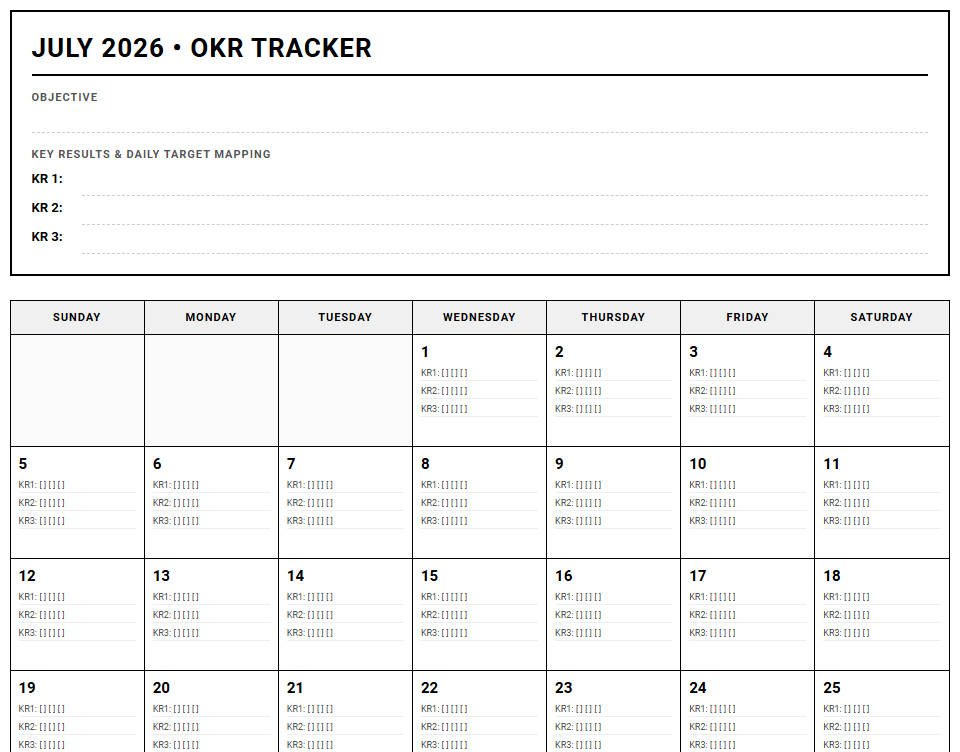
Maintaining momentum with Objectives and Key Results (OKRs) is a notorious challenge, often derailed by tracking fatigue. While organizations frequently rely on costly enterprise software to fund these performance frameworks, digital tools often lack daily visibility. Fortunately, a physical printable calendar grants teams the cognitive focus needed to bridge daily tasks with macro goals, provided they commit to disciplined weekly reviews. Below, we explore how this specialized OKR tracker calendar optimizes your goal-setting workflow.
Create Your Objectives and Key Results Tracker Calendar
Done customizing?
Objectives and Key Results Tracker Calendar - Good to Know
OKR Cadence
Establishing a structured OKR cadence ensures that organizational goals remain synchronized with daily execution. A standard cadence typically operates on dual tracks, combining a high-level annual strategy with tactical, quarterly execution cycles. This dual-track approach allows modern enterprises to maintain a consistent long-term vision while remaining agile enough to pivot based on sudden market shifts.
By defining clear operational boundaries, teams understand exactly when to set, review, and grade their objectives. Managing this rhythm requires disciplined adherence to scheduled milestones, preventing goal drift and maintaining organizational momentum. To maximize efficiency, leadership should structure the cadence around three key phases:
- Formulation: Setting aligned objectives before the cycle starts.
- Execution: Continuous tracking and resource allocation.
- Retrospective: Grading results and capturing key learnings.
This synchronization fosters a corporate culture of predictability, ensuring that resource allocation aligns perfectly with strategic priorities throughout the fiscal year.
Weekly Check-in Cycle
The weekly check-in cycle serves as the heartbeat of execution, transforming static goals into dynamic daily priorities. During these brief, highly focused sessions, team members gather to review progress, identify immediate roadblocks, and adjust tactics. Rather than exhaustive status updates, these meetings focus strictly on movement toward key results.
Teams evaluate their confidence, share qualitative insights, and commit to high-impact actions for the upcoming week. This continuous feedback loop ensures that impediments are surfaced and resolved before they derail quarterly progress. Furthermore, it reinforces individual accountability while fostering a collaborative environment where cross-functional support is readily offered.
- Review previous week's commitments and actual progress.
- Identify critical bottlenecks and operational dependencies.
- Establish high-priority initiatives for the next five business days.
Consistent execution of this micro-cadence keeps teams aligned, motivated, and highly responsive to emerging challenges throughout the quarter.
Confidence Score Tracking
Confidence score tracking introduces a vital qualitative metric to the quantitative world of objective assessment. Instead of relying solely on lagging indicators, teams assign a subjective probability score-typically ranging from 0.1 to 1.0-reflecting their belief in achieving a specific Key Result. This metric acts as an early warning system, highlighting hidden challenges before they manifest in poor performance metrics.
A sudden drop in confidence prompts immediate strategic conversations, allowing teams to reallocate resources or pivot their approach proactively. By documenting the rationale behind these fluctuations, organizations capture valuable qualitative context that numbers alone cannot convey. Over time, tracking confidence trends cultivates psychological safety, encouraging honest assessments rather than superficial optimism. Integrating this practice ensures that leadership maintains an accurate, real-time pulse on organizational health and project viability.
Quarterly Planning Window
The quarterly planning window is a dedicated timeframe designed to align organizational resources with strategic initiatives. Spanning roughly two to three weeks before a new quarter begins, this period involves intense collaboration, retrospective analysis, and goal negotiation. Teams analyze past performance data, evaluate market conditions, and draft aspirational objectives that support broader company goals.
This phase requires balancing top-down strategic direction with bottom-up tactical innovation. Effective planning windows utilize structured workshops, cross-departmental reviews, and rigorous stress-testing of proposed key results to ensure they are measurable, realistic, and sufficiently challenging. By the end of this window, every team should have approved, transparent OKRs documented within a central repository. This disciplined preparation phase minimizes execution delays, allowing teams to hit the ground running on day one.
Key Result Milestones
Breaking down ambitious objectives into discrete key result milestones is essential for maintaining momentum over long horizons. Milestones serve as measurable checkposts that validate progress and provide psychological victories along the execution path. When designing these milestones, organizations should utilize a mix of leading and lagging indicators to gauge true progress.
Rather than waiting until the end of a cycle to measure success, incremental milestones allow for course corrections while there is still time to impact the outcome. Clear milestones also simplify reporting, enabling stakeholders to grasp project health at a glance. To implement this effectively, consider the following structure:
- 25% Mark: Baseline established and initial strategies validated.
- 50% Mark: Core deliverables operational and tested.
- 75% Mark: Optimization completed and scale achieved.
Celebrating these incremental achievements sustains high morale and keeps teams engaged.
OKR Progress Heatmap
An OKR progress heatmap is a visual management tool that provides immediate clarity on organizational performance. By utilizing color-coded indicators-typically red, yellow, and green-heatmaps aggregate complex progress data into an intuitive, high-level dashboard. Executives and team leads can quickly identify which objectives are thriving and which require immediate intervention.
This visual synthesis eliminates the need to sift through extensive spreadsheets, streamlining weekly leadership review meetings. Furthermore, heatmaps foster transparency and cross-functional empathy, as teams can easily see the challenges faced by their peers. This shared visibility encourages proactive collaboration, where healthy departments offer support to those in red zones. Implementing a dynamic, real-time heatmap ensures that organizational focus remains directed toward critical bottlenecks, optimizing resource allocation across the entire enterprise.
Initiative Alignment Mapping
Initiative alignment mapping bridges the gap between high-level strategy and daily execution. It ensures that every project, task, and resource spend directly contributes to a defined Key Result. Without this mapping, organizations risk falling into the trap of busywork, where teams exert immense energy on projects that do not drive strategic outcomes.
Through systematic mapping, teams visualize the direct lineage from individual tasks to organizational objectives. This process often reveals redundant projects, allowing leaders to de-prioritize non-essential work and eliminate operational waste. Consequently, this alignment optimizes resource utilization and ensures that daily efforts yield maximum impact. It also empowers team members by showing them exactly how their daily work influences the company's broader mission, significantly boosting employee engagement and retention.
Stretch Goal Deadlines
Incorporating stretch goals into the OKR framework encourages teams to think outside operational comfort zones and pursue exponential growth. Unlike standard operational targets, stretch goals are designed to be deliberately ambitious, where achieving seventy percent of the target is considered a resounding success. Setting distinct deadlines for these aspirational milestones prevents teams from experiencing burnout while maintaining a high level of innovation.
These deadlines must be carefully managed to ensure they inspire rather than demotivate. By establishing clear timeframes, organizations channel creative energy toward solving complex problems under healthy constraints. This approach fosters a culture of continuous learning, where failure is viewed as a valuable data point rather than a performance deficit. Consequently, stretch goal deadlines push the boundaries of what the organization deems possible.
Cascading Objectives Timeline
A cascading objectives timeline outlines how strategic goals flow from executive leadership down to individual contributors. This timeline ensures that high-level annual objectives are translated into actionable, departmental goals in a structured, sequential manner. The process begins with the executive team defining corporate priorities, followed by department heads aligning their strategies, and finally, individual teams establishing tactical key results.
Managing this cascade requires a disciplined timeline to prevent bottlenecks and ensure that lower-level goals are finalized quickly. A well-orchestrated timeline balances top-down alignment with bottom-up feedback, ensuring that front-line realities inform strategic direction. This bi-directional communication prevents goal fragmentation and fosters a unified corporate culture. Through this structured flow, every employee understands how their daily responsibilities support the grand corporate vision.
Goal Velocity Tracking
Goal velocity tracking measures the rate of progress toward Key Results over time, providing critical insights into team productivity and execution efficiency. By analyzing the speed at which milestones are achieved, leaders can project whether an objective will be completed on schedule. This analytical approach moves beyond simple binary success-or-failure metrics, offering a nuanced view of execution patterns.
Velocity tracking helps identify systemic issues, such as unrealistic goal setting, resource constraints, or process bottlenecks. For instance, a flatlining velocity curve suggests immediate intervention is required, whereas a steady upward trajectory indicates healthy, sustainable execution. Utilizing velocity data during retrospectives enables teams to refine their estimating capabilities, leading to more accurate, predictable, and achievable OKRs in subsequent planning cycles.
Leave a comment