
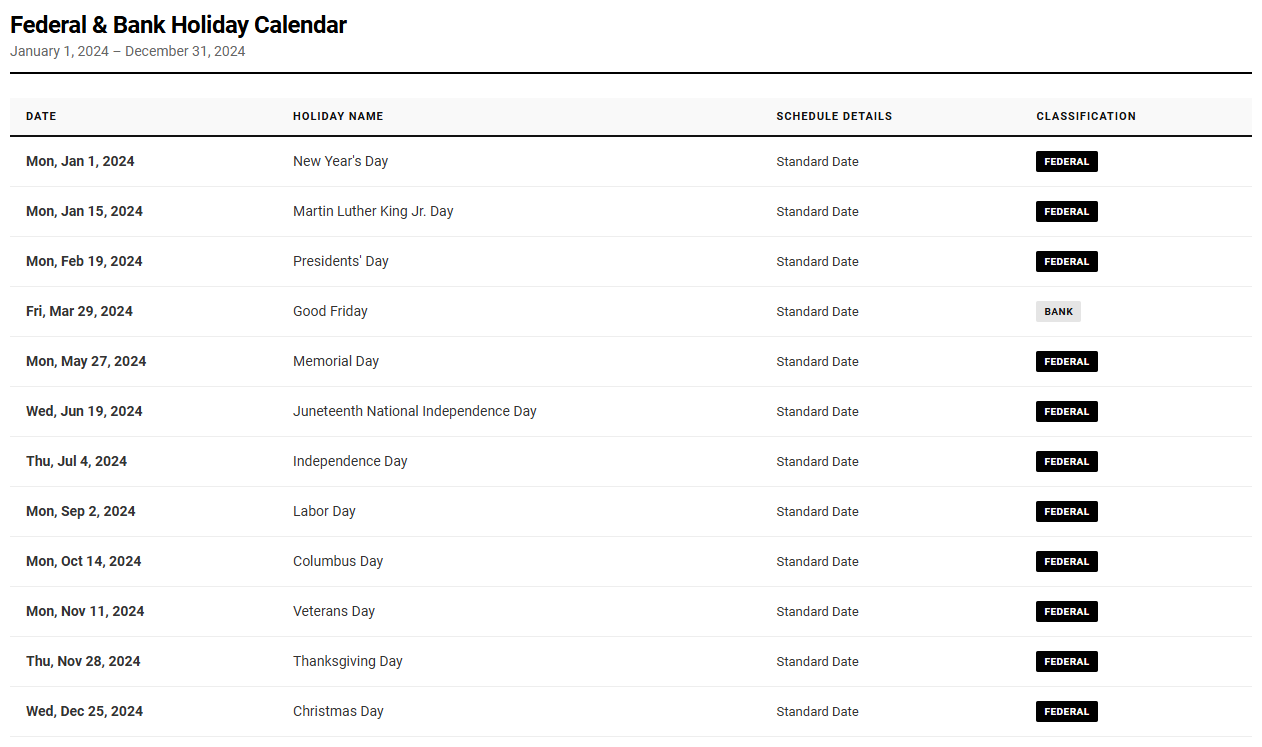
Managing corporate cash flow and payroll around bank closures often leads to costly operational delays. While standard digital planners track general events, they frequently overlook critical banking-specific offline days. This printable Federal and Bank Holiday Calendar grants financial planners seamless alignment with Federal Reserve schedules. Note that while bank holidays are federally mandated, individual institution policies may vary. With key closures like Veterans Day clearly marked, this guide outlines the complete printable schedule to help you plan your fiscal year effectively.
Create Your Federal and Bank Holiday Calendar
Done customizing?
Federal and Bank Holiday Calendar - Good to Know
Federal Reserve holiday schedule
The Federal Reserve holiday schedule dictates the operational availability of the United States central banking system. Each year, the Federal Reserve Board of Governors recognizes eleven standard public holidays during which regional Reserve Banks close their doors.
This closure directly impacts critical financial services, including:
- Federal Reserve bank wire transfers (Fedwire)
- Check processing and clearing services
- Automated Clearing House (ACH) settlement services
When a standard holiday falls on a Sunday, the preceding or following days may observe modified operations. Specifically, the Federal Reserve observes Sunday holidays on the following Monday. Saturday holidays are not observed on the preceding Friday by the Reserve Banks, though the Board of Governors might close. Financial managers must integrate these specific dates into their automated treasury systems to prevent unexpected liquidity constraints and processing bottlenecks.
ACH processing holiday delays
The Automated Clearing House network does not settle financial transactions on weekends or federal holidays. Consequently, ACH processing holiday delays occur whenever a submission timeline intersects with a bank holiday. For businesses, this means that file transmissions must be carefully planned in advance.
Consider the following standard processing timeline:
- File Transmission: The business uploads the payroll or payment file.
- Banking Holiday: The clearing house pauses operations, delaying settlement.
- Settlement Date: Funds are finally debited or credited on the next active banking day.
To avoid cash flow disruptions and late payments, organizations should submit ACH files at least one business day prior to the scheduled holiday. Clear communication with payroll providers and vendors ensures that expectations remain aligned and transactional delays do not result in costly penalties or service interruptions.
Juneteenth National Independence Day
Established as a federal holiday in 2021, Juneteenth National Independence Day is celebrated annually on June 19th. This day commemorates the end of slavery in the United States and represents a significant addition to the modern banking calendar.
Following its official federal designation, the Federal Reserve System and major commercial banking institutions added Juneteenth to their permanent non-operating schedules.
Because this holiday is relatively new, some legacy payroll systems and corporate templates may require manual updates to recognize June 19th as a non-processing day. When the date falls on a weekend, the holiday is observed on the closest weekday, causing standard financial markets and banking operations to pause. Treasury departments must ensure their annual schedules are updated to accommodate this mid-year closure, preventing unexpected delays in clearing payroll, wire transfers, and merchant credit card settlements.
Floating holiday policy
A corporate floating holiday policy provides employees with flexible paid time off to celebrate cultural, religious, or personal events that do not align with standard federal calendars. This modern HR benefit enhances workplace inclusivity and boosts employee satisfaction.
Key components of an effective policy include:
- Allotment: Offering one to three floating days per calendar year.
- Accrual: Determining whether days roll over or expire at year-end.
- Approval: Requiring prior managerial consent to maintain coverage.
From an operational standpoint, floating holidays do not disrupt corporate banking or payroll cycles because the company remains open for business. However, HR departments must utilize robust tracking software to monitor these requests, ensuring that essential staffing levels are maintained while respecting the diverse personal observances of their global workforce.
Non-settlement day
A non-settlement day refers to any day on which financial transactions cannot be finalized, cleared, or settled through the central banking system. While retail bank branches might remain open, the underlying clearing networks are inactive.
This situation typically arises during:
- Specific regional or state-designated holidays
- International bank holidays affecting cross-border currency trades
- Scheduled system maintenance windows at the Federal Reserve
For financial analysts and corporate treasurers, recognizing these non-settlement intervals is crucial for liquidity management. If an organization schedules a high-value transaction on a non-settlement day, the funds will remain in transit, potentially causing temporary cash shortages. Financial platforms must be programmed with multi-currency banking calendars to automatically identify these dates and reschedule sensitive transfers to the next valid settlement window.
NYSE market holidays
The New York Stock Exchange operates on a specific calendar of NYSE market holidays. While this schedule closely mirrors the Federal Reserve holiday calendar, there are distinct differences that traders and investors must monitor.
The exchange observes nine major holidays each year, which typically include:
- New Year's Day and Martin Luther King Jr. Day
- Washington's Birthday (Presidents' Day) and Good Friday
- Memorial Day, Juneteenth, and Independence Day
- Labor Day, Thanksgiving, and Christmas Day
In addition to full-day closures, the NYSE frequently schedules early closings, ending trading at 1:00 PM Eastern Time on the days preceding or following major holidays like Independence Day and Thanksgiving. Understanding these market holidays prevents failed orders, ensures orderly portfolio management, and helps institutional traders maintain sufficient liquidity during shortened trading weeks.
State-designated bank holidays
While federal holidays apply nationwide, state-designated bank holidays are established by individual state governments. These localized holidays can create unique operational hurdles for regional businesses and multi-state financial institutions.
Examples of state-specific holidays include:
- Patriot's Day in Massachusetts and Maine
- Cesar Chavez Day in California and Texas
- Mardi Gras in specific Louisiana parishes
On these days, state-chartered banks and local government offices may close, while nationally chartered banks and the Federal Reserve network remain fully operational. This dichotomy can lead to localized processing delays. Companies operating across state lines must map these regional variations carefully to ensure timely local deposits, compliant payroll distributions, and smooth treasury operations throughout their regional branch networks.
Inauguration Day holiday
The Inauguration Day holiday is a highly specific public holiday observed once every four years on January 20th (or January 21st if the 20th falls on a Sunday) following a United States presidential election.
This holiday is unique due to its restricted geographic scope:
- It applies legally only to federal employees in the Washington, D.C., metropolitan area.
- Local government offices in Maryland and Virginia suburbs frequently close.
- The national banking system and the Federal Reserve remain fully operational.
Because the Federal Reserve and major stock exchanges do not close for Inauguration Day, national business transactions, ACH processing, and wire transfers proceed normally. However, local businesses located within the capital region must prepare for physical bank branch closures and potential courier delays caused by security cordons and public events during the inaugural ceremonies.
Bank holiday payroll cycle
Navigating a bank holiday payroll cycle requires meticulous planning from human resources and payroll processing teams. When a standard pay date falls on a bank holiday, direct deposits cannot be delivered on that day because banking networks are closed.
To prevent payroll disruptions, employers must execute several critical steps:
- Adjust the payroll submission deadline to an earlier date.
- Verify funding timelines with the payroll service provider.
- Notify employees of the adjusted pay date well in advance.
Standard corporate policy dictates that when a pay date lands on a bank holiday, funds should be made available to employees on the business day immediately preceding the holiday. Implementing automated payroll software that flags these conflicts automatically helps businesses maintain compliance, build employee trust, and avoid costly manual processing mistakes.
Federal statutory holidays
Federal statutory holidays are public holidays established by United States federal law. Currently, the government recognizes eleven statutory holidays, which serve as the foundation for public sector closures and national banking schedules.
These holidays include historic observances such as:
- New Year's Day (January 1)
- Memorial Day (Last Monday in May)
- Independence Day (July 4)
- Thanksgiving Day (Fourth Thursday in November)
While private employers are not legally required to provide paid time off or holiday premium pay on these days, most businesses align their operational calendars with federal standards to remain competitive in the labor market. Because these holidays close the Federal Reserve, they dictate the flow of commerce and financial clearing nationwide, making them essential benchmarks for corporate scheduling, contract negotiations, and annual operational planning.
Leave a comment