
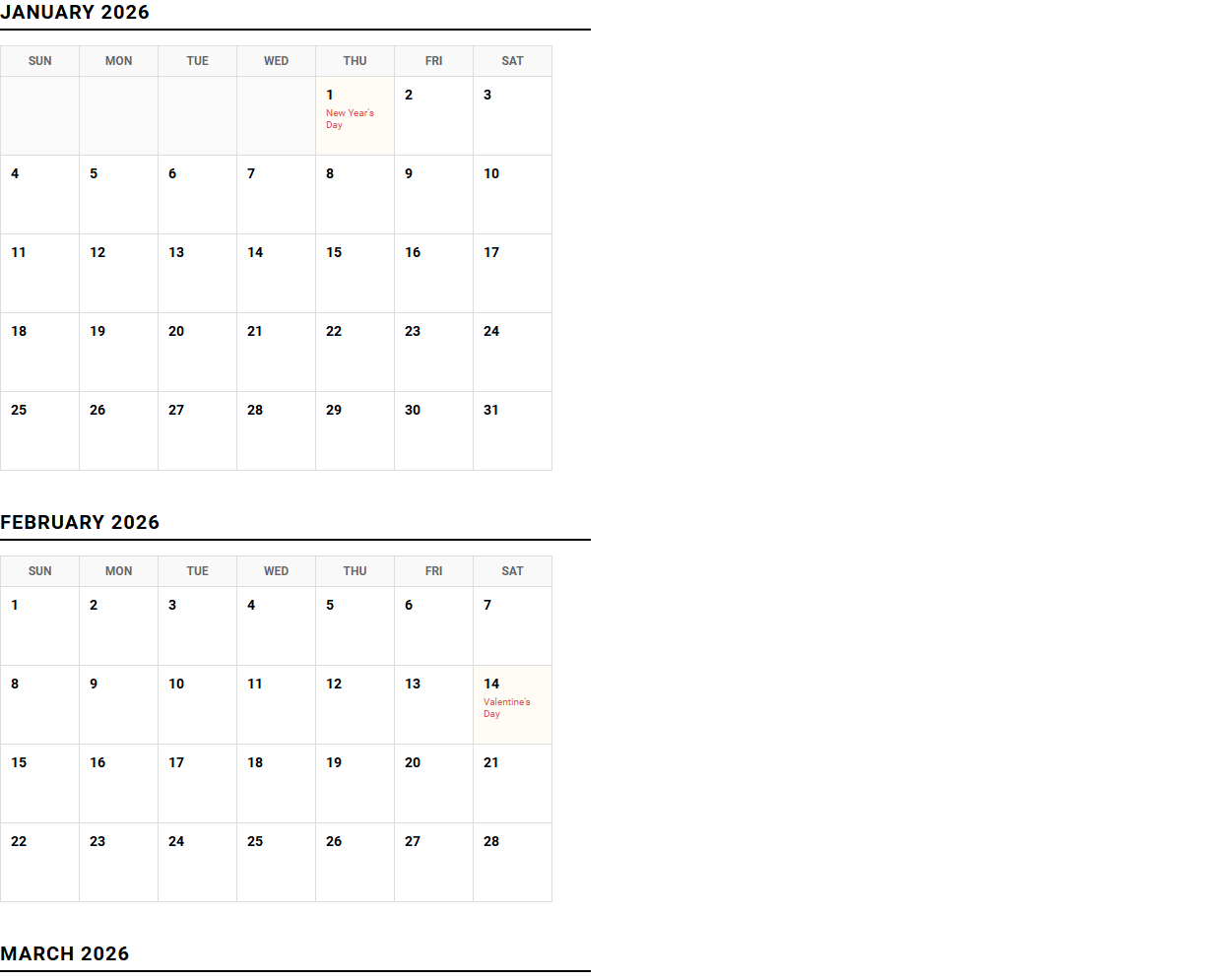
Managing cross-border operations often leads to scheduling friction and missed cultural observances. While standard corporate scheduling tools provide basic tracking, they frequently lack the comprehensive localized context required for global synchronization. Our printable International Holiday Calendar grants teams immediate, visual clarity across borders. Note the educational stipulation that regional observation dates may shift annually. Featuring major events like Lunar New Year and Diwali, this guide outlines how to utilize printable layouts to streamline your international workflow.
Create Your International Holiday Calendar
Done customizing?
International Holiday Calendar - Good to Know
Public Holidays
Public holidays represent legally established days off established by a nation's government, allowing citizens to pause their daily routines to celebrate historical, cultural, or religious milestones. These observances foster social cohesion and national identity by bringing diverse communities together in shared reflection. Typically, schools, government offices, and many commercial enterprises suspend operations on these specific dates.
While some public holidays have fixed dates, others shift annually based on celestial cycles or legislative decisions. Businesses must navigate these variations to remain compliant with local labor laws. The economic impact of these closures is often balanced by a significant surge in consumer spending within the tourism, leisure, and hospitality sectors.
- National Unity: Commemorates foundational historic events.
- Cultural Significance: Honors deep-seated heritage and local customs.
- Economic Stimulus: Drives seasonal travel and retail growth.
Federal Holidays
In federalist systems, federal holidays are public holidays recognized specifically by the central government. These official days are legally binding for federal employees and offices, though individual states or provinces retain the sovereignty to decide whether to recognize them at the regional level. Consequently, private employers are not automatically mandated to grant paid leave, although many align their corporate calendars with federal schedules to maintain operational consistency.
In the United States, for instance, federal institutions close on designated days established by Congress. These dates often celebrate pivotal historical figures or crucial turning points in the nation's democratic journey. Understanding this framework is vital for multi-state corporations managing payroll, logistics, and employee benefits across different jurisdictions.
- New Year's Day – Celebrating the start of the civil calendar.
- Memorial Day – Honoring fallen military service members.
- Independence Day – Commemorating the nation's founding principles.
UN International Days
The United Nations designates specific dates throughout the year as International Days to advocate for critical global issues, mobilize political will, and celebrate humanity's collective achievements. Rather than functioning as statutory days off, these observances serve as powerful catalysts for international awareness and targeted educational campaigns.
Each designated day targets a specific global challenge, ranging from environmental conservation and human rights protection to scientific innovation and public health improvements. Governments, non-governmental organizations (NGOs), and educational institutions leverage these moments to host conferences, launch community initiatives, and fundraise for pressing global causes. By aligning local actions with international frameworks, these days foster a sense of shared responsibility for our planet's future stewardship.
"These observances are powerful tools to educate the public on issues of concern, to mobilize political will and resources, and to reinforce achievements of humanity."
Diversity and Inclusion Calendar
Modern organizations increasingly rely on a comprehensive Diversity and Inclusion (D&I) Calendar to build equitable workplaces where every individual feels recognized. This strategic planning tool documents a wide array of religious holidays, cultural heritages, accessibility awareness weeks, and identity celebrations that might otherwise be overlooked by traditional corporate schedules.
Integrating a D&I calendar into business operations helps leadership proactively avoid scheduling major corporate events, product launches, or town halls on significant religious or cultural observances. Furthermore, it provides educational opportunities that demystify different backgrounds, reduce unconscious bias, and actively promote empathy among colleagues. Respecting these diverse milestones enhances talent acquisition, improves employee retention, and cultivates a workplace culture rooted in authentic belonging.
- Pride Month
- Celebrating LGBTQ+ history, achievements, and ongoing advocacy for equal rights.
- Global Accessibility Awareness
- Focusing on digital inclusion and usability for individuals with disabilities.
Bank Holidays
Historically originating in the United Kingdom during the nineteenth century, bank holidays were designated days when financial institutions closed their doors to settle accounts. Over time, these closures evolved into statutory public holidays enjoyed by the broader workforce. Today, the term is widely used in several Commonwealth nations to denote official days of rest recognized by the banking sector and general public alike.
Because financial transactions, wire transfers, and stock market operations pause on these dates, businesses must carefully plan their cash flows and payment processing schedules. While brick-and-mortar branches remain closed, modern digital banking platforms have mitigated some operational delays, yet processing backlogs can still occur, requiring strategic financial management from corporate treasury departments.
Consequently, these holidays require proactive planning to ensure payroll processing and supply chain settlements remain uninterrupted despite the temporary suspension of clearing house services.
Gazetted Holidays
Commonly referenced in countries like India, Pakistan, and Singapore, a gazetted holiday is an official public holiday that has been formally published in the government's official journal, known as the gazette. This official publication makes the holiday legally mandatory for government organizations, public sector undertakings, and educational institutions, requiring them to observe the day with paid closure.
Unlike restricted or optional holidays, which allow employees to choose a limited number of personal days off from a broader list, gazetted holidays are non-negotiable closures. They typically encompass major national celebrations and widely observed religious festivals, ensuring that the majority of the population can participate in significant cultural and civic events without risking their employment status or compensation.
- Mandated by official government decree.
- Applicable to public sector and governmental agencies.
- Ensures uniform observance of highly significant cultural events.
Lunar Calendar Observances
Many of the world's most vibrant cultural traditions rely on lunar calendar observances rather than the standard Gregorian calendar. Because these celebrations are synchronized with the phases of the moon, their corresponding dates on the solar calendar shift continuously from year to year. This fluid schedule requires careful annual planning for global supply chains and international corporate communications.
Major celebrations like the Lunar New Year, Eid, Diwali, and Rosh Hashanah see billions of people travel, gather, and feast with family. For global enterprises, understanding these lunar cycles is essential; factory closures in major manufacturing hubs during these periods can cause significant production delays if not anticipated months in advance. Respecting these holidays demonstrates cultural competence and strengthens relationships with international partners.
Consequently, scheduling flexibility during these periods is highly valued by global teams seeking to balance business objectives with cultural heritage.
Floating Holidays
As workplaces embrace flexibility, many employers offer floating holidays as a progressive benefit. Unlike fixed public holidays, a floating holiday is a paid day off that employees can use at their discretion to celebrate personal milestones, cultural events, or religious observances that are not officially recognized on the standard corporate calendar.
This policy empowers a diverse workforce to tailor their time off to their personal values, whether they are celebrating a specific religious festival, taking a mental health day, or marking a unique family tradition. For human resources departments, implementing floating holidays reduces the administrative burden of accommodating diverse religious accommodation requests and serves as an attractive recruitment tool that highlights a progressive, inclusive corporate culture designed for the modern era.
- Enhances employee autonomy and work-life balance.
- Promotes inclusivity for minority religious and cultural groups.
- Simplifies human resources scheduling and accommodation requests.
iCal Subscription Feeds
In our hyper-connected digital world, keeping track of various national and global observances is made seamless through iCal subscription feeds. These dynamic calendar feeds utilize the universal ICS format to automatically sync holiday schedules, cultural observances, or corporate events directly into an individual's personal digital calendar, whether they use Google Calendar, Apple Calendar, or Microsoft Outlook.
Unlike static manual entries, iCal subscriptions update automatically in real-time whenever changes occur, ensuring that scheduling conflicts are avoided. Organizations utilize these feeds to keep remote, global teams aligned, preventing internal meetings from being scheduled on regional holidays. Integrating these subscriptions is an efficient way to enhance operational coordination and maintain a high level of cultural awareness across global boundaries.
By subscribing to verified holiday feeds, professionals can ensure their scheduling software remains accurate without manual updates.
Bridge Days
A bridge day refers to a working day that falls between a public holiday and a weekend. For example, if a national holiday falls on a Thursday, the subsequent Friday is often utilized as a bridge day, allowing workers to enjoy a contiguous four-day weekend. In many countries, governments officially declare these days as holidays to boost domestic tourism and improve worker productivity.
In regions where bridge days are not officially mandated, employees frequently request annual leave on these specific dates. Forward-thinking companies often anticipate this trend by implementing flexible remote-work policies or scheduling low-intensity operational tasks during these periods, recognizing that workplace attendance and productivity naturally decline when a major weekend connection is within reach.
- Extended Weekends: Maximizes leisure time with minimal vacation day usage.
- Tourism Boost: Increases travel, dining, and hospitality revenue.
- Operational Planning: Requires proactive staffing adjustments to maintain service levels.
Leave a comment