
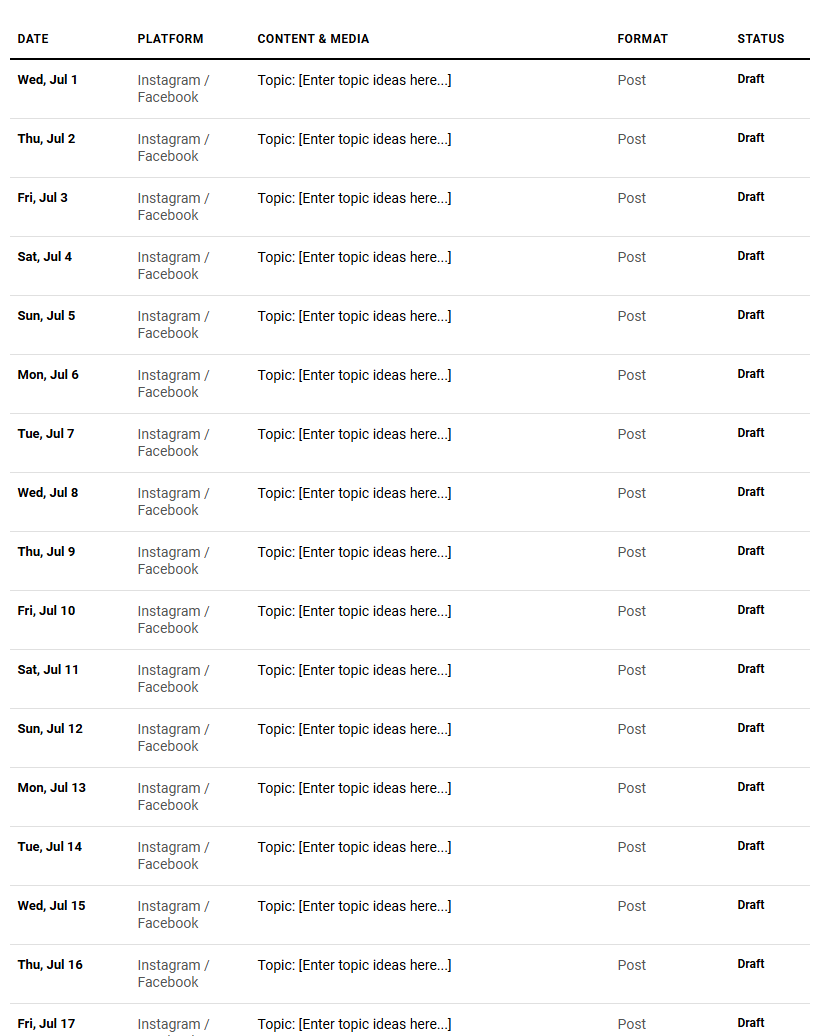
Managing a consistent posting schedule often leaves digital marketing teams overwhelmed. While standard spreadsheets offer basic tracking, they frequently lack tactile clarity. Implementing printable, blank & custom template calendars grants teams immediate, high-level visual control over complex campaign launches, such as a multi-week Instagram rollout. Success, however, stipulates that users consistently update these physical sheets alongside digital assets. Below, we examine how to customize these printable layouts to optimize your editorial workflow.
Create Your Social Media Content Calendar
Done customizing?
Social Media Content Calendar - Good to Know
Content Pillars
Content pillars, or brand themes, serve as the foundational topics that define your brand's content strategy. By establishing three to five specific areas of focus, digital marketers can ensure thematic consistency across all marketing channels. These core categories align closely with your target audience's interests and your brand's core expertise.
Using structured pillars helps prevent content fatigue and ensures your messaging remains highly relevant. To implement this successfully, consider the following structural benefits:
- Audience Clarity: Visitors immediately understand your core value proposition and niche.
- Search Engine Authority: Focusing on specific topics builds deep topical relevance for SEO.
- Creation Efficiency: It simplifies brainstorming by providing clear boundaries for content generation.
By mapping every social post, blog article, and newsletter back to these established pillars, brands maintain a cohesive voice that fosters long-term consumer trust and increases search visibility.
Content Batching
Content batching is a highly effective productivity technique where you focus on a single phase of the content creation process during a dedicated block of time. Instead of switching daily between writing, designing, and scheduling, creators perform similar tasks simultaneously to minimize cognitive load and eliminate multitasking inefficiencies.
Integrating content batching into your marketing workflow generally follows a systematic sequence:
- Ideation and Keyword Research: Brainstorming and planning topics for the upcoming month.
- Copywriting and Drafting: Writing all captions, scripts, and articles in one focused session.
- Visual Asset Creation: Designing graphics, taking photos, or editing videos consecutively.
- Scheduling: Uploading and automating delivery via content management systems.
This organized method significantly reduces stress, improves creative focus, and guarantees a steady stream of promotional material, allowing businesses to remain consistent with minimal daily effort.
Evergreen Content
Evergreen content refers to search-optimized material that remains continually relevant, fresh, and valuable to readers over a long period. Unlike time-sensitive news stories or trending topics, evergreen articles, tutorials, and guides do not have an expiration date, ensuring sustainable traffic patterns long after their initial publication date.
"Evergreen assets represent the compound interest of your digital marketing portfolio, delivering compounding organic reach and steady lead generation over months and years."
To maximize the shelf life of your digital media assets, focus on creating comprehensive resources, such as how-to guides, glossaries, and frequently asked questions (FAQs). Regularly auditing and updating these evergreen posts keeps them accurate, secures high search engine result rankings, and continuously attracts new prospects into your sales funnel without requiring constant creative reinvestment.
Content Cadence
Establishing a consistent content cadence-the frequency, timing, and pattern of your publishing schedule-is vital for building an engaged audience and signaling reliability to search engines and social media algorithms. Whether you post daily, weekly, or bi-weekly, maintaining a predictable rhythm establishes trust and sets clear expectations for your subscribers.
Determining the ideal publishing frequency requires a strategic balance between your internal team's creative capacity and your audience's appetite for consumption. Consider these three factors:
- Platform Nuances: Different networks require varying posting frequencies to remain visible.
- Resource Constraints: Quality must never be sacrificed for pure quantity.
- Audience Analytics: Monitor engagement metrics to discover when your community is most active online.
A disciplined cadence keeps your brand top-of-mind, improves organic placement, and ensures steady growth across digital platforms.
Grid Aesthetic
The grid aesthetic refers to the overall visual layout, color scheme, and stylistic harmony of a brand's social media profile feed, particularly on highly visual networks like Instagram. A cohesive grid serves as a digital storefront, forming a critical first impression that influences whether casual profile visitors choose to click the follow button.
To cultivate an appealing grid, designers often employ strategic visual frameworks, including:
- Color Harmony: Sticking to a strict palette of primary and secondary brand colors.
- Layout Patterns: Alternating between detailed photos, graphic quotes, and minimalist negative space.
- Consistent Filters: Utilizing uniform editing presets to bind diverse imagery together.
A beautifully curated feed communicates professionalism, elevates brand value, and transforms a collection of individual posts into a unified storytelling canvas that resonates with your core demographic.
User-Generated Content
User-Generated Content (UGC) encompasses any form of digital media, such as videos, images, reviews, or social posts, created by customers rather than the brand itself. In an era where consumers are skeptical of traditional advertising, UGC serves as powerful social proof that builds authenticity and peer-to-peer validation.
Leveraging customer creators offers distinct competitive advantages for modern digital storefronts:
- Authenticity: Real photos of products in use build credibility and consumer confidence.
- Cost Efficiency: Minimizes the necessity for expensive in-house commercial photoshoots.
- Community Building: Encouraging customers to share experiences strengthens brand affinity and loyalty.
By actively showcasing customer photos, unboxing videos, and honest product reviews on your official website and social platforms, you foster a vibrant community while driving conversions through relatable, real-world proof.
Social Media Audit
A social media audit is a comprehensive evaluation of your business's metrics, profiles, and active campaigns across all digital channels. Conducting this assessment quarterly ensures that your marketing investments align with real-world business objectives and reveals which tactics are successfully engaging your target demographic.
A thorough audit requires analyzing several key performance indicators (KPIs) and operational areas:
- Profile Optimization: Ensuring consistent bios, profile photos, and links across all networks.
- Performance Analysis: Identifying top-performing posts to replicate successful creative strategies.
- Demographic Insights: Verifying that your active followers match your buyer personas.
- Competitor Benchmarking: Observing industry standards and identifying market gaps.
This structured analysis provides the actionable data necessary to refine your creative output, eliminate underperforming channels, and optimize future advertising budgets.
Content Repurposing
Content repurposing is the strategic practice of adapting existing marketing assets into different formats to expand their reach and maximize their return on investment. Instead of continuously generating new ideas from scratch, marketers extract additional value from high-performing materials by presenting them through various creative lenses.
This multi-channel approach can be structured efficiently using a simple translation model:
- Source Asset: Long-form Blog Post
- Repurposed into a series of short social media graphics and a detailed newsletter feature.
- Source Asset: Video Webinar
- Sliced into several vertical video clips for mobile platforms and transcribed into a comprehensive guide.
Repurposing expands your visibility across diverse audiences who prefer consuming information in varied formats, making your overall production process sustainable and scalable.
Asset Library
An asset library is a centralized, digital repository where a brand stores, organizes, and manages its creative files, including high-resolution logos, brand fonts, photography, videography, and approved templates. Implementing a structured digital asset management system ensures that all team members and external agencies have instant access to consistent visual assets.
A well-maintained library prevents brand dilution and streamlines collaborative workflows by offering several operational benefits:
- Time Efficiency: Eliminates time spent searching through scattered folders for creative files.
- Brand Consistency: Guarantees that only approved, current versions of visual assets are deployed.
- Secure Collaboration: Simplifies sharing permissions with freelancers, agency partners, and remote staff.
An organized media library forms the operational foundation for modern design teams, allowing rapid deployment of high-quality campaigns.
Editorial Workflow
An editorial workflow is a documented, step-by-step process that a creative team follows to take a content piece from its initial ideation phase to final publication. Establishing a structured pipeline ensures that every article, video, and social post undergoes rigorous quality assurance, copy editing, and brand alignment checks.
A typical enterprise workflow defines clear responsibilities for team members at every stage of production:
- Ideation and Approval: Pitching concepts and evaluating their strategic value.
- Creation and Design: Writing draft copy and generating supporting media assets.
- Review and Compliance: Proofreading, fact-checking, and ensuring legal and brand compliance.
- Scheduling and Distribution: Formatting within the CMS and setting the post live.
Defining clear ownership for each stage eliminates bottlenecks, reduces production errors, and allows creative organizations to scale their output with predictability and poise.
Leave a comment