
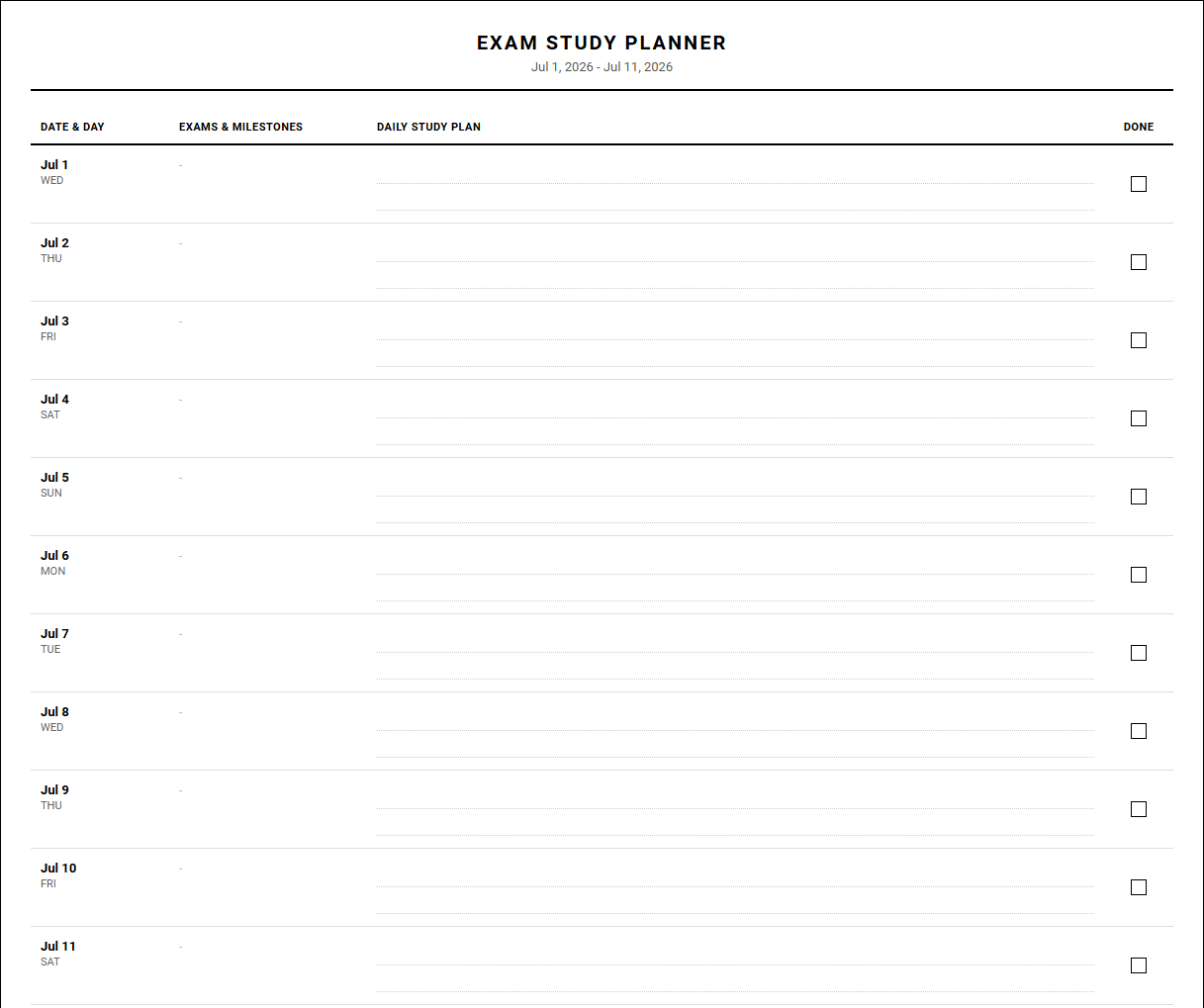
Juggling dense exam syllabi often leaves students feeling overwhelmed during finals week. While institutions utilize departmental resource funding to provide general academic advising, these standard services rarely offer personalized, day-to-day time management tools.
Our printable Exam Study Schedule Planner bridges this gap; it grants students immediate, structured clarity over their revision timelines. Provided users commit to disciplined daily tracking, utilizing proven frameworks like the 30-Day Finals Matrix significantly improves retention. Below, we outline the customizable template options designed to optimize your upcoming study block.
Create Your Exam Study Schedule Planner
Exam Study Planner
Select study dates and click "Update Output" to preview.
Done customizing?
Exam Study Schedule Planner - Good to Know
Spaced repetition
Spaced repetition is a highly effective learning technique that leverages the psychological spacing effect. Instead of cramming information in a single session, learners review study material at increasing intervals over time. This method directly combats the forgetting curve, a mathematical formula representing how quickly memories fade without reinforcement.
By reviewing concepts just before you are about to forget them, your brain strengthens its neural connections, converting short-term knowledge into long-term memory. Students often implement this strategy using physical card systems or popular software applications. The core benefits include:
- Optimized study time by focusing energy on difficult topics.
- Enhanced long-term retention of complex medical, historical, or linguistic data.
- Reduction of academic stress through systematic, daily preparation.
Consistent practice is key, as the system relies on structured review schedules to maintain maximum mental retention and cognitive efficiency throughout your academic journey.
Time blocking
Time blocking is a time management method where you divide your day into dedicated chunks of time. Each block is dedicated to completing a specific task or group of tasks, rather than keeping an open-ended to-do list. This proactive approach minimizes the cognitive load associated with task switching and decision fatigue.
By pre-allocating hours for deep work, administrative chores, or rest, you create a structured, realistic roadmap for your day. To implement this, visual planners or digital calendars are highly recommended. This technique forces you to estimate how much time tasks actually take, promoting realistic planning and accountability. It helps protect your focus from daily distractions and ensures that high-priority projects receive undivided attention. Integrating this method into your routine transforms passive scheduling into an active commitment to productivity, keeping you focused on your goals.
Active recall
Active recall is a powerful learning strategy that involves actively stimulating your memory for a piece of information. Unlike passive review, where students simply re-read textbooks or highlight notes, active recall requires you to retrieve information from your brain without looking at the answer. This cognitive effort strengthens neural pathways and enhances memory consolidation.
You can practice active recall by closed-book testing, writing down everything you remember on a blank sheet, or answering practice questions. While it feels significantly more challenging than passive reading, the mental strain is precisely what signals the brain to prioritize and retain that information. Integrating this technique into your daily study routine dramatically improves comprehension, retention, and performance during exams, making it a cornerstone of efficient academic preparation and long-term skill acquisition.
Pomodoro technique
The Pomodoro technique is a globally recognized time management system developed by Francesco Cirillo in the late 1980s. It breaks down work into manageable intervals, traditionally twenty-five minutes in length, separated by short five-minute breaks. These intervals are known as pomodoros. After completing four consecutive study sessions, you take a longer, more substantial break of fifteen to thirty minutes.
This rhythmic cycle helps maintain high levels of focus while preventing mental fatigue and burnout. By working against the clock, students develop a sense of urgency that discourages procrastination. The structured breaks offer a necessary pause to rest, recharge, and process information. It is ideal for tasks requiring sustained concentration and is easily customizable to fit individual productivity cycles, ensuring steady progress without physical or mental exhaustion.
Syllabus mapping
Syllabus mapping is a strategic preparation technique where you align your study schedule directly with the official course syllabus. At the beginning of a semester, you break down the syllabus into core modules, learning objectives, and key topics. By visualizing the entire course structure, you can allocate your study time based on the weight and difficulty of each topic.
This prevents the common pitfall of spending too much time on minor details while neglecting heavily weighted exam topics. You can create a master spreadsheet or a physical mind map to track your progress through each syllabus point. This method ensures complete coverage of all required material and provides a clear, organized roadmap that reduces exam anxiety and keeps your study sessions highly targeted, purposeful, and aligned with your instructor's grading rubric.
Retroactive study schedule
A retroactive study schedule, or retrospective timetable, is a flexible study planning method that prioritizes topic difficulty and memory decay over fixed calendar dates. Instead of scheduling what you will study weeks in advance, you keep a list of all exam topics and record the date you last studied them. Alongside each entry, you use a color-coding system to rate your level of understanding.
- Red: Poor understanding or high difficulty.
- Amber: Moderate comprehension; needs quick review.
- Green: Fully mastered; requires minimal maintenance.
When planning your next session, you look at your tracker and choose the topic that has either the worst rating or the longest time elapsed since your last review. This dynamic approach ensures you spend time where it is needed most, adapting to your actual learning pace in real-time.
Leitner system
The Leitner system is a classic, highly effective method of using physical flashcards based on the principle of spaced repetition. It involves setting up a series of numbered boxes, usually three to five, each representing a different review interval. All flashcards start in Box One. When you review a card and get it correct, you promote it to the next box.
If you answer incorrectly, the card returns to Box One, regardless of how far it had progressed. Box One is reviewed daily, Box Two every three days, and Box Three every five days. This elegant system ensures that difficult concepts are reviewed more frequently, while mastered material is spaced further apart, maximizing efficiency and saving valuable study hours during intense exam preparation phases.
Buffer days
Buffer days are intentionally scheduled empty days in a study plan designed to handle overflow, review difficult concepts, or simply catch up on delayed tasks. Even the most carefully designed study schedules can be disrupted by unexpected events, illness, or complex topics that take longer to master than anticipated. By embedding buffer days once or twice a week, you build a safety net into your preparation.
If you fall behind, you use the buffer day to catch up without feeling overwhelmed. If you are on schedule, you can use this time for relaxation, deep review, or advanced preparation. Integrating these rest days into your workflow reduces academic stress, maintains mental well-being, and prevents the domino effect of falling permanently behind on your educational goals.
Exam countdown
An exam countdown is a structured time-management strategy that involves planning backward from the date of your final assessment. By establishing a clear visual timeline, you break the remaining weeks into distinct phases, such as content acquisition, intense active recall, and full-length practice examinations. This system helps transform an abstract, distant deadline into concrete, daily milestones.
It instills a healthy sense of urgency, encouraging consistent study habits well before the exam date approaches. Tracking the countdown daily keeps your goals at the forefront of your mind and prevents cramming. Additionally, this method allows you to adjust your daily workload dynamically, ensuring that you peak academically at precisely the right moment for peak performance on test day.
Interleaved practice
Interleaved practice is a learning technique that involves mixing different topics, subjects, or types of problems within a single study session. This contrasts with blocked practice, where a student focuses on mastering one specific concept before moving to the next. While block practicing might provide a temporary illusion of mastery, interleaving challenges the brain to constantly differentiate between similar concepts and choose the appropriate solution strategy.
Research shows that this cognitive effort leads to deeper understanding and superior long-term retention. For instance, instead of practicing ten geometry problems followed by ten algebra problems, you should mix them together. This method trains your brain to quickly identify problem types, preparing you for actual exam conditions where questions appear in random order.
Leave a comment