
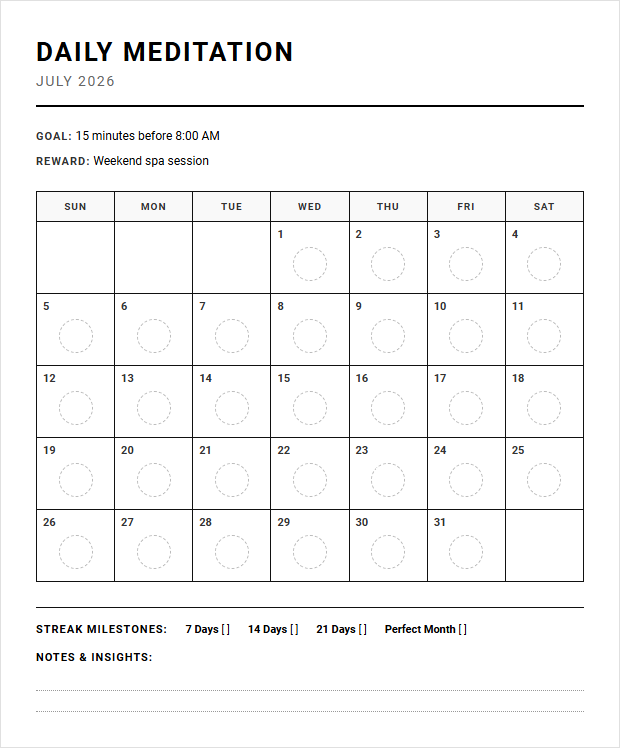
Maintaining consistent lifestyle changes is notoriously difficult, often leading to abandoned routines. While standard wellness investments-like gym memberships or premium digital subscriptions-offer structure, they often lack visual reinforcement.
The Healthy Habit Streak Calendar bridges this gap, granting users an immediate, tangible sense of daily momentum. Note that while this tool visualizes consistency for goals like daily hydration or 10,000-step targets, it requires personal commitment to succeed. Below, we outline how to utilize this printable to secure long-term behavioral change.
Create Your Healthy Habit Streak Calendar
| Sun | Mon | Tue | Wed | Thu | Fri | Sat |
|---|
Done customizing?
Healthy Habit Streak Calendar - Good to Know
Habit stacking
Habit stacking is a highly effective behavioral modification strategy that leverages your current routines to build new, positive behaviors. Instead of trying to insert a new action into a random part of your day, you anchor it directly to an established anchor habit. This technique utilizes the strong neural pathways already paved in your brain, reducing the cognitive load required to initiate the new task.
To implement this method successfully, you can utilize a simple, structured formula:
- Identify existing anchors: List daily automatic behaviors, such as brewing morning coffee or brushing your teeth.
- Define the new habit: Choose a specific, realistic action you want to introduce.
- Formulate the stack: State your commitment clearly: "After I [Current Habit], I will [New Habit]."
By pairing your aspirations with established routines, you create a seamless transition, transforming willpower-dependent tasks into automatic, natural responses that require minimal mental effort over time.
Don't break the chain
The "Don't break the chain" methodology, famously popularized by comedian Jerry Seinfeld, is a powerful visual strategy designed to maintain long-term consistency. The core principle relies on marking a physical calendar with a prominent red "X" for every day you successfully complete a targeted task. As the consecutive marks grow, they form a cohesive chain that serves as a tangible representation of your dedication and hard work.
This approach shifts your primary focus from the massive, distant goal to the simple, daily execution of the task at hand. The primary psychological benefits include:
- Visual momentum: Seeing a continuous line of progress provides immediate psychological rewards.
- Loss aversion: The desire to avoid breaking a long, beautiful chain becomes more motivating than the effort required to complete the daily task.
Maintaining this visual record reinforces your self-discipline, transforming daily progress into a rewarding game of personal consistency.
Streak freeze
While maintaining a continuous streak is highly motivating, life often presents unpredictable disruptions that can derail our best intentions. This is where the concept of a streak freeze becomes invaluable. Originating in modern digital apps, a streak freeze acts as a strategic safety net, allowing users to miss a single day without resetting their hard-earned progress to zero.
Incorporating flexibility into your habit design prevents the devastating "what-the-hell effect," where a single slip-up leads to total abandonment of the goal. By allowing occasional, planned grace periods, you protect your psychological momentum and maintain high morale. This balanced approach acknowledges human limitation while actively encouraging long-term resilience. Embracing a streak freeze ensures that minor, temporary setbacks do not destroy weeks of consistent effort, allowing you to resume your routine with confidence, enthusiasm, and zero guilt.
Micro-habits
Micro-habits are the fundamental building blocks of monumental personal transformation. This concept involves scaling down a desired behavior to its absolute smallest, easiest iteration. For instance, instead of aiming to read one book per week, a micro-habit approach focuses on reading just one single page every night. By reducing the entry barrier, you bypass the brain's natural resistance to change and effort.
The beauty of this technique lies in its accessibility during low-energy days. Consider these practical examples:
- Flossing just one tooth instead of your entire mouth.
- Doing a single push-up after waking up.
- Meditating for sixty seconds before opening your laptop.
Starting exceptionally small allows you to establish the crucial routine of showing up. Once the behavior is successfully integrated into your identity, scaling up the intensity and duration happens naturally and effortlessly.
Keystone habits
Keystone habits are pivotal, foundational behaviors that naturally trigger a positive chain reaction throughout your entire life. When you successfully establish a keystone habit, it reorganizes other routines and values without requiring direct, conscious effort. These habits create a ripple effect, building a strong infrastructure of discipline that makes other beneficial practices much easier to adopt and maintain over time.
Typical examples of these powerful catalyst behaviors include:
- Regular physical exercise: Often leads to better nutrition, improved sleep quality, and increased daily productivity.
- Daily journal writing: Enhances emotional intelligence, self-reflection, and goal clarity.
- Making your bed: Instills a sense of order, pride, and accomplishment first thing in the morning.
Focusing your energy on developing these central pillars maximizes your personal growth efficiency, driving widespread positive transformation across multiple disciplines simultaneously.
Behavioral design
Behavioral design is the deliberate practice of altering your immediate physical and digital environments to make desirable habits easier to perform and undesirable habits harder to execute. Instead of relying solely on fleeting willpower, you architect your surroundings to naturally guide your choices. This systemic approach acknowledges that our daily behavior is often a direct reaction to the environmental cues that surround us.
To optimize your environment effectively, consider implementing these dual design strategies:
- Friction reduction: Lay out your workout clothes the night before to make morning exercise effortless.
- Friction addition: Place your television remote control in another room to curb mindless evening viewing.
By systematically designing your environment to support your long-term goals, you create a path of least resistance that naturally steers you toward productive, healthy choices every day.
Identity-based habits
True, lasting behavior change does not stem from what you want to achieve, but rather from who you wish to become. Identity-based habits focus on shifting your core beliefs about yourself rather than focusing solely on external outcomes. When your behaviors align seamlessly with your deeply held self-image, maintaining positive habits ceases to feel like a chore and instead becomes a natural expression of your true self.
This transformative process involves two simple, iterative steps:
- Decide the exact type of person you want to be (e.g., a healthy person, a writer, or a reliable friend).
- Prove this identity to yourself daily through small, consistent victories.
By framing your actions as votes for your desired identity, you build deep-seated confidence and pride, establishing a sustainable foundation for lifelong personal growth and positive evolution.
Visual cue
A visual cue is an environmental trigger that immediately prompts your brain to initiate a specific behavior. Because human beings are highly visual creatures, the sights in our immediate surroundings play a monumental role in shaping our daily actions. When positive habits are hidden, they are easily forgotten; conversely, when visual reminders are prominent, action becomes almost inevitable.
To leverage visual cues effectively, try these practical arrangements:
- Place a fresh bottle of water directly on your desk to encourage proper hydration throughout the workday.
- Keep your current book resting on your pillow as an immediate invitation to read before sleeping.
- Position a yoga mat in the middle of your living room floor as a call to stretch.
Designing obvious visual triggers ensures that your positive intentions remain top of mind, facilitating seamless daily habit execution.
Habit loop
The habit loop is a powerful psychological framework that explains how all human behaviors are formed, reinforced, and automated. Popularized by neurological research, this neurological loop consists of three distinct, consecutive phases that feed into one another:
- The Cue: A specific trigger that tells your brain to go into automatic mode and which routine to use.
- The Routine: The physical, mental, or emotional behavior that you perform in response to the trigger.
- The Reward: The positive feedback or physical satisfaction that helps your brain determine if this loop is worth remembering.
Understanding this cyclic anatomy allows you to systematically deconstruct bad habits and engineer constructive new ones. By identifying the underlying cues and rewards of your behaviors, you can successfully rewrite the routine to foster healthy, productive life patterns.
Gamified tracking
Gamified tracking infuses elements of game design into your daily habit-building journey, making self-improvement highly engaging and fun. By incorporating points, levels, unlockable achievements, and avatars, you transform routine tasks into an immersive quest. This playful approach leverages our natural desire for play, competition, and immediate feedback, turning mundane consistency into an exciting adventure.
Key mechanics of a gamified habit tracking system include:
- Leveling up: Earning experience points as you complete your daily reading or exercise routines.
- Unlocking rewards: Treating yourself to a movie night or a relaxing massage after reaching a week-long milestone.
- Social quests: Joining forces with friends to complete challenges and hold each other mutually accountable.
Gamifying your progress provides instant gratification, keeping you highly motivated and deeply invested in your personal growth journey.
Leave a comment