
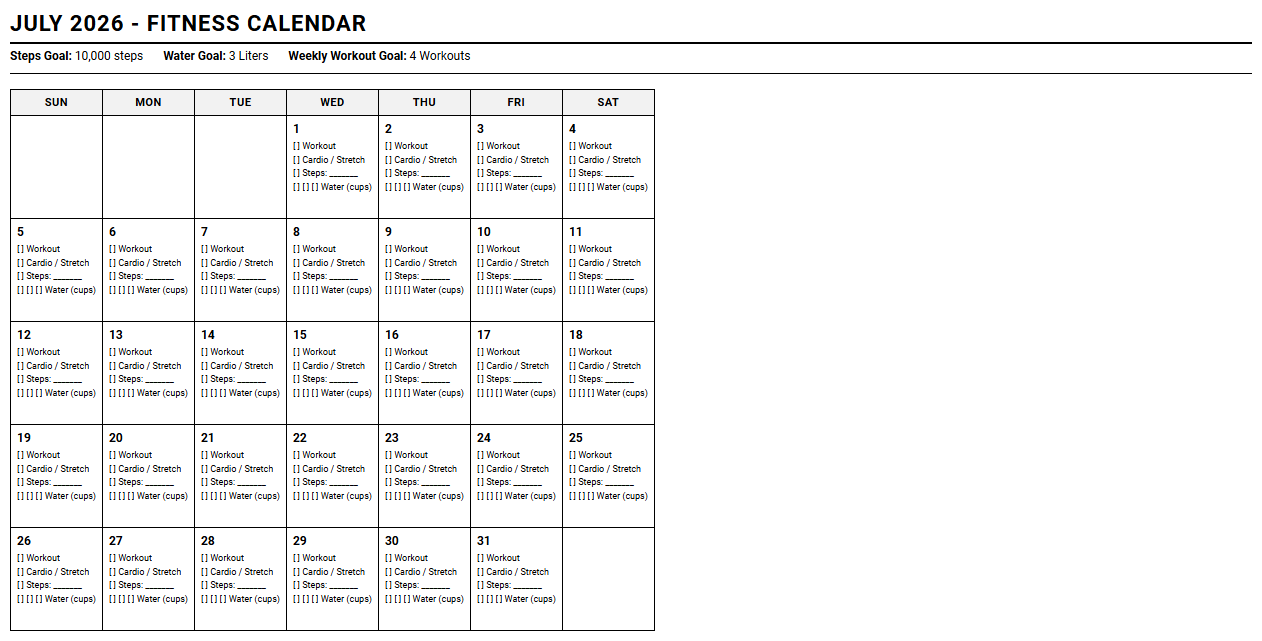
Maintaining consistency with health goals is a persistent challenge for many. While standard investments like gym memberships or premium apps are common starting points, they often fail to inspire daily habit formation. A printable Monthly Fitness Calendar grants users a tangible feedback loop that reinforces progress. Importantly, its utility stipulates consistent daily engagement; tracking specific metrics, such as hydration or daily step counts, builds lasting accountability. Below, we examine how to effectively integrate these physical trackers into your routine.
Create Your Monthly Fitness Calendar
Done customizing?
Monthly Fitness Calendar - Good to Know
Workout tracker
A structured workout tracker serves as the foundation for any successful fitness journey. By meticulously logging exercises, sets, repetitions, and weights lifted, individuals can visualize their progress over time. This data-driven approach removes guesswork, allowing athletes to identify which routines yield the best results and where performance plateaus occur.
Utilizing a digital or physical tracker fosters accountability and maintains motivation. When looking at historical data, you gain valuable insights into your physical capabilities and developmental milestones.
- Volume Tracking: Monitoring total weight lifted per session to ensure systemic growth.
- Frequency Metrics: Recording the consistency of targeted muscle group stimulation.
- Rest Intervals: Timing rest periods to optimize cardiovascular or strength adaptations.
Consistently updating your logs transforms abstract effort into concrete, measurable data, paving a clear path toward your physical aspirations.
Active recovery days
Integrating active recovery days into your weekly regimen is essential for tissue repair and psychological rejuvenation. Rather than complete cessation of movement, active recovery involves low-intensity exercise that stimulates blood flow without inducing excessive muscular fatigue. This process delivers oxygen and nutrients to damaged tissues, accelerating the healing process.
Engaging in light movement helps alleviate delayed onset muscle soreness (DOMS) and maintains joint mobility. It bridges the gap between intense training sessions, ensuring the body remains supple and prepared for future physical demands.
- Low-Impact Cardio: Activities like swimming, cycling, or brisk walking.
- Mobility Work: Dynamic stretching and yoga sequences to improve range of motion.
- Myofascial Release: Foam rolling to target trigger points and release muscle tightness.
Prioritizing these gentle movement sessions balances the nervous system, transitioning your body from a sympathetic fight-or-flight state to a parasympathetic healing state.
Progressive overload schedule
A systematic progressive overload schedule is the primary driver of muscular hypertrophy and strength gains. This principle dictates that the skeletal system must be subjected to gradually increasing demands to force physiological adaptation. Without a structured plan to increase stimulus, physical progress inevitably stagnates.
Implementing this schedule requires strategic manipulation of training variables. It is not merely about adding weight; it involves sophisticated adjustments to training density and mechanical disadvantage.
Consider modifying these key variables to maintain adaptation:
- Load: Increasing the resistance or weight of the exercises.
- Volume: Adding more total sets or repetitions within a microcycle.
- Tempo: Prolonging the eccentric phase to increase time under tension.
By systematically raising the physical demands weekly, you ensure continuous neuromuscular adaptation and avoid long-term plateaus.
Deload week
A scheduled deload week is a planned reduction in training volume or intensity, typically occurring every four to eight weeks. This proactive recovery period allows the central nervous system, joints, and connective tissues to fully heal from the accumulation of chronic training stress. Skipping this crucial phase often leads to overreaching, chronic fatigue, or acute injury.
"True physical progression occurs during periods of rest, not during periods of destruction."
During a deload, workouts should feel relatively easy, leaving you energized rather than exhausted. You can achieve this by reducing your normal working weights by thirty percent, or halving your total working sets while keeping the weight moderate.
Embracing this brief respite prepares your musculoskeletal system to handle subsequent blocks of high-intensity training with renewed vigor and diminished risk of burnout.
Fitness challenge template
An adaptable fitness challenge template provides a structured timeline designed to boost engagement, build habits, and kickstart stalled progress. Whether spanning thirty, sixty, or ninety days, a well-defined challenge establishes clear parameters and daily milestones that make long-term objectives seem attainable and urgent.
| Phase | Focus Area | Daily Action Item |
|---|---|---|
| Weeks 1-2 | Habit Formation | Log 10,000 steps and drink 3 liters of water. |
| Weeks 3-4 | Intensity Ramp | Complete 30 minutes of resistance training daily. |
| Weeks 5-6 | Consolidation | Incorporate high-intensity intervals and mobility. |
Using a template helps break down intimidating lifestyle transformations into daily, manageable tasks, promoting consistency and building self-efficacy.
Hybrid training calendar
A balanced hybrid training calendar is designed for athletes who refuse to choose between strength and cardiovascular endurance. This programming methodology concurrently develops aerobic capacity and muscular power, challenging the traditional belief that these traits are mutually exclusive. Managing the interference effect is the central challenge of this approach.
- Concurrent Training
- The practice of training multiple athletic disciplines, such as powerlifting and marathon running, within the same microcycle.
- Interference Effect
- The potential physiological conflict where excessive endurance training limits maximal strength and hypertrophic adaptations.
To succeed, the calendar must strategically separate high-intensity lifting sessions from demanding cardiovascular workouts, often utilizing morning and evening splits or dedicated alternating days. This precise arrangement ensures both energy systems adapt efficiently.
Habit loop tracker
An effective habit loop tracker targets the neurological patterns that govern daily behavior, helping users automate positive fitness behaviors. Based on behavioral psychology, every habit consists of three distinct components: a cue, a routine, and a reward. Tracking these variables helps identify and reshape unconscious actions.
- The Cue: The environmental trigger that initiates the behavior, such as placing running shoes by the bed.
- The Routine: The actual behavior performed, which is the workout itself.
- The Reward: The positive reinforcement received, such as a post-workout smoothie or a sense of accomplishment.
By mapping out these components, you gain conscious control over your daily routines. Over time, consistent logging reinforces these neurological pathways, turning deliberate discipline into effortless, automatic lifestyle habits.
Micro-workout routine
A modern micro-workout routine is designed for busy individuals who struggle to find continuous blocks of exercise time. These short, hyper-focused movement snacks last between five and fifteen minutes and are distributed throughout the day. This approach proves that brief, frequent exercise accumulated over time yields significant metabolic and physical benefits.
- Morning Activation: Five minutes of bodyweight squats and push-ups to stimulate circulation.
- Midday Mobility: Five minutes of dynamic stretching to reverse the postural strain of desk work.
- Evening Conditioning: Ten minutes of high-intensity kettlebell swings or core work.
These brief sessions elevate the heart rate, improve joint health, and burn additional calories without requiring a gym commute or a change of clothes. They make a healthy lifestyle accessible under any schedule constraints.
Periodization planner
A comprehensive periodization planner is the ultimate tool for structuring long-term athletic development. By dividing an annual training plan into distinct phases, athletes can peak for specific events while minimizing the risks of overtraining and injury. This systematic approach balances phases of high volume with phases of high intensity.
The planning hierarchy typically spans three structural cycles:
- Macrocycle: The overall annual or multi-month training plan targeting a singular ultimate goal.
- Mesocycle: A specific blocks lasting four to twelve weeks, focusing on a singular physical attribute like hypertrophy or power.
- Microcycle: A weekly schedule detailing daily workouts, recovery sessions, and training variables.
Using this structured breakdown ensures that every workout serves a specific purpose, transitioning you seamlessly from general physical preparedness to specialized athletic peak performance.
HRV-guided training
Embracing HRV-guided training introduces biofeedback into your daily fitness routine. Heart Rate Variability (HRV) measures the variation in time between consecutive heartbeats, serving as a direct window into the status of your autonomic nervous system. A high HRV indicates a well-recovered, resilient nervous system ready for intense physical stress.
Conversely, a suppressed HRV suggests systemic fatigue, mental stress, or under-recovery, signaling that a light training day or rest day is appropriate. Adjusting your training intensity based on this metric optimizes your body's natural adaptation curves.
"Work with your physiology, not against it, by letting biological data guide your daily training thresholds."
This objective, data-driven methodology prevents overtraining syndrome, reduces injury rates, and ensures you perform high-intensity workouts only when your body is primed to adapt and grow stronger.
Leave a comment