
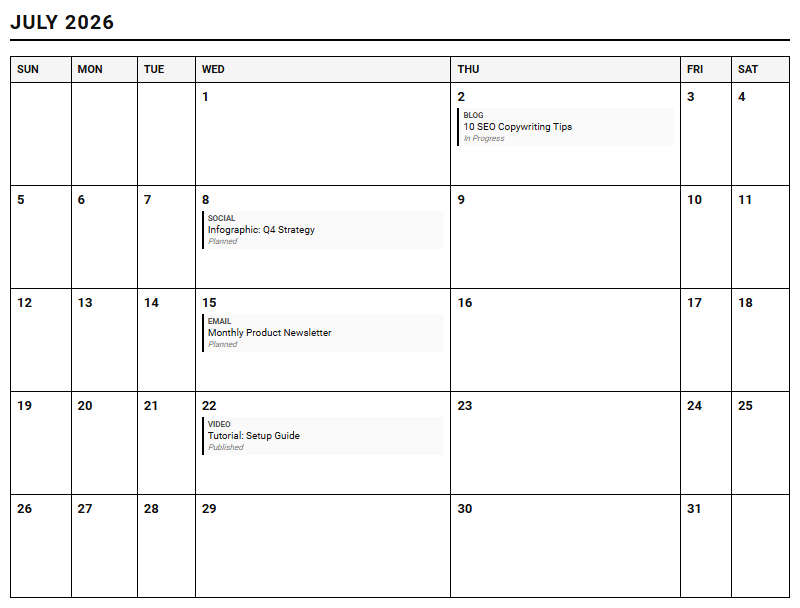
Managing a multi-channel editorial pipeline often leads to chaotic scheduling and missed deadlines. While standard operational funding typically secures complex, high-cost software, these digital platforms can overwhelm creative teams. A physical Business & Project Tracker grants immediate, tactile clarity that screens cannot replicate. Note that while printable trackers require consistent manual updates, they eliminate notification fatigue-similar to the analog storyboards used by leading publishing agencies. Below, we examine how to leverage this printable calendar to streamline your marketing strategy.
Create Your Marketing and Editorial Content Calendar
Done customizing?
Marketing and Editorial Content Calendar - Good to Know
Architecting a High-Performance Content Strategy
An enterprise-grade framework for sustainable organic growth, brand authority, and systematic content execution.
Content Pillars
Content pillars represent the foundational thematic clusters that define an organization's authority and expertise. By establishing three to five primary topics, brands can create a robust topical depth that signals trust to search engine algorithms and human readers alike. These core subjects guide the entire ideation process, ensuring that every published piece aligns with the brand's core value proposition.
Implementing structured pillars prevents the fragmentation of your editorial footprint. When organizing your brand taxonomy, consider the following structural benefits:
- Demonstrates undisputed topical authority through comprehensive interlinked resource hubs.
- Streamlines user navigation by grouping related topics logically.
- Prevents content duplication and guides clear internal linking strategies.
Focusing on these thematic cornerstones allows marketing teams to build comprehensive hubs that capture high-intent search queries while systematically nurturing prospects through the information-gathering phase of their journey.
Evergreen Content
Unlike transient news cycles or seasonal promotions, evergreen content remains continuously relevant, driving sustainable traffic and compounding search engine optimization (SEO) value over months and years. This category of content addresses foundational industry questions, core pain points, and timeless tutorials that maintain search volume indefinitely.
To maximize the return on investment of these durable assets, content teams must implement a rigorous maintenance schedule. Consider this structural lifecycle for timeless assets:
- Identify high-volume, low-decay search queries within your established niche.
- Draft exhaustive guides that address these queries with unmatched depth.
- Audit and update data points, screenshots, and links annually to maintain freshness.
Consistently updating these core assets ensures that search crawlers recognize the material as current. This continuous relevance builds a dependable baseline of organic traffic, reducing reliance on paid acquisition channels.
Content Cadence
A structured publishing cadence builds an unspoken contract of reliability with your audience. Consistency in content delivery signals operational maturity to both human subscribers and search platform crawlers, which prioritize active domains. Whether your schedule demands daily updates or bi-weekly deep dives, maintaining a predictable rhythm is far more valuable than erratic bursts of high-volume publishing.
"Consistency of execution will always outperform sporadic brilliance. A reliable cadence trains your audience when to return and teaches search engines when to crawl."
A well-defined cadence helps marketing managers allocate budget, balance creative resources, and manage promotional distribution channels efficiently. By aligning your publishing frequency with historical performance data, you ensure that every asset has sufficient breathing room to gain traction, gather initial performance metrics, and build social signals before the next wave of distribution begins.
Editorial Workflow
An optimized editorial workflow transforms chaotic creative processes into a predictable, scalable production pipeline. Without defined stages, content creation suffers from bottlenecks, misaligned expectations, and quality degradation. A standardized workflow ensures that every asset passes through rigorous quality control checkpoints before reaching the public.
- Ideation and Briefing
- Strategists define search intent, target personas, and primary keywords in a comprehensive creative brief.
- Drafting and Optimization
- Writers execute the copy using semantic tools to ensure natural keyword integration and readability.
- Editorial Review and Compliance
- Editors verify brand voice consistency, factual accuracy, legal compliance, and technical SEO elements.
Structuring the creation process into distinct, ownership-clear phases allows teams to scale production without sacrificing quality. This predictable flow minimizes administrative overhead and empowers contributors to focus on their core competencies.
Content Batching
Content batching is a highly productive time-management technique where creators focus on one specific stage of the production process for multiple assets simultaneously. Instead of writing, editing, and designing a single article sequentially, team members execute tasks in grouped intervals to eliminate the heavy cognitive costs associated with context switching.
By dedicating specific blocks of time to singular tasks, creative teams achieve a flow state that enhances output quality. For example, a content team might structure their monthly sprint using this batched methodology:
- Day 1-2: Conduct keyword research and outline ten distinct topics.
- Week 1-2: Write first drafts for all outlined assets in dedicated deep-work blocks.
- Week 3: Edit all drafts and format HTML structures in bulk.
- Week 4: Design all accompanying featured graphics, infographs, and social media assets.
This operational efficiency dramatically reduces lead times and ensures a consistent pipeline of assets ready for publishing.
COPE Framework
The Create Once, Publish Everywhere (COPE) framework is an essential operational strategy designed to maximize content efficiency and scaling. By designing core assets with modularity in mind from the outset, organizations can easily extract, reformat, and distribute elements across a multitude of channels without starting from scratch each time.
This methodology shifts the focus from high-volume creation to strategic architecture. When drafting a cornerstone whitepaper, writers structured the chapters as self-contained units. This foresight enables a seamless transition into supporting media formats:
A singular, comprehensive research report can be instantly modularized into a six-part email newsletter series, several specialized blog posts, and multiple graphical slide decks for professional networks. Operating through this framework minimizes creative fatigue, dramatically lowers production costs, and ensures unified brand messaging across all digital touchpoints.
Content Repurposing
Content repurposing is the deliberate practice of transforming existing assets into new formats to expand reach, engage different audience segments, and breathe new life into historical work. Not all consumers digest information the same way; some prefer long-form text, while others engage with audio or visual summaries.
By restructuring successful assets, you maximize the lifespan of your initial investment. Consider these highly effective conversion pathways for proven content:
- Converting a highly trafficked blog post into an interactive web tool or calculator.
- Adapting a webinar transcript into a downloadable step-by-step checklist.
- Compiling related resource guides into an authoritative, ungated digital book.
This systematic reuse ensures your best ideas reach prospects who might never discover the original medium, accelerating organic authority and maximizing the utility of every creative asset your team produces.
Keyword Mapping
Keyword mapping is the foundational search engine optimization process of assigning targeted search queries to specific URLs on a website. This strategic alignment ensures that each page has a singular, distinct search intent, preventing internal pages from competing against one another in search engine results pages-a critical issue known as keyword cannibalization.
| Target URL | Primary Keyword | Search Intent | Secondary Keywords |
|---|---|---|---|
| /services/cloud-migration | enterprise cloud migration | Transactional | cloud migration strategy, data migration services |
| /blog/cloud-migration-checklist | cloud migration checklist | Informational | how to migrate to cloud, cloud migration steps |
A meticulously maintained keyword map acts as a blueprint for site architecture, signaling clear semantic relevancy to search crawlers while guiding your internal linking strategy to support key transactional pages.
Asset Library
An organized Asset Library serves as the single source of truth for all creative and strategic brand collateral. Without a centralized, tagged, and easily searchable digital asset management database, valuable visual assets, templates, and written documents quickly become lost, leading to redundant work and brand inconsistency.
Maintaining high taxonomy standards within your library improves cross-departmental collaboration. A high-performing asset repository catalog contains key elements:
- Highly structured metadata tags detailing asset type, campaign, and target audience.
- Clear version control histories to ensure obsolete collateral is never used.
- Standardized licensing and usage rights information for third-party media assets.
Centralizing these resources allows writers, social media managers, and design teams to rapidly retrieve approved assets, accelerating production times and guaranteeing cohesive visual identity across all outbound campaigns.
Campaign Lifecycle
A comprehensive campaign lifecycle encompasses the structured phases a themed marketing initiative moves through, from initial ideation to post-mortem analysis. Understanding this progression prevents marketing teams from launching uncoordinated activities that fail to generate meaningful momentum. Every campaign requires disciplined planning to ensure proper asset integration.
- Ideation and Alignment: Define measurable business goals, audience personas, and key performance indicators.
- Production and Staging: Author content assets, build landing pages, and set up attribution parameters.
- Distribution and Promotion: Launch assets across organic search, paid ads, email lists, and social channels.
- Optimization and Analysis: Analyze performance metrics, run A/B tests, and compile reports on conversion rates.
Executing campaigns through these clear phases guarantees that lessons learned during performance analysis directly inform future creative planning, fostering a culture of continuous operational improvement and higher returns on marketing spend.
Leave a comment