
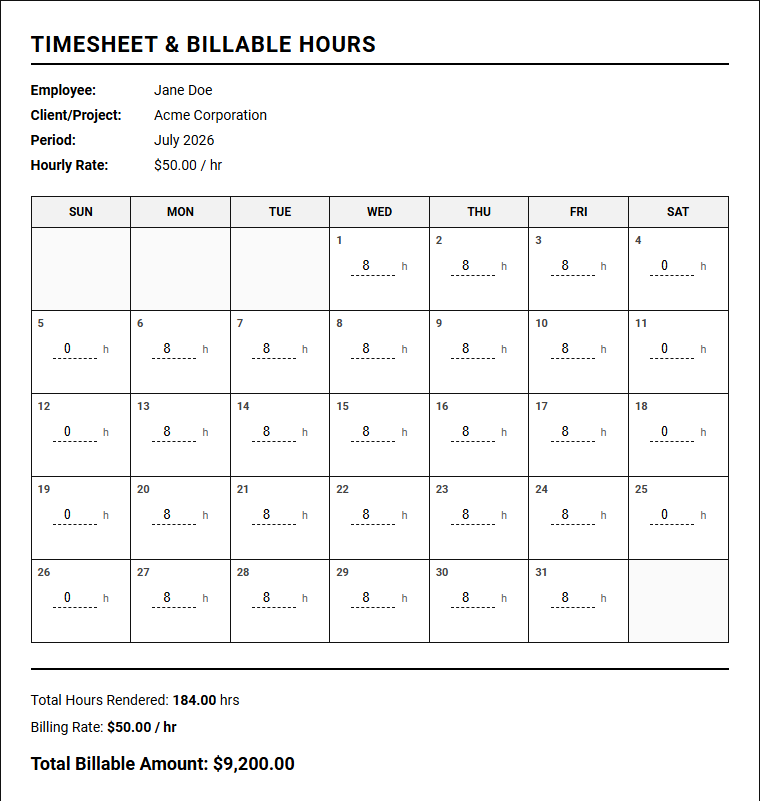
Accurately capturing billable hours remains a constant struggle for independent consultants, often leading to leaked revenue. While standard client retainers secure baseline funding, maximizing profitability requires meticulous daily tracking. Our printable Timesheet and Billable Hours Calendar grants immediate visibility over every project minute. Note this stipulation: while not a substitute for automated accounting software, it serves as a vital first line of defense. Below, we outline how this tool structures your daily workflow for seamless invoicing.
Create Your Timesheet and Billable Hours Calendar
Done customizing?
Timesheet and Billable Hours Calendar - Good to Know
Billable Utilization
Billable utilization measures the percentage of available working hours that employees spend on revenue-generating tasks. This metric serves as a foundational performance indicator for agencies, consultancies, and professional service firms. Maximizing this ratio requires a delicate balance between client-facing delivery and essential internal operations.
To calculate this effectively, organizations use the following formula:
- Utilization Rate = (Billable Hours ÷ Total Available Hours) × 100
- Target benchmarks typically range between 70% to 80% for delivery roles.
High utilization drives profitability, but consistently exceeding healthy thresholds leads to employee burnout and diminished work quality. Modern resource management systems track this metric in real-time, allowing operational leaders to reassign tasks dynamically. By analyzing historical utilization trends, businesses can make informed hiring decisions, refine project pricing models, and ensure that delivery teams remain highly productive without sacrificing their mental well-being.
Time Blocking
Time blocking is a highly effective cognitive scheduling technique where individuals divide their workday into distinct, dedicated blocks of time. Each block is reserved exclusively for a specific task or group of tasks, rather than keeping an open-ended to-do list. This method fosters deep focus by eliminating the cognitive load associated with frequent task-switching.
Implementing this strategy successfully involves several structured phases:
- Categorization: Grouping similar administrative tasks, such as email replies and meeting scheduling, into a single block.
- Buffer Blocks: Allocating short windows of unscheduled time to handle unexpected emergencies or overruns.
- Deep Work Sessions: Reserving uninterrupted multi-hour periods for complex analytical or creative tasks.
By defining clear boundaries for daily activities, professionals can regain control over their schedules, minimize external distractions, and ensure that high-priority strategic goals receive the dedicated attention they require to progress.
Automatic Time Capture
Automatic time capture technology revolutionizes how organizations record labor hours by silently tracking user activity in the background. Unlike traditional manual timesheets, which rely heavily on memory and prone-to-error estimates, automated systems log active software applications, browser tabs, and document names directly as work occurs.
This seamless approach offers significant operational benefits to modern enterprises:
- Unparalleled Accuracy: Captures minor, easily forgotten tasks like quick client emails or spontaneous phone calls.
- Frictionless UX: Eliminates the administrative burden on employees, allowing them to focus entirely on creative and strategic output.
- Strict Privacy Control: Offers robust user-side review features, ensuring private personal activity remains hidden before submitting timesheets.
By leveraging intelligent background monitoring, businesses capture a highly granular and precise record of daily operations, which drastically reduces timesheet inaccuracies and simplifies billing processes across complex client portfolios.
Capacity Planning
Capacity planning is the strategic process of determining the human and technical resources required to meet upcoming project demands over a specified timeframe. It involves analyzing current staff availability, specialized skill sets, and project pipelines to identify potential bottlenecks before they disrupt delivery schedules or inflate budgets.
"Effective planning aligns sales pipelines directly with workforce availability, ensuring realistic delivery dates."
When organizations fail to plan capacity, they often face sudden resource shortages, forcing them into expensive, reactionary hiring cycles or leading to delayed project milestones. Conversely, overestimating capacity results in underutilized talent and bloated overhead costs. Sophisticated project management frameworks utilize predictive modeling to balance workloads, optimize resource distribution, and maintain a highly agile workforce capable of adapting to shifting market demands and client expectations.
DCAA Compliance
DCAA compliance refers to adhering to the stringent guidelines established by the Defense Contract Audit Agency. For organizations partnering with the United States Department of Defense, maintaining compliant timekeeping procedures is a strict legal requirement. These audits ensure that taxpayer funds are allocated appropriately and that labor charges are accurately recorded against specific government contracts.
To survive a rigorous DCAA audit, timekeeping software must enforce specific control measures:
- Daily Logins: Employees must log their hours on a daily basis, without exception.
- Immutable Audit Trails: Any retroactively edited timesheet entry must document the precise reason for the change.
- Supervisory Verification: Managers must review and formally approve all hours submitted by their direct reports.
Implementing a robust, DCAA-compliant system protects government contractors from severe financial penalties, contract cancellations, and potential legal repercussions while fostering transparent operational practices.
Geofencing Time Tracking
Geofencing time tracking leverages global positioning system (GPS) technology to establish virtual geographical boundaries around specific physical jobsites. When mobile or field-based employees enter or exit these predefined zones, the time tracking application automatically logs their arrival and departure times, or sends a push notification prompting them to clock in or out.
This location-aware technology is highly valuable for industries with distributed labor forces:
- Construction and Trade Services: Tracks hours accurately across multiple remote construction zones.
- Healthcare & Home Visits: Verifies actual on-site caregiver presence for billing transparency.
- Logistics and Delivery: Streamlines fleet management and physical delivery confirmations.
Geofencing reduces time theft, eliminates buddy punching, and automates administrative workflows, providing operations managers with verifiable proof of presence and precise labor cost metrics for remote project sites.
Non-Billable Leakage
Non-billable leakage occurs when employees perform legitimate, client-related work that is never tracked, recorded, or billed. This silent revenue drain typically manifests as brief status calls, unscheduled consultation emails, or post-project revisions that slip through the cracks of manual time-tracking systems, eroding overall agency profitability.
Addressing this hidden operational challenge requires systematic observation and intervention:
- Analyze Friction Points: Identify why employees avoid logging minor tasks, such as overly complex software interfaces.
- Set Clear Guidelines: Define exactly what constitutes billable activity versus general administrative overhead.
- Utilize Smart Tracking: Deploy real-time tools that prompt users when untracked gaps occur in their calendars.
By recovering leaked hours, professional service firms can significantly boost their top-line revenue without increasing their client base or raising hourly rates.
Resource Allocation
Resource allocation is the systematic process of assigning and managing assets, primarily human labor, in a manner that maximizes operational efficiency and project outcomes. It requires matching the specific skill sets, experience levels, and availability of team members with the unique technical demands of active or upcoming projects.
Strategic allocation prevents team member isolation and ensures balanced workloads across the enterprise:
- Skill Mapping: Aligning task complexity directly with employee expertise to ensure high-quality output.
- Conflict Resolution: Preventing multiple project managers from overbooking the same key specialist.
- Utilization Balancing: Spreading tasks equitably to prevent top performers from carrying disproportionate burdens.
Through intelligent, centralized scheduling, operations leaders can optimize resource utilization, reduce external contractor expenses, and maintain consistent, predictable project delivery timelines across the entire organizational portfolio.
Timesheet Approval Workflow
A standardized timesheet approval workflow is critical for ensuring billing accuracy, payroll integrity, and regulatory compliance. This structured process outlines exactly how hourly logs transition from initial employee entry to final managerial validation and integration into accounting systems, reducing friction across departments.
A typical high-efficiency workflow follows a sequential, automated path:
- Submission: Employees log hours and submit their timesheets at the end of each designated period.
- Automated Validation: Software checks entries against predefined rules, flagging missing descriptions or overtime.
- Managerial Review: Department heads approve, reject, or request corrections on flagged entries.
- Exporting: Approved logs transfer seamlessly into billing, invoicing, and payroll databases.
Establishing clear, automated workflows minimizes administrative delays, reduces internal payment disputes, and accelerates client invoicing cycles.
Real-Time Dashboard
A real-time dashboard provides project managers and executives with an instantaneous, consolidated visualization of essential business metrics. By aggregating data streams from time tracking, resource scheduling, and financial tracking tools, these interactive portals offer immediate visibility into the health and trajectory of ongoing projects.
Key indicators displayed on these visual command centers often include:
- Burn Rate: The speed at which a project's allocated financial budget is being consumed.
- Schedule Variance: Real-time comparisons between actual project progress and baseline milestones.
- Resource Strain: Visual alerts highlighting over-allocated team members or sudden scheduling conflicts.
Having instant access to clean, live data allows decision-makers to pivot strategies rapidly, address project scope creep instantly, and proactively communicate project statuses with stakeholders, keeping operations aligned with business goals.
Leave a comment