
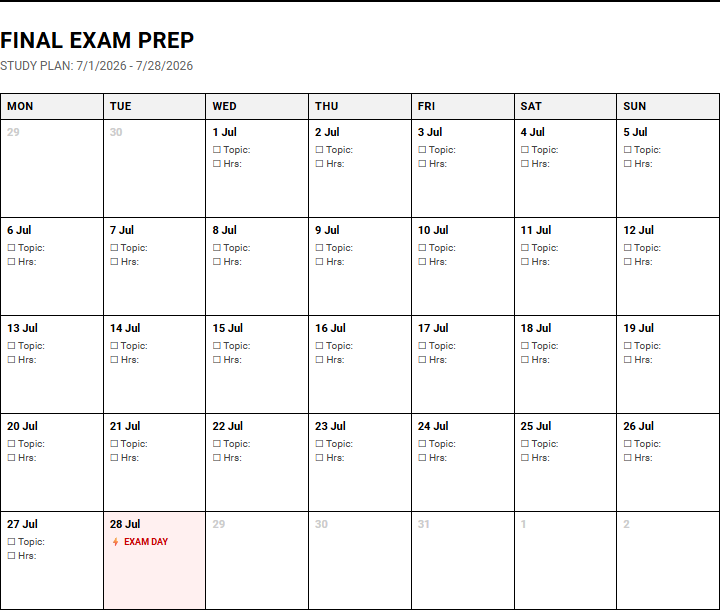
Balancing dense exam syllabi often leads to cognitive overload and last-minute cramming. While standard digital calendars list deadlines, they rarely map out daily cognitive pacing. A dedicated printable Study and Exam Prep Calendar bridges this gap, granting learners immediate visual clarity and reduced anxiety. To be effective, however, this tool must be paired with structured active recall intervals. Whether preparing for board finals or professional certifications, this guide outlines how to leverage productivity calendars for peak academic performance.
Create Your Study and Exam Prep Calendar
Done customizing?
Study and Exam Prep Calendar - Good to Know
Spaced Repetition Schedule
A spaced repetition schedule is an evidence-based learning technique designed to increase memory retention by spacing out review sessions. Instead of cramming information into a single night, learners revisit the material at calculated, increasing intervals. This systematic approach exploits the psychological spacing effect, ensuring neural pathways are reinforced precisely when forgetting is about to occur.
Implementing this system requires structured tracking. By categorizing flashcards or topics into difficulty tiers, you can optimize your calendar. Consider adopting the classic Leitner system framework:
- Daily Review: Newly introduced topics or highly challenging concepts.
- Weekly Review: Moderately understood material requiring periodic reinforcement.
- Monthly Review: Well-mastered facts that only need light maintenance.
Embracing this methodical workflow prevents cognitive overload, allowing students to store vast amounts of complex data in their long-term memory over extended periods.
Time Blocking
Time blocking is a highly productive time management methodology where you divide your entire day into distinct, dedicated blocks of time. Unlike a standard, overwhelming to-do list, this practice assigns specific tasks to concrete hours on your calendar. This proactive strategy minimizes decision fatigue and helps maintain focus by eliminating multitasking.
To design an effective daily schedule, you must treat your study blocks as non-negotiable appointments. Consider this structured approach to organize your daily routine:
- Deep Work Blocks: Dedicate uninterrupted morning hours to your hardest academic subjects.
- Administrative Blocks: Allocate short intervals in the afternoon for emails and organization.
- Restorative Blocks: Schedule mandatory breaks to prevent burnout and recharge cognitive faculties.
Securing these time blocks ensures that your high-priority study sessions receive your absolute, undivided attention throughout the academic semester.
Exam Countdown
An exam countdown serves as a visual and psychological anchor, generating a healthy sense of urgency while facilitating long-term planning. By keeping the exact number of remaining days visible, students can break down massive, intimidating curricula into manageable, bite-sized daily milestones. This visual metric prevents procrastination and keeps academic goals in constant focus.
A highly structured timeline should map out progressive phases of preparation as the test date approaches:
- Phase 1 (Weeks Out): Comprehensive content review and initial conceptual mapping.
- Phase 2 (Fortnight Out): Intensive practice examinations and targeted weak-spot remediation.
- Phase 3 (Days Out): Light consolidation, mental visualization, and adequate physical rest.
Transforming a daunting final deadline into a structured step-by-step countdown ensures that you arrive on test day fully prepared, confident, and calm.
Syllabus Mapping
Syllabus mapping is the strategic practice of dissecting your course outline and aligning it directly with your study calendar. Rather than guessing what will be covered on exams, this process ensures that every single learning objective is systematically accounted for, organized, and scheduled. This macro-level view prevents students from getting lost in minor details at the expense of core concepts.
To construct a robust syllabus map, you should categorize your entire course curriculum based on priority and difficulty levels:
High-yield topics-those heavily weighted on previous exams-must receive priority scheduling. Conversely, low-priority concepts can be assigned to shorter review slots later in the semester. This comprehensive mapping guarantees complete coverage of the curriculum, leaving absolutely no gaps in your knowledge base before the final assessment arrives.
Interleaving
Interleaving is a cognitive science learning strategy where you mix or alternate different topics or subjects within a single study session. While block studying focuses on practicing one skill repeatedly, interleaving forces the brain to constantly adapt and differentiate between concepts. This mental effort enhances problem-solving skills and improves the transfer of knowledge to unfamiliar contexts.
When structuring an interleaved study session, consider organizing your materials in the following manner:
- Avoid studying similar mathematical formulas consecutively; instead, mix geometry with algebra.
- Rotate between learning a language's vocabulary, grammar, and listening comprehension skills.
- Incorporate distinct historical eras within a single afternoon study block.
This deliberate practice cultivates versatile mental frameworks, allowing students to easily identify the correct solution paths during challenging examinations.
Study Streak
Maintaining a consistent study streak utilizes behavioral psychology to build powerful, long-lasting academic habits. By committing to studying for a minimum amount of time every single day, you build powerful momentum that makes starting your work feel effortless over time. The primary objective is to make consistency a core component of your daily identity.
To successfully protect your academic streak from being broken, you can implement several simple safeguards:
- Set a remarkably low minimum daily threshold, such as fifteen minutes of active reading.
- Utilize visual trackers, habit apps, or physical wall calendars to log your progress.
- Establish small, motivating rewards for achieving milestone streaks of ten, thirty, or fifty days.
This consistent daily action builds a resilient habit loop, transforming studying from a chore into an automatic routine.
Buffer Days
Buffer days are intentionally blank, unscheduled days placed strategically throughout your study calendar to absorb unexpected delays. In any academic journey, disruptions like illness, social emergencies, or exceptionally difficult topics are inevitable. Without built-in flexibility, a single missed day can completely derail an entire study schedule and cause significant anxiety.
Integrating these flexible buffers into your routine provides a vital safety net. You can utilize this time for two primary purposes:
- Catch-Up Sessions: Master complex topics that took longer than originally anticipated.
- Mental Recovery: Rest completely if your study plan is currently on track.
This deliberate planning strategy prevents burnout, reduces academic stress, and ensures your master schedule remains realistic and achievable.
Revision Cycle Tracker
A revision cycle tracker is an essential logbook that monitors how many times you have reviewed specific academic topics. Successful learning is rarely a one-time event; it requires multiple exposures to convert short-term concepts into permanent knowledge. This tracker serves as a visual diagnostic tool, highlighting which subjects have been neglected and which have been sufficiently mastered.
To maintain an accurate and effective revision log, organize your dashboard using these criteria:
Assign a simple numerical status (e.g., Round 1, Round 2, Round 3) to each chapter. Additionally, use color-coding systems-red for weak areas, yellow for progressing topics, and green for mastered material. This constant visual feedback loop guides your daily study sessions, ensuring your efforts are directed precisely where they are needed most.
Pomodoro Session Planner
The Pomodoro session planner is a time management tool that breaks work into focused, highly intense intervals separated by short breaks. Traditionally, this involves working with complete concentration for twenty-five minutes, followed by a rejuvenating five-minute break. This rhythm maximizes sustained mental focus while systematically preventing cognitive fatigue.
A highly structured daily planner page should outline your exact intervals:
- Session 1: High-priority reading or essay drafting (25 minutes).
- Short Break: Quick stretching or hydration (5 minutes).
- Long Break: A full walk or snack after completing four successful cycles (15-30 minutes).
Structuring your academic day into these manageable, bite-sized intervals helps maintain a high level of cognitive performance over hours of rigorous academic preparation.
Active Recall Slots
Active recall slots are dedicated calendar periods reserved strictly for testing your memory, rather than passively rereading textbooks. Passive review creates an illusion of competence, whereas active recall forces your brain to retrieve information from scratch. This cognitively demanding process is one of the most effective ways to solidify neural connections and guarantee long-term retrieval.
To populate your dedicated slots, incorporate a variety of dynamic testing methods:
- Solve challenging practice questions without referring to your textbooks or notes.
- Write down everything you can remember on a blank sheet of paper from memory.
- Explain complex scientific or historical concepts aloud as if teaching a classmate.
Integrating these active retrieval slots into your weekly routine guarantees a deep, functional understanding of the course material.
Leave a comment