
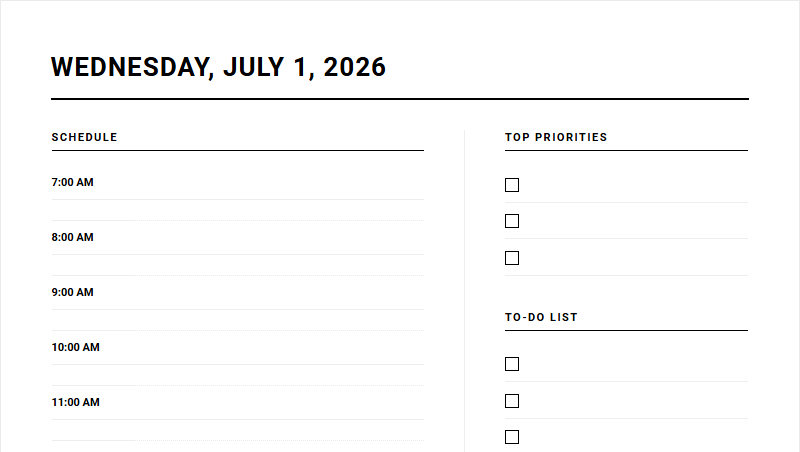
Managing a fragmented daily schedule is a constant struggle, often worsened by rigid, pre-dated planners that fail to fit your unique workflow. While standard commercial planners offer basic structures, blank and custom printable calendar templates grant the ultimate flexibility to design your own hourly layout. Note that while these templates require some initial setup discipline, they adapt perfectly to specific methodologies like Pomodoro blocks or 15-minute increments. Below, we outline how to choose, customize, and implement these templates to reclaim your day.
Create Your Daily Time Block Planner
Done customizing?
Daily Time Block Planner - Good to Know
Time boxing
Time boxing is a highly effective productivity strategy where you allocate a fixed, predetermined limit to an activity. Instead of working on a task until it is finished, you commit to working on it for a specific timeframe. This approach leverages Parkinson's Law, which dictates that work expands to fill the time available for its completion.
By establishing strict boundaries, you force your brain to focus and make rapid decisions. This technique is particularly useful for overcoming procrastination and managing perfectionism. To implement this strategy successfully, consider the following steps:
- Estimate the required effort and select a realistic time frame.
- Set a visible timer to maintain a sense of urgency.
- Stop working immediately when the box expires to assess your progress.
This structured discipline ensures that low-priority tasks do not consume your entire day, allowing for a more balanced and predictable schedule.
Deep work scheduling
Deep work scheduling involves carving out dedicated, uninterrupted blocks of time to focus on cognitively demanding tasks. Popularized by computer science professor Cal Newport, this method requires the elimination of all environmental distractions and cognitive residue.
During these sessions, activities like checking emails, answering Slack messages, or browsing social media are strictly prohibited. To master this scheduling method, practitioners often utilize distinct depth philosophies:
- Monastic: Eliminating all shallow obligations by isolating oneself for long periods.
- Bimodal: Dividing your time between highly isolated deep stretches and normal operational days.
- Rhythmic: Creating a daily habit of deep work at the exact same hours.
Protecting these blocks allows you to reach a state of flow, facilitating the synthesis of complex information and the production of high-value output that is difficult to replicate.
Task batching
Task batching is the practice of grouping similar, low-concentration tasks together and completing them in a single dedicated period. This method minimizes the heavy cognitive cost associated with context switching, which occurs when your brain repeatedly transitions between disparate activities.
When you jump from writing a report to answering an email, your attention remains partially divided, decreasing your overall processing speed. By batching, you maintain a singular mental state for longer durations.
- Administrative Batching: Handling invoicing, filing, and scheduling in one afternoon block.
- Communication Batching: Replying to all digital messages twice a day rather than instantly.
- Creative Batching: Brainstorming multiple content ideas in one continuous session.
This concentration of similar efforts streamlines mental processing, reduces fatigue, and dramatically increases your daily operational efficiency.
Chronotype alignment
Chronotype alignment is the practice of scheduling your most demanding work around your natural biological clock. Every individual has an inherent sleep-wake pattern, categorized into distinct chronotypes such as Lions, Bears, Wolves, and Dolphins.
"Aligning your schedule with your biology is the ultimate life hack for effortless productivity."
Lions excel in the early morning, Bears operate best on a standard daylight schedule, Wolves thrive in the late afternoon and evening, while Dolphins have irregular patterns. Attempting to perform deep, analytical work during your biological trough leads to rapid burnout and subpar results.
By identifying your specific chronotype, you can intentionally position high-focus projects during your peak alertness windows, leaving administrative, shallow tasks for periods of natural energetic decline. This synchronization ensures you work with your biology rather than constantly fighting against it.
Energy mapping
Energy mapping is a personalized time management technique that focuses on managing your energy levels rather than just your hours. While time is a finite resource, your personal energy is highly fluctuating and renewable.
To implement this, you must track your daily energy fluctuations over a two-week period, rating your physical and mental stamina on a scale from one to ten hourly. Once you visualize these patterns, you can categorize your daily tasks into three distinct zones:
- High-Energy Zones: Reserved for strategic thinking, creative problem-solving, and difficult writing.
- Supportive Zones: Best for collaborative meetings, team check-ins, and client calls.
- Low-Energy Zones: Designated for routine database entries, organizing folders, and cleaning your inbox.
Designing your workflow around these physiological waves prevents cognitive exhaustion and maximizes your daily creative output.
Hyper-scheduling
Hyper-scheduling takes traditional time management to an extreme level by accounting for every single minute of the working day. Unlike general to-do lists, a hyper-scheduled calendar leaves absolutely no blank spaces, treating time as a highly precious, non-renewable commodity.
Every activity, including checking text messages, taking lunch, walking, and thinking, is assigned a specific time slot on the calendar. This granular level of planning eliminates the daily decision fatigue of wondering what task to tackle next.
- Map out your ideal day down to fifteen-minute blocks.
- Color-code tasks by category to quickly analyze your daily focus distribution.
- Treat these calendar events as non-negotiable appointments with yourself.
While highly rigid, this meticulous framework provides a realistic view of what you can actually accomplish, preventing over-commitment and keeping you highly accountable.
Buffer blocks
Buffer blocks are intentional, unstructured periods of time built into a schedule to accommodate unexpected delays, administrative overflow, or much-needed mental recovery. Without these planned cushions, a single delayed meeting or urgent emergency can disrupt your entire daily itinerary.
Integrating buffer blocks prevents the anxiety associated with falling behind schedule. Experts suggest placing a thirty-minute buffer in both the morning and afternoon. During these blocks, you can:
- Catch up on tasks that ran over their allotted time boxes.
- Respond to urgent requests that surfaced throughout the day.
- Step away from your screen to rest your eyes and stretch your body.
By proactively planning for chaos, you maintain control over your workflow, protect your mental well-being, and ensure that your schedule remains resilient in the face of unpredictable disruptions.
Quarter-hour increments
Scheduling your workday in quarter-hour increments is a precision time-blocking strategy used by high-performing executives and politicians. By breaking the standard sixty-minute hour into four distinct blocks, you develop a heightened awareness of time passing.
This micro-scheduling format forces you to ruthlessly edit your tasks and meetings. Most half-hour meetings can easily be compressed into fifteen minutes if a tight agenda is maintained. To adopt this method, consider these practices:
- Audit your current tasks to see which ones can be executed in short bursts.
- Set timers to signal the transition of these rapid-fire intervals.
- Use specialized digital calendars that support tight fifteen-minute grids.
This hyper-focused approach minimizes administrative drift, encourages rapid execution, and ensures that not a single segment of your valuable workday is wasted on unproductive distractions.
Day themes
Day themes involve dedicating entire workdays to a single, specific functional area of your business or life. This macro-level time management strategy is famously utilized by tech leaders to manage multiple complex initiatives simultaneously without losing focus.
Instead of dividing every day into dozens of micro-tasks, you dedicate your cognitive power to one overarching theme. This creates deep mental alignment and continuity. Examples of thematic days include:
- Mondays: Management, team operations, and internal administrative workflows.
- Tuesdays: Deep creative production, product development, and writing.
- Wednesdays: Marketing, sales outreach, and client relationship management.
Thematic scheduling provides a reliable mental rhythm, reduces the stress of competing priorities, and ensures that all major areas of your responsibility receive deep, sustained attention throughout the week.
Cal Newport method
The Cal Newport method is a comprehensive productivity philosophy built around time-block planning and the preservation of cognitive resources. Newport argues that a structured plan, even if modified throughout the day, provides a sense of control and focus that a simple checklist cannot match.
The method emphasizes dividing a notebook page into two columns: one for scheduling blocks and the other for adjustments as the day inevitably changes. A core component of this philosophy is the shutdown ritual, a systematic process performed at the end of every workday.
- Review your incomplete tasks to ensure they are captured in a trusted system.
- Update your calendar and plan the next day's time blocks.
- Say a specific phrase to mentally signal that work is completely finished.
This deliberate ritual completely unloads professional anxiety, allowing your mind to rest deeply during your evening leisure hours.
Leave a comment