
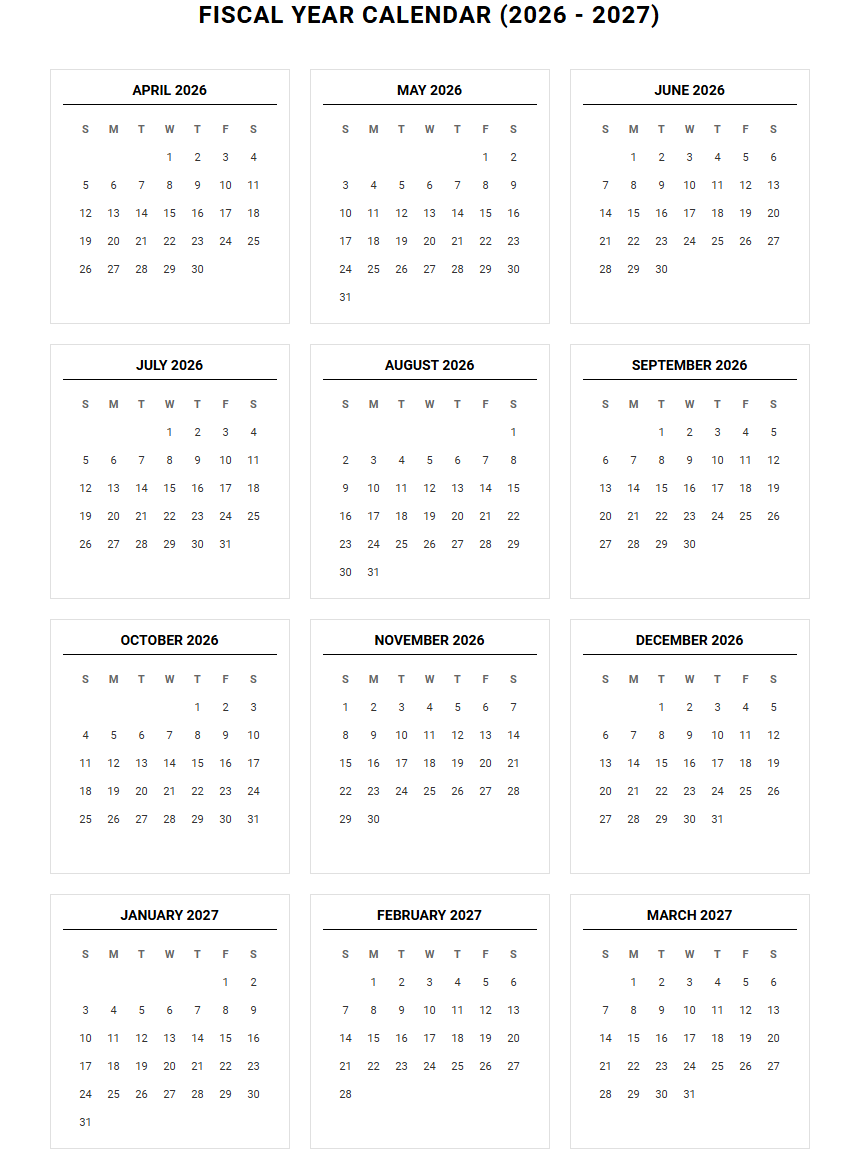
Managing corporate budget deadlines across non-standard calendar years is notoriously difficult for financial planners. Traditional revenue cycles and federal funding sources rarely align with the standard January-to-December timeline. Utilizing a dedicated printable Fiscal Year Calendar grants teams immediate visual control over complex financial milestones. While these templates require alignment with your specific organizational tax cycle-such as the standard July-to-June corporate cycle-they dramatically simplify reporting. Below, we explore the best printable layouts to optimize your annual planning.
Create Your Fiscal Year Calendar
Done customizing?
Fiscal Year Calendar - Good to Know
4-4-5 Retail Calendar
The 4-4-5 retail calendar is a structured accounting method utilized primarily in the retail and consumer goods industries. Unlike the traditional Gregorian calendar, this system divides the year into four quarters, each consisting of exactly 13 weeks. These quarters are further broken down into three periods structured as follows:
- First period: 4 weeks
- Second period: 4 weeks
- Third period: 5 weeks
This alignment ensures that every period ends on the same day of the week, typically a Saturday, which greatly simplifies year-over-year sales comparisons. By eliminating the calendar shift where days of the week fall on different dates each year, retailers can analyze weekend performance consistently. Consequently, reporting accuracy increases significantly, allowing inventory planners and financial analysts to identify trends without the statistical noise of varying month lengths or extra weekend days.
Year-End Close
The year-end close is a critical financial process where accounting teams finalize and seal the company's financial records for the preceding fiscal year. This multi-step procedure requires meticulous attention to detail to ensure compliance with relevant accounting standards. Key activities during this period include:
- Reconciling all bank accounts and ledger balances.
- Adjusting journal entries for depreciation and amortization.
- Verifying inventory valuations and writing off obsolete stock.
- Closing temporary accounts, such as revenue and expenses, into retained earnings.
Completing this cycle allows the organization to generate audited financial statements, including the balance sheet, income statement, and cash flow statement. These reports are essential for external stakeholders, regulatory bodies, and internal decision-makers who rely on precise data to evaluate the organization's overall financial health and operational performance over the past twelve months.
Fiscal Year-End (FYE)
The Fiscal Year-End (FYE) represents the official conclusion of a business's 12-month accounting period. While many organizations align their fiscal year with the traditional calendar year ending on , others select a date that better matches their specific operational cycles or seasonal business peaks.
Choosing a strategic FYE allows organizations to present a cleaner, more accurate financial picture when business activities are at their annual low point.
For instance, educational institutions often conclude their fiscal year on June 30th to align with the academic cycle, whereas retail enterprises frequently select late January or February to account for post-holiday returns. At this juncture, corporations calculate their annual taxable income, undergo rigorous external auditing, and establish the baseline performance metrics that will guide corporate strategy and investor expectations for the upcoming fiscal cycle.
Thirteenth Period
An accounting thirteenth period is a specialized, non-standard reporting block used by organizations operating on weekly or cyclical calendars. This period does not represent a traditional month of operations; instead, it serves as a dedicated window for year-end adjustments, accruals, and audit corrections. By separating these entries from standard operational months, companies prevent their monthly performance reports from being distorted by large, retroactive adjustments.
Common transactions reserved for this unique period include:
- Year-end inventory write-downs and valuation adjustments.
- Audit-driven reclassifications and adjustments.
- The calculation and allocation of annual executive bonuses.
This structural isolation ensures that managers can review standard monthly trends with high clarity, maintaining historical accuracy and data comparability across operational cycles throughout the fiscal year.
Off-Calendar Fiscal Year
An off-calendar fiscal year is any annual accounting period that does not begin on January 1st and end on December 31st. Companies opt for this structure to mirror their actual business cycle rather than conforming to the standard calendar year. This approach is highly prevalent in industries characterized by extreme seasonality or unique regulatory frameworks.
For example, a ski resort might establish a fiscal year starting June 1st to ensure an entire winter season is captured within a single reporting period. This avoids splitting revenue and expenses across two different accounting years. Additionally, adopting an off-calendar system can reduce administrative burdens, as CPA firms and internal financial teams can avoid the peak resource demands associated with the traditional January-to-March audit season, leading to more efficient financial oversight.
Quarterly Forecasting
Quarterly forecasting is a dynamic financial planning process wherein an organization reviews and updates its financial projections every three months. This rolling forecast mechanism enables businesses to adapt swiftly to changing market conditions, competitive pressures, and internal operational shifts. Unlike a rigid annual budget, quarterly forecasts serve as a living document reflecting real-time performance data.
Organizations that pivot quickly based on quarterly forecast adjustments maintain a significant competitive advantage in volatile markets.
During this review, leadership compares actual performance against previous projections, refines revenue targets, and reallocates capital to high-performing sectors. This continuous feedback loop ensures that resource allocation remains aligned with the company's strategic goals, reducing the risk of budget overruns and preparing the organization for potential economic headwinds.
Blackout Period
A corporate blackout period is a designated timeframe during which specific financial transactions, such as employee stock trading or major corporate announcements, are strictly prohibited. These periods typically occur in the weeks leading up to the public release of quarterly or annual earnings reports. The primary objective is to prevent insider trading and maintain market integrity by ensuring that individuals with access to non-public financial information cannot trade on that knowledge.
Typical restrictions during this interval include:
- Prohibiting executives and key employees from buying or selling company stock.
- Restricting changes to 401(k) plan investment allocations.
- Enforcing a quiet period where management avoids discussing financial projections with analysts.
Adhering to these strict guidelines protects the organization from legal liabilities and fosters investor trust in the equity markets.
Budget Cycle
The budget cycle is the comprehensive process of planning, developing, approving, and executing an organization's financial plan. This cycle is critical for establishing operational boundaries and allocating resources to achieve strategic corporate objectives. Typically, the cycle progresses through several structured phases over several months:
- Setting strategic goals and guidelines by executive leadership.
- Departmental submission of resource requests and projected expenses.
- Negotiation, consolidation, and refinement by the finance committee.
- Final approval and implementation of the finalized budget.
Once approved, the budget acts as a benchmark against which actual performance is measured. Ongoing variance analysis throughout the fiscal period helps managers identify deviations early, allowing for corrective actions that keep the organization on a stable financial trajectory.
Accrual Accounting Period
An accrual accounting period is a defined timeframe in which financial events are recorded regardless of when the associated cash transactions occur. Under the matching principle of accrual accounting, revenues are recognized when they are earned, and expenses are recorded when they are incurred. This contrasts sharply with cash basis accounting, which only recognizes transactions when cash changes hands.
For example, if a firm delivers services in November but receives payment in January, the revenue is recorded in the November accounting period. This methodology provides a much more accurate representation of a company's operational profitability and economic reality. It ensures that standard financial statements, particularly the income statement, accurately reflect the true level of economic activity and financial commitments made during that specific timeframe.
FY25 Planning
FY25 planning refers to the forward-looking strategic and financial preparation undertaken by organizations preparing for the 2025 fiscal year. This initiative involves evaluating macroeconomic indicators, assessing technological advancements, and analyzing historical performance to set achievable growth targets. During this phase, leadership teams determine capital expenditures, talent acquisition strategies, and marketing budgets required to sustain growth.
Key focus areas for the upcoming FY25 cycle include:
- Integrating artificial intelligence to streamline operational workflows.
- Diversifying supply chains to mitigate global geopolitical risks.
- Optimizing working capital to navigate fluctuating interest rate environments.
By conducting thorough scenario planning and establishing robust contingency plans, organizations can position themselves to seize emerging opportunities and build operational resilience, safeguarding long-term stakeholder value in an increasingly complex and dynamic global business landscape.
Leave a comment