
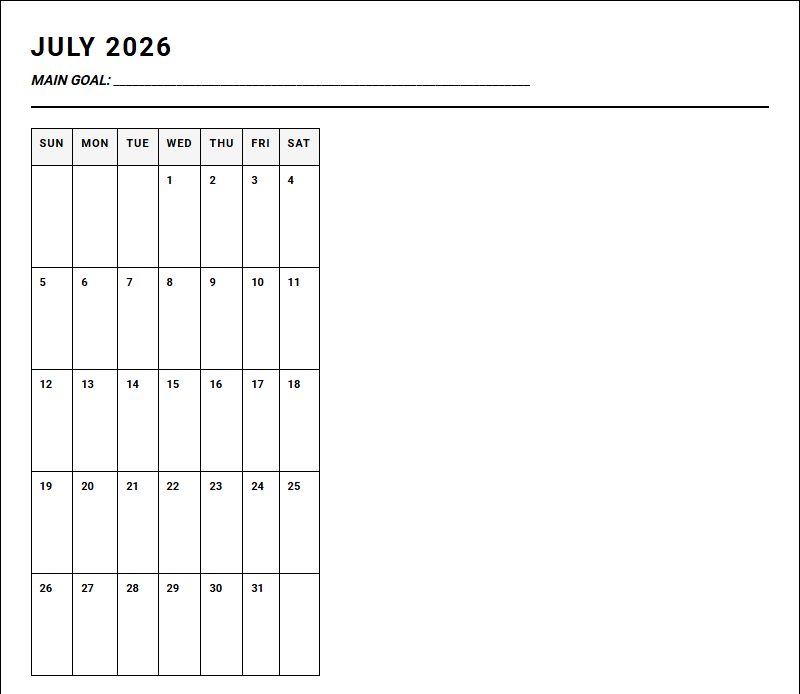
Maintaining consistent progress toward long-term objectives is a common planning challenge. While standard digital project management suites offer tracking, they often suffer from screen fatigue and neglect. A physical Yearly Calendars printable calendar bridges this gap, granting an immediate, tactile visual anchor that reinforces daily focus.
Stipulation: these templates only succeed when paired with disciplined review habits. Organizations tracking quarterly sales milestones, for example, demonstrate the power of this physical reinforcement. Below, we outline how to structure your printable layout for maximum goal-setting impact.
Create Your Goal Setting Calendar
Done customizing?
Goal Setting Calendar - Good to Know
Time Blocking
Time blocking is a highly effective productivity technique that involves dividing your day into dedicated segments of time. Each block is reserved for a specific task or group of tasks, which helps eliminate distractions and fosters deep focus. Instead of keeping an open-ended to-do list, you assign a concrete slot to every objective. This structured approach prevents multi-tasking and ensures that high-priority projects receive the attention they deserve. By visualizing your entire day, you gain realistic insights into your actual capacity.
Key benefits of this method include:
- Enhanced focus: Dedicating uninterrupted periods to deep work.
- Reduced decision fatigue: Knowing exactly what to do next without hesitation.
- Improved time awareness: Learning how long tasks actually take.
Implementing this strategy can transform your daily output and dramatically reduce stress.
OKR Dashboard
An Objectives and Key Results (OKR) dashboard serves as a strategic management tool that aligns your daily efforts with your grandest aspirations. By defining ambitious Objectives and measurable Key Results, you create a transparent roadmap for success. A digital dashboard visualizes these metrics in real-time, allowing you to track progress, identify bottlenecks, and pivot when necessary.
This framework keeps you accountable by quantifying qualitative achievements. Whether you are managing personal milestones or leading a multinational team, the visual clarity of an OKR dashboard eliminates ambiguity. To get started, follow these core steps:
- Define your Objective: State a qualitative, inspiring goal.
- Establish Key Results: Determine three to five quantifiable metrics.
- Monitor Progress: Update your dashboard weekly to maintain momentum.
This systematic tracking ensures your long-term vision translates into actionable progress.
Habit Tracker
A habit tracker is a powerful instrument designed to build consistency and monitor behavioral patterns over time. By recording daily repetitions, you leverage the psychological phenomenon of the "streak effect," which drives you to maintain continuous progress. Whether you utilize a paper journal or a digital application, the simple act of checking off a completed habit provides an immediate dopamine release. This reinforces positive behavior and solidifies identity-based change. Over time, these micro-actions compound into significant lifestyle transformations.
"Success is the product of daily habits-not once-in-a-lifetime transformations."
By tracking habits, you shift focus from distant outcomes to the daily systems that produce them. This consistent monitoring illuminates patterns, helps identify triggers for unproductive routines, and fosters long-term self-discipline.
12-Week Year Planner
The 12-Week Year Planner revolutionizes traditional annual planning by condensing the execution cycle from twelve months to twelve weeks. This system creates a heightened sense of urgency, eliminating the complacency that often plagues yearly goals. By treating each week as a full month, you maintain constant focus and push for rapid execution. The planner encourages you to select only two or three critical objectives, preventing resource dilution and ensuring deep commitment.
- Urgency: Deadlines are always close, keeping motivation consistently high.
- Clarity: A shorter window simplifies tracking and strategic adjustments.
- Focus: Fewer goals mean higher quality execution and fewer distractions.
Operating in these condensed cycles prevents procrastination and accelerates your journey toward achieving major milestones.
Quarterly Review
A Quarterly Review is an essential reflective practice that bridges the gap between daily operations and long-term vision. Every ninety days, you step back to evaluate your progress, analyze performance data, and recalibrate your strategy. This cadence provides the perfect balance between sustained focus and agile adaptation. During this evaluation, you celebrate your achievements, dissect failures, and identify key lessons learned.
It is a time to ask hard questions: Are these goals still relevant? What bottlenecks hindered progress? How can systems be optimized? By formalizing this reflective habit, you prevent drift and ensure your daily actions remain aligned with your overarching purpose. This structured pause empowers you to start the next quarter with renewed clarity, adjusted priorities, and a sharper execution strategy.
Micro-Goals Calendar
A Micro-Goals Calendar breaks down massive, intimidating projects into tiny, manageable daily assignments. Big objectives can induce paralysis, but a micro-goals approach reduces friction by making the next step incredibly easy to accomplish. By scheduling these bite-sized tasks on a dedicated calendar, you build consistent momentum and avoid the trap of procrastination. Each day represents a single, achievable victory that compounds over time.
- Reduces cognitive load by simplifying daily expectations.
- Combats procrastination through low-barrier entry points.
- Builds steady, unbreakable forward momentum.
This method transforms overwhelming challenges into structured, daily habits, ensuring steady progress toward your grandest ambitions without the accompanying burnout.
Notion Goal Template
A Notion Goal Template offers a highly customizable digital workspace to centralize your ambition, tracking systems, and action plans. Utilizing relational databases, you can connect your broad life vision to quarterly projects and daily tasks. This digital ecosystem allows you to build a personalized dashboard that reflects your unique workflow. With features like progress bars, formula-driven calculations, and customizable views, you can visualize your trajectory with unprecedented clarity.
- Vision Integration: Link your core values to specific, actionable goals.
- Progress Databases: Automatically track completion rates of related tasks.
- Weekly Reviews: Embed reflection templates directly into your active dashboard.
By organizing your life in Notion, you create a dynamic, living system that evolves alongside your achievements.
Vision Board Calendar
A Vision Board Calendar merges the inspirational power of visual goal-setting with the practical structure of a traditional calendar. Instead of hiding your aspirations on a static poster, you integrate them directly into your daily schedule. Each month or week is paired with curated imagery, inspiring quotes, and visual milestones that represent your deepest desires. This constant exposure keeps your subconscious mind focused on what matters most, aligning your daily energy with your long-term dreams.
By interacting with this visual guide daily, you reinforce your motivation and maintain emotional connection to your work. Visualization is not passive; it is an active cognitive tool. Utilizing a vision board calendar ensures that your daily schedule remains deeply rooted in the bright future you are actively building.
Gamified Goal Tracker
A Gamified Goal Tracker injects elements of game design-such as experience points, levels, quests, and rewards-into your personal development journey. By turning productivity into a game, you tap into powerful intrinsic and extrinsic motivational drivers. Completing a task earns you "gold" or unlocks achievements, while missing deadlines might result in a loss of virtual health points. This playful structure transforms mundane chores into engaging challenges.
- Reward Systems: Keep engagement high with immediate virtual feedback.
- Avatars and Levels: Visualize personal growth as a leveling-up process.
- Quests: Break complex projects into adventurous daily missions.
This innovative approach removes the dread of hard work, replacing it with the addictive drive of play and accomplishment.
Milestone Mapping
Milestone Mapping is a visualization technique that plots critical intermediate achievements along the timeline of a major project. Rather than focusing solely on the final destination, you identify key checkpoints that must be reached to ensure success. This method provides structured waypoints, making long journeys feel manageable and clearly defined. Each milestone acts as a minor finish line, offering opportunities for celebration and strategic adjustment.
- Define the Endpoint: Establish the clear, final target.
- Identify Checkpoints: Determine major transition points and dependencies.
- Set Deadlines: Assign realistic dates to each milestone.
By mapping these critical junctures, you establish a clear path forward, making it easier to track progress and maintain alignment throughout the lifecycle of your project.
Leave a comment