
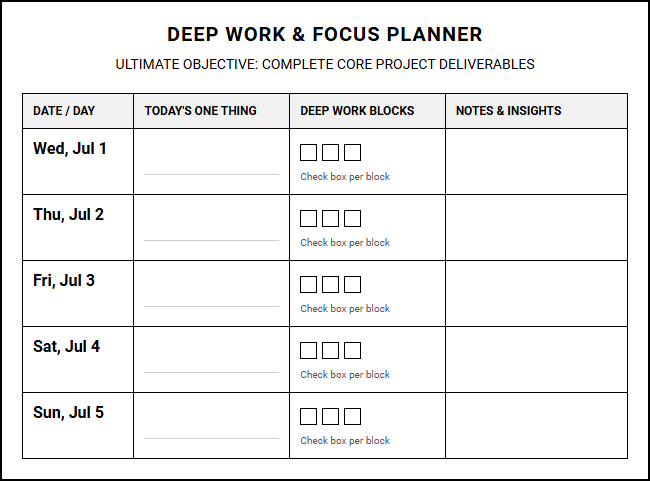
Maintaining deep focus amidst digital distractions is a constant professional struggle. While standard calendars aim to fund our daily time, they often fragment attention. The Daily Agendas printable calendar-part of the Ultimate Focus And Deep Work Planner-grants immediate cognitive clarity. Notably, Cal Newport-style deep work blocks are easily sustained through this physical layout. Although success requires a brief, daily offline commitment, we will outline how these templates systematically structure your peak productivity hours.
Create Your Ultimate Focus And Deep Work Planner
Done customizing?
Ultimate Focus And Deep Work Planner - Good to Know
Time blocking
Time blocking is a highly effective productivity method where you divide your day into dedicated segments of time. Instead of keeping an open-ended, overwhelming to-do list, you proactively assign specific tasks or categories of work to distinct time slots throughout your schedule. This approach transforms your calendar from a passive tool for meetings into an active framework for deep execution.
By implementing this spatial organization of your day, you create clear boundaries that protect your cognitive resources. When you use time blocking, you benefit from several structural advantages:
- Defended priorities: Important but non-urgent tasks receive guaranteed real estate on your calendar.
- Reduced decision fatigue: You no longer waste mental energy deciding what to work on next.
- Improved estimation skills: Over time, you gain a realistic understanding of how long tasks actually take.
This structured discipline ensures that your daily actions align perfectly with your high-level strategic goals, maximizing output and minimizing procrastination.
Flow state optimization
Achieving a state of flow-the optimal mental condition where you become fully immersed in an activity-requires deliberate environmental and cognitive engineering. In this state, self-consciousness vanishes, time perception alters, and performance peaks. To consistently unlock this level of deep concentration, you must balance the challenge level of a task with your specific skill set.
If a task is too easy, boredom sets in; if it is too difficult, anxiety disrupts focus. To optimize your biological and physical environment for flow, consider the following protocol:
- Eliminate external triggers: Silence all notifications and establish physical boundaries in your workspace.
- Define clear goals: Establish exactly what constitutes success for the session before you begin.
- Provide immediate feedback loops: Use tools or metrics that show real-time progress.
Consistently entering flow states not only boosts professional productivity but also enhances overall life satisfaction and cognitive fulfillment.
Monotasking
Despite the modern glorification of multitasking, cognitive science proves that the human brain cannot consciously process two complex tasks simultaneously. What we perceive as multitasking is actually rapid task-switching, a highly inefficient process that drains cognitive energy and increases error rates. Monotasking is the practice of dedicating your entire cognitive capacity to a single, singular task until its completion or until a designated milestone is reached.
"To do two things at once is to do neither." - Publilius Syrus
By consciously rejecting distractions and committing to one objective, you preserve your mental energy and produce higher-quality output. Monotasking allows your working memory to operate at peak efficiency, fostering deep analytical thinking and creative problem-solving. This deliberate focus acts as an antidote to the fractured attention spans caused by the digital age, training your brain to sustain concentration over extended periods.
Pomodoro technique
The Pomodoro Technique is a classic time management framework designed to sustain mental stamina and prevent burnout. Created by Francesco Cirillo, this method utilizes a timer to break your workday into structured intervals, traditionally twenty-five minutes of intense focus followed by a five-minute break. These intervals are called "Pomodoros."
The beauty of this system lies in its psychological pacing. By working in short, concentrated bursts, you create a sense of urgency that discourages procrastination. The frequent, brief rests are equally crucial; they allow your mind to assimilate information and prevent physical fatigue. To implement this technique successfully, adhere to these simple guidelines:
- Protect the interval: A Pomodoro is indivisible; if interrupted, the session must be restarted.
- Step away during breaks: Use your five minutes to stretch or hydrate, not to check emails.
- Take longer rests: After four consecutive sessions, reward yourself with a twenty-to-thirty-minute break.
Chronotype scheduling
Chronotype scheduling is the practice of aligning your daily professional demands with your biological clock. Human beings are genetically predisposed to specific circadian rhythms, commonly categorized into chronotypes like lions (morning oriented), wolves (night oriented), bears (aligned with the sun), and dolphins (irregular sleepers). Forcing a rigid, traditional schedule onto an incompatible biology often results in chronic fatigue and subpar performance.
By identifying your specific chronotype, you can strategically schedule your most demanding cognitive work during your natural biological peaks. Analytical tasks, strategic decision-making, and creative brainstorming should be mapped to your high-energy windows. Conversely, routine administrative tasks, email management, and scheduling are best reserved for your natural energy troughs. Designing your workday around your internal biological rhythms leads to effortless productivity and improved long-term physiological well-being.
Cognitive load management
Your working memory has a strictly limited capacity, often referred to as cognitive load. When you overwhelm your brain with too much information, unfinished tasks, and chaotic environments, your mental processing speed plummets. Effective cognitive load management involves strategically offloading mental burdens to preserve space for critical thinking and decision-making.
To prevent mental exhaustion, you must manage three types of cognitive load: intrinsic (effort associated with a specific topic), extraneous (the way information is presented), and germane (the work put into creating a permanent store of knowledge). You can optimize this balance by utilizing external memory aids:
- Externalize tasks: Write down every fleeting thought or to-do in a trusted digital capture system.
- Simplify instructions: Break complex, multi-step projects down into micro-actions.
- Minimize distractions: Declutter your physical desk and digital desktop to reduce extraneous sensory inputs.
Digital minimalism
Digital minimalism is a philosophy of technology use in which you focus your online time on a small number of carefully selected and optimized activities that strongly support the things you value. It requires a radical departure from the default state of constant digital consumption. Rather than adopting every new app or platform, a digital minimalist evaluates digital tools through a strict lens of utility and cost.
"Technology is a useful servant but a dangerous master." - Christian Lous Lange
Implementing this philosophy involves decluttering your digital workspace, silencing non-essential notifications, and setting strict boundaries for social media consumption. By reclaiming your attention from addictive algorithms, you free up massive amounts of cognitive bandwidth and time. This newly recovered time can then be reinvested into real-world interactions, high-quality leisure activities, and deep, uninterrupted professional work.
Attention residue reduction
When you switch from one task to another, a portion of your attention remains glued to the previous task. This phenomenon, known as attention residue, significantly impairs your cognitive performance on the new task. Research shows that even brief interruptions, like checking a quick email, can leave a lingering residue that reduces your problem-solving abilities for up to twenty minutes afterward.
To combat this hidden productivity killer, you must design clean transitions between different types of work. You can systematically reduce attention residue by following these protocols:
- Complete logical milestones: Avoid stopping a task in the middle of a complex thought process.
- Create a transition buffer: Take a two-minute silent pause between meetings or distinct work blocks.
- Write closure notes: If you must interrupt a project, jot down your immediate next steps to ease mental transition.
Time auditing
Most professionals have a highly distorted perception of how they actually spend their workdays. Time auditing is the rigorous practice of tracking every single minute of your daily activities for a set period, typically one to two weeks, to uncover the disparity between your perceived schedule and reality. This objective data serves as the foundation for all meaningful productivity adjustments.
To conduct an effective audit, you must log your activities in real-time rather than relying on memory at the end of the day. You can categorize your findings into distinct buckets, such as:
- Deep work: High-value, cognitively demanding tasks.
- Shallow work: Administrative tasks, emails, and logistical meetings.
- Distractions: Unplanned interruptions, social media, and context switching.
Analyzing this data reveals hidden bottlenecks, permitting you to reclaim lost hours and realign your schedule with your actual priorities.
Hyperfocus ritual
A hyperfocus ritual is a customized, repeatable sequence of actions designed to signal to your brain that it is time to transition into a state of deep, unshakeable concentration. Relying solely on willpower to focus is an unreliable strategy. Instead, establishing a structured physical and mental warm-up routine lowers the barrier to entry for demanding cognitive work.
Your ritual should address all sensory inputs to create a complete environmental shift. For example, your routine might include clearing your physical desk, opening a specific focus playlist, lighting a distinct candle, and closing all unrelated browser tabs. By consistently repeating these identical steps, you build a strong classical conditioning response. Over time, the execution of this ritual automatically triggers a biological shift, allowing you to slide effortlessly into a state of deep focus regardless of your initial motivation levels.
Leave a comment