
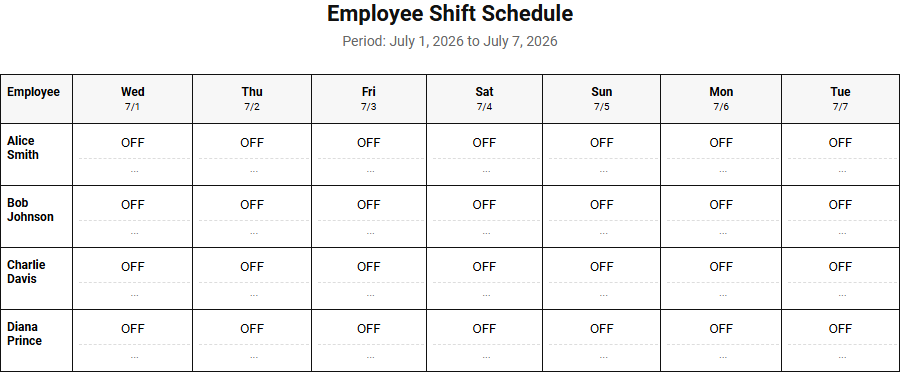
Managing inconsistent workforce coverage and schedule conflicts is a persistent challenge for operations managers. While traditional operational budgets and staffing funding sources secure the necessary labor, maximizing that investment requires precise execution. Our Business & Project Trackers printable calendar grants complete visibility over daily resource allocation. To ensure success, users must stipulate to maintaining daily schedule updates. Organizations already leverage this shift planner template to synchronize retail teams seamlessly. Below, we outline how to implement this tool effectively.
Create Your Employee Shift and Schedule Planner
Done customizing?
Employee Shift and Schedule Planner - Good to Know
Demand-based scheduling
Demand-based scheduling is a data-driven workforce management strategy that aligns employee schedules with anticipated customer traffic, sales volumes, and service requirements. By analyzing historical data, seasonal trends, and real-time market indicators, businesses can accurately forecast their exact labor needs throughout the day.
Implementing this optimization method delivers significant operational advantages:
- Minimizes labor waste by reducing unnecessary coverage during historical low-activity periods.
- Prevents understaffing during peak operational hours, ensuring high customer satisfaction.
- Enhances profitability by directly linking labor expenditures to revenue-generating periods.
Using sophisticated forecasting algorithms, managers can create highly precise shift structures that accommodate both customer demand and operational budgets. This modern approach transforms scheduling from a reactive administrative chore into a proactive, strategic business advantage that supports long-term growth.
Shift bidding
Shift bidding is an empowering scheduling methodology that grants employees greater control over their professional work hours. Instead of managers assigning specific shifts arbitrarily, open shifts are posted to a shared digital platform where qualified staff members can submit bids based on their personal preferences and availability.
This cooperative process usually operates under predefined organizational guidelines, including:
- Seniority ranking, where tenure determines priority for coveted shifts.
- Performance metrics, rewarding high-performing staff with first choice of hours.
- First-come, first-served mechanisms to ensure speed and equal opportunity.
This transparent system significantly boosts workplace morale and reduces employee turnover. By giving workers a voice in their scheduling, organizations experience fewer call-outs and foster a culture of mutual respect, trust, and shared responsibility.
Clopening
The term clopening refers to a controversial scheduling practice where an employee is assigned to work the closing shift one night, followed immediately by the opening shift the next morning. This practice often leaves workers with less than eight hours of rest between consecutive shifts, leading to physical exhaustion and decreased cognitive performance.
To combat the negative consequences of this practice, many jurisdictions have implemented strict labor laws that mandate minimum rest periods. Modern scheduling software helps organizations avoid clopening violations by:
- Automatically flagging back-to-back shifts that violate rest requirements.
- Enforcing a mandatory 11-hour buffer period between scheduled workdays.
- Alerting schedulers to potential compliance risks before schedules are finalized.
Prioritizing adequate rest between shifts safeguards employee health, drastically reduces on-the-job accidents, and maintains a highly productive, alert, and engaged workforce.
Auto-scheduling
Auto-scheduling utilizes advanced artificial intelligence and automated algorithms to generate optimal staff schedules in a fraction of the time required by manual methods. The system seamlessly processes vast amounts of complex data, including employee availability, skills, payroll budgets, and labor laws, to produce a conflict-free schedule.
This automated approach resolves traditional scheduling headaches by instantly balancing multiple variables simultaneously:
| Scheduling Factor | Manual Method | Auto-Scheduling |
|---|---|---|
| Processing Time | Hours or days of work | Seconds to minutes |
| Error Rate | High risk of double-booking | Zero scheduling conflicts |
| Compliance Check | Prone to human oversight | 100% automated enforcement |
Liberating managers from administrative tasks allows them to focus on employee development, customer engagement, and high-level strategic initiatives.
Labor compliance
Maintaining strict labor compliance is critical for modern enterprises navigating a complex landscape of federal, state, and local employment regulations. Organizations must continuously adhere to predictive scheduling laws, overtime limits, mandatory breaks, and fair compensation requirements to avoid severe financial penalties and legal exposure.
A robust compliance strategy involves integrating legal boundaries directly into the scheduling framework. This preventative approach protects the business from costly wage-and-hour lawsuits while defending the basic rights of the workforce.
By automating compliance checks, companies build trust with their staff, demonstrate corporate integrity, and establish a stable operating environment that respects both statutory regulations and human resource ethics.
Shift swapping
Shift swapping offers a flexible, peer-to-peer solution for managing unexpected personal scheduling conflicts. Rather than involving management in every minor adjustment, employees can independently trade shifts with qualified colleagues through a centralized mobile application or digital communication portal.
To ensure seamless operations, the process typically follows three simple steps:
- An employee posts an unwanted shift indicating their desire to swap.
- A qualified coworker accepts the shift, offering one of theirs in return.
- A manager reviews and approves the trade to verify skill compatibility and prevent overtime.
This collaborative approach reduces the burden on administrative staff while drastically decreasing absenteeism, as employees can easily manage their work-life balance through reliable peer support.
Fatigue management
Fatigue management is a systematic safety process designed to monitor and mitigate the mental and physical exhaustion of employees. In industries with high-risk environments, such as manufacturing, healthcare, and transportation, excessive fatigue can lead to catastrophic operational errors and severe workplace injuries.
Implementing a scientific fatigue management policy involves monitoring several key parameters:
- Limiting the maximum number of consecutive night shifts an individual can work.
- Restricting weekly overtime to prevent cognitive burnout.
- Mandating scheduled breaks during prolonged periods of intense physical or mental labor.
By prioritizing the physiological well-being of the workforce, businesses experience fewer safety incidents, decrease absenteeism, and enjoy sustained long-term productivity and employee retention.
Real-time availability
Managing real-time availability ensures that scheduling coordinators always have access to the most current employee working preferences and time-off requests. In fast-paced business environments, outdated availability data leads directly to scheduling errors, shift conflicts, and unfilled floor positions.
Modern workforce solutions solve this challenge by syncing mobile apps with the master schedule, enabling immediate updates when:
- An employee's academic schedule or childcare needs change.
- An unexpected illness or personal emergency arises.
- An employee wishes to pick up extra hours on short notice.
This dynamic flow of communication creates an agile ecosystem where managers can fill sudden vacancies instantly, maintaining continuous service levels without disruptive delays.
Split shifts
A split shift is a scheduling practice where an employee's workday is divided into two distinct parts separated by a prolonged, unpaid break. Commonly utilized in the hospitality and public transit sectors, this pattern allows employers to maximize staffing during peak hours without paying for idle time during mid-day lulls.
While highly efficient for managing labor costs, split shifts require careful implementation to remain fair to employees. Schedulers must consider:
- Local labor regulations that may mandate extra "split-shift premium" pay.
- The geographical commute times of workers forced to travel multiple times a day.
- The potential impact on overall employee work-life balance and job satisfaction.
When managed transparently and paired with proper financial incentives, split shifts serve as an effective tool for balancing seasonal and daily operational fluctuations.
Geofenced clock-in
Geofenced clock-in technology utilizes GPS boundaries to restrict employee time-tracking to a specific physical location. By establishing a virtual perimeter around a job site, retail store, or office building, the system ensures that employees can only log their working hours when they are physically present on site.
This modern security measure addresses several historical time-tracking challenges:
- Eliminates buddy punching, preventing employees from clocking in for absent coworkers.
- Improves payroll accuracy by logging exact arrival and departure times automatically.
- Streamlines remote work management for construction, home health, and field services.
Integrating geofencing into the payroll workflow ensures that labor expenses represent actual hours worked, boosting operational trust and protecting the company's financial bottom line.
Leave a comment