
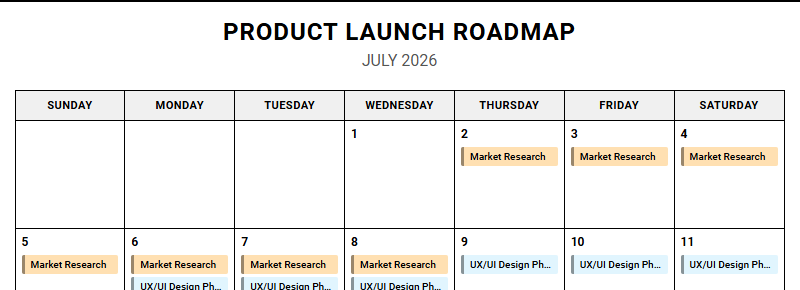
Managing cross-functional project timelines often leads to fragmented communication and missed milestones. While traditional capital funding sources secure your project's budget, execution relies entirely on structured visibility. A dedicated Monthly Project Management Calendar grants teams immediate visual control over complex deliverables. Naturally, while this tool coordinates deadlines, it stipulates consistent updates to remain effective-as seen in successful product launches. Below, we examine how these printable trackers optimize your operational workflow.
Create Your Monthly Project Management Calendar
Done customizing?
Monthly Project Management Calendar - Good to Know
Milestone Tracking
Milestone tracking serves as the strategic scaffolding of any successful project lifecycle. By identifying key achievements, major deliverables, or critical phase transitions, project managers can monitor progress without getting bogged down in daily micro-tasks. These high-level checkpoints act as visual beacons on the project roadmap, signaling whether the timeline remains healthy and aligned with stakeholder expectations.
Implementing an effective milestone tracking system involves several best practices:
- Defining clear, binary success criteria for every milestone.
- Aligning major milestones with client billing or external release cycles.
- Communicating milestone status changes instantly to stakeholders.
By focusing on these vital inflection points, teams maintain a high-level view of momentum. This structured visibility ensures that potential delays are spotted weeks in advance, allowing for proactive resource reallocation before critical deadlines are compromised, ensuring project health remains robust from initiation to closing.
Gantt Chart View
The Gantt chart view remains an indispensable tool for modern project managers, offering a comprehensive, timeline-based visualization of work. By mapping individual tasks against a calendar grid, this interactive interface illustrates task durations, start and end dates, and overlapping schedules. Teams can quickly discern who is doing what, when each deliverable is due, and how individual contributions fit into the broader organizational picture.
To maximize the utility of a Gantt chart, project planners should utilize specific visual cues:
- Color-coding: Group tasks by department, priority, or assignee.
- Progress bars: Shaded areas within task blocks to indicate real-time percent completion.
- Milestone markers: Distinct diamond icons indicating major phase completions.
This dynamic visualization bridges the gap between abstract project planning and operational reality, empowering team members to manage their daily workloads with superior contextual awareness.
Resource Capacity Planning
Successful execution relies heavily on Resource Capacity Planning, the systematic process of matching human and material assets with project demands. Without this balancing act, organizations suffer from employee burnout, high turnover, and missed deadlines. By analyzing availability, skill sets, and current allocations, resource managers can distribute work equitably across the entire talent pool.
An optimized capacity plan relies on continuous data collection to address key operational questions:
- What specialized skills are required for upcoming deliverables?
- Are any team members overallocated beyond 80% of their total capacity?
- When will key contributors become available for new initiatives?
By maintaining a centralized inventory of skills and availability, organizations can confidently scale their operations. Balancing capacity ensures that teams remain highly productive, project budgets stay predictable, and creative talents are utilized in areas where they deliver the maximum possible value.
Time Blocking
Time blocking is a highly effective time-management methodology where individuals partition their workday into distinct, dedicated blocks of time. Unlike a traditional, reactive to-do list, this practice forces professionals to commit to specific slots for deep focus, administrative duties, and collaborative meetings. By reserving concrete segments on a calendar, team members protect their cognitive bandwidth from the constant disruption of multitasking.
To implement this productivity framework successfully, professionals should adopt these core habits:
- Deep Work Blocks: Dedicate uninterrupted two-hour sessions to complex problem-solving.
- Buffer Blocks: Allocate time for responding to unexpected emails and Slack messages.
- Rest Blocks: Schedule short breaks to maintain cognitive stamina throughout the day.
By establishing these rigid yet realistic boundaries, workers regain control over their schedules, foster a deeper sense of focus, and consistently deliver high-quality work within predictable timeframes.
Dependency Mapping
In complex environments, tasks rarely exist in isolation; dependency mapping is the process of identifying and managing these crucial relationships. By explicitly documenting which tasks must finish before subsequent ones can begin, teams prevent bottleneck scenarios. This mapping creates a clear flow of work, allowing contributors to understand how their output directly impacts their colleagues' ability to proceed.
There are four primary logical relationships managed during this planning phase:
- Finish-to-Start (FS): Task B cannot start until Task A finishes.
- Start-to-Start (SS): Task B cannot start until Task A starts.
- Finish-to-Finish (FF): Task B cannot finish until Task A finishes.
- Start-to-Finish (SF): Task B cannot finish until Task A starts.
Proactive management of these relationships reduces scheduling conflicts, minimizes idle time, and prevents costly project delays that cascade through the entire workflow ecosystem.
Sprint Cadence
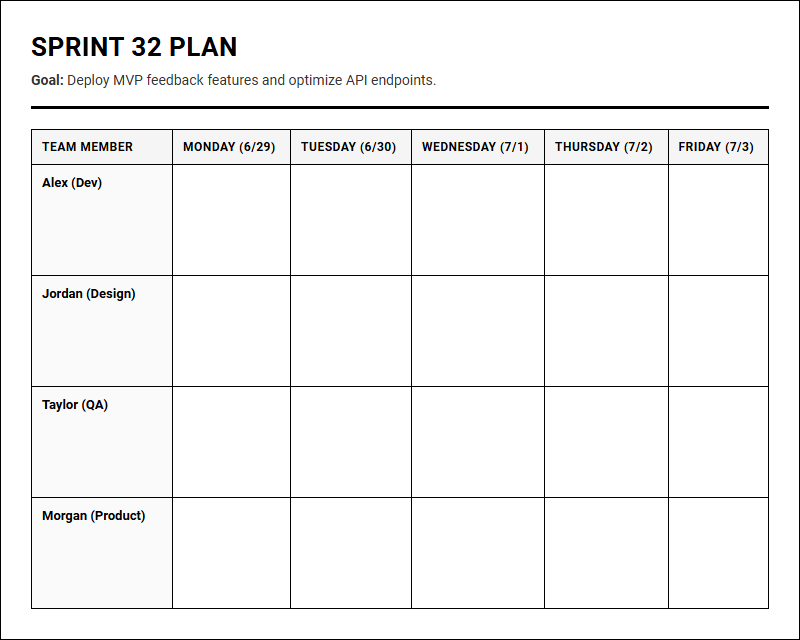
A structured Sprint Cadence acts as the heartbeat of agile product development, establishing a predictable, repeating rhythm for cross-functional teams. Typically spanning one to four weeks, these time-boxed iterations focus the team on delivering incremental, functional software or value. By adhering to a consistent schedule, teams build momentum and establish a baseline velocity that aids in future planning.
A standard sprint rhythm includes several essential collaborative ceremonies:
- Sprint Planning: Setting the goal and selecting backlog items for the upcoming cycle.
- Daily Standup: A brief check-in to align on progress and surface blockers.
- Sprint Review: Demonstrating completed work to stakeholders for immediate feedback.
- Retrospective: Analyzing process efficiency to implement continuous improvements.
This disciplined structure balances flexibility with predictability, enabling teams to pivot rapidly in response to market changes while maintaining a steady, sustainable pace of high-value output.
Critical Path Method
The Critical Path Method (CPM) is a mathematically formulated algorithm used to schedule complex project activities. By identifying the longest sequence of dependent tasks from start to finish, CPM determines the absolute minimum duration required to complete a project. Any delay in a task along this critical path directly impacts the final delivery date, making these tasks the highest priority for managers.
To apply CPM effectively, planners must calculate key parameters for each individual task:
- Earliest Start (ES) and Earliest Finish (EF): The soonest a task can begin and end.
- Latest Start (LS) and Latest Finish (LF): The latest a task can occur without delaying the project.
- Total Float (Slack): The amount of time a task can be delayed without affecting the deadline.
Understanding where slack exists allows managers to optimize resource distribution, moving assets away from flexible tasks to safeguard the critical path.
Work Breakdown Structure
The Work Breakdown Structure (WBS) is a deliverable-oriented, hierarchical decomposition of a project's total scope. By breaking down massive, complex initiatives into manageable chunks called work packages, the WBS provides a structured framework for estimation, scheduling, and control. It acts as the foundational blueprint from which all budgets, schedules, and resource assignments are derived.
A highly functional WBS adheres to specific structural guidelines:
- The 100% Rule: The WBS must encompass 100% of the work defined by the scope.
- Mutually Exclusive Elements: No overlap of deliverables between different branches.
- Manageable Work Packages: Deconstructed to a level where progress is easily measured.
Utilizing a structured WBS prevents scope creep, improves cost estimation accuracy, and ensures that every team member has a crystal-clear understanding of their specific, measurable contributions to the grand design.
Asynchronous Collaboration
In a globalized workforce, asynchronous collaboration has transitioned from a modern convenience to a primary competitive advantage. This operational model decouples communication from real-time presence, allowing team members to consume information, process complex ideas, and contribute updates on their own schedules. By reducing reliance on continuous, disruptive meetings, teams unlock deep-focus hours and foster a more thoughtful culture.
Building a successful asynchronous working environment requires specific digital infrastructure:
- Comprehensive, centralized documentation in a single source of truth.
- Threaded communication channels that keep conversations organized by topic.
- Screen recordings and video walkthroughs to explain ideas without live meetings.
Embracing asynchronous methods respects individual work preferences, accommodates diverse time zones, and encourages well-considered contributions over hurried, real-time responses, leading to superior decision-making outcomes across distributed networks.
Project Baseline
A Project Baseline is the approved, finalized reference point established at the end of the planning phase, consisting of scope, schedule, and cost baselines. This frozen state serves as the yardstick against which actual performance is measured throughout the project lifecycle. Without a validated baseline, assessing whether a project is under budget, on schedule, or suffering from scope creep is virtually impossible.
Managing the project baseline effectively involves several key operational protocols:
- Formal Sign-off: Securing executive agreement before work commences.
- Variance Analysis: Measuring actual progress against the baseline to identify deviations.
- Change Control: Restricting modifications to the baseline to formal change requests.
This disciplined tracking standardizes performance evaluation. It provides project leaders with the empirical data needed to make informed course corrections, keeping expectations aligned and delivering predictable, high-quality results.
Leave a comment