
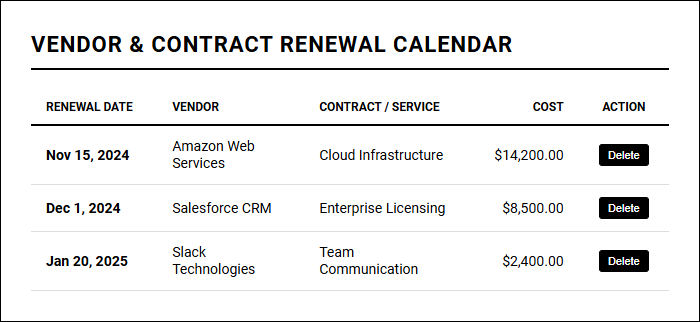
Managing multiple vendor contract cycles often leads to costly, overlooked auto-renewals. For organizations relying on strict quarterly budget allocations or department-specific funding sources, these surprise expenses disrupt financial planning. A dedicated Business & Project Trackers printable calendar grants leadership total oversight of upcoming commitment windows. While this tool cannot automate negotiations, it establishes the necessary preparation timelines for critical contracts like SaaS subscriptions. Below, we outline how to implement this calendar to protect your operational budget.
Create Your Vendor and Contract Renewal Calendar
| Renewal Date | Vendor | Contract / Service | Cost | Action |
|---|
Done customizing?
Vendor and Contract Renewal Calendar - Good to Know
Contract Lifecycle Management
SaaS contract management is a complex cycle. Contract Lifecycle Management (CLM) represents the end-to-end process of managing contracts from initiation through execution, performance, and renewal. In modern procurement, leveraging CLM software automates critical workflows, reduces administrative bottlenecks, and ensures absolute compliance. Organizations use these systems to establish a centralized repository, making all software agreements searchable and transparent.
Key stages of an effective CLM process include:
- Authoring and initial drafting
- Collaborative negotiation and redlining
- Formal approval and e-signature execution
- Post-execution auditing and compliance monitoring
By implementing a robust CLM strategy, procurement teams mitigate legal risks and gain complete visibility into their software portfolio. This structural visibility prevents costly auto-renewals and aligns vendor performance with organizational goals, transforming static documents into dynamic assets that drive business value across the entire enterprise.
Auto-renewal Opt-out Window
The auto-renewal opt-out window is a critical milestone within software licensing agreements. This specific timeframe dictates when a customer must formally notify a vendor of their intention to cancel or renegotiate a subscription before it automatically renews for another term. Missing this window frequently traps organizations in unwanted, multi-year commitments for redundant or underutilized software.
To successfully navigate these windows, procurement departments should implement the following practices:
- Log exact cancellation deadlines in a centralized calendar.
- Set automated alerts at 90, 60, and 30 days prior to the window closing.
- Review usage analytics to determine if the software still delivers measurable ROI.
Failing to track these dates leads to unexpected budgetary leaks. By proactively managing the opt-out window, businesses maintain their purchasing leverage, allowing them to either negotiate better terms or transition seamlessly to superior alternative solutions.
Co-termination
Co-termination is a highly effective procurement strategy designed to align the end dates of multiple software subscriptions or licenses under a single vendor. Instead of managing fragmented renewal dates throughout the fiscal year, organizations synchronize these agreements to expire simultaneously. This consolidation simplifies administrative overhead, reduces billing complexity, and significantly enhances a company's negotiation leverage during renewal discussions.
Consider these primary benefits of co-termination:
- Administrative Efficiency: Fewer invoices to process and fewer renewal cycles to manage.
- Enhanced Leverage: Negotiating a larger, consolidated contract often yields volume discounts.
- Predictable Budgeting: Aligning software expenses with annual budget planning cycles.
When purchasing new seats or additional modules mid-contract, savvy buyers request pro-rated terms to match the existing master agreement's expiration date, ensuring the portfolio remains perfectly synchronized and easy to manage.
SaaS Spend Optimization
SaaS spend optimization is the strategic practice of analyzing, managing, and reducing software-as-a-service expenses. As cloud applications proliferate across organizations, shadow IT and redundant subscriptions can rapidly inflate operating costs. Active optimization requires a detailed inventory of all software assets, mapped against actual user engagement and feature utilization data to identify waste.
Effective optimization campaigns typically target three core areas:
- License Right-sizing: Downgrading inactive users or shifting them to cheaper, read-only tiers.
- Eliminating Redundancy: Consolidating duplicate tools that perform identical business functions.
- Contract Renegotiation: Leveraging historical usage data to secure volume discounts or longer-term price freezes.
Continuous monitoring ensures that software budgets are spent efficiently, freeing up valuable capital that can be reinvested into strategic innovation and growth initiatives instead of dormant licenses.
Evergreen Clause
An evergreen clause is a contractual provision that automatically renews a software agreement for a successive period unless one party provides advance written notice of non-renewal. While these clauses offer convenience by preventing service interruptions, they present a significant financial risk for businesses that fail to actively monitor their contract portfolio. Without strict oversight, evergreen contracts quietly drain budgets on obsolete technology.
To mitigate the risks associated with evergreen clauses, procurement specialists should:
- Identify and flag all contracts containing automatic renewal language.
- Negotiate the removal of evergreen provisions during initial contract drafting.
- Insist on "active renewal" terms that require explicit written consent to extend the service.
Understanding the legal implications of these clauses is essential for maintaining control over operational software expenditures and preventing vendors from locking your organization into perpetual payment cycles.
Notice Period Trigger
A notice period trigger is the contractual mechanism that initiates the formal countdown toward a contract's expiration or renewal. This clause specifies exactly how much advance notice a customer must provide to alter or terminate an agreement. Notice periods typically range from 30 to 90 days, though enterprise SaaS agreements can require up to 180 days of prior written warning.
Managing these triggers requires structured internal workflows:
- Automated Alerts: Configure notification systems to trigger alerts well ahead of the actual deadline.
- Stakeholder Reviews: Gather feedback on vendor performance before the trigger date arrives.
- Formal Communication: Prepare and deliver legally compliant non-renewal notices via the prescribed communication channels.
Missing a trigger date effectively surrenders your negotiating power, forcing a renewal under the vendor's standard terms. Proactive tracking ensures you control the timeline.
Vendor Offboarding
Vendor offboarding is the systematic process of disengaging from a software provider once a contract ends. Often overlooked, comprehensive offboarding is vital for securing corporate data, maintaining regulatory compliance, and eliminating ghost expenses. Simply stopping payment is insufficient; a formal protocol must be executed to transition operations smoothly and securely.
A robust offboarding checklist should encompass:
- Data Retrieval: Exporting all proprietary data, system logs, and intellectual property.
- Access Revocation: Disabling user accounts, single sign-on (SSO) integrations, and API keys.
- Data Destruction: Obtaining written certification that the vendor has deleted all corporate data from their servers.
- Financial Reconciliation: Verifying final invoices and ensuring no lingering automatic charges remain active.
Executing a structured offboarding strategy protects your digital perimeter and ensures a clean, risk-free break from outgoing software vendors.
Maverick Spend
Maverick spend refers to unauthorized or uncontrolled purchasing that occurs outside of established procurement processes and negotiated contracts. In the SaaS landscape, this typically manifests as shadow IT, where individual departments or employees purchase software subscriptions using corporate credit cards without IT or procurement oversight. This fragmented spending compromises security and bypasses volume discounts.
Addressing maverick spend requires a multi-faceted organizational approach:
- Implement clear purchasing policies and approval workflows for all software acquisitions.
- Educate employees on the security risks of unsanctioned software.
- Utilize expense management tools to flag recurring software charges.
- Establish a streamlined, rapid-approval process for vetted low-cost tools.
By curbing maverick spend, organizations consolidate their purchasing power, enforce strict security standards, and ensure that all technology investments align directly with the broader corporate strategy.
Procurement Roadmap
A procurement roadmap is a strategic framework that aligns technology acquisition with long-term business objectives. Rather than reacting to immediate software needs ad hoc, organizations use a roadmap to plan future investments, manage upcoming renewals, and schedule system migrations. This forward-looking approach ensures that the IT ecosystem evolves in tandem with organizational growth.
Key components of a successful procurement roadmap include:
- A comprehensive timeline of all contract expiration dates and renewal windows.
- Scheduled technology assessments to identify capability gaps.
- Financial forecasts detailing projected software expenditures and budget allocations.
- Strategic goals for consolidating vendors and optimizing overall SaaS spend.
Having a clear, visualized roadmap enables procurement teams to transition from tactical buyers to strategic partners, driving efficiency and ensuring that every software purchase actively supports the company's overarching mission.
Early Termination Penalty
An early termination penalty is a contractually mandated fee charged to customers who cancel a subscription agreement before its designated expiration date. Vendors include these clauses to guarantee revenue and recoup customer acquisition costs. For buyers, exiting a multi-year contract prematurely can result in substantial financial penalties, sometimes requiring payment of the entire remaining contract value.
To protect your business from these punitive fees, consider the following strategies:
- Negotiate "termination for convenience" clauses with reasonable, capped exit fees.
- Include "termination for cause" provisions, allowing free exit if the vendor fails to meet Service Level Agreements (SLAs).
- Opt for shorter contract terms when piloting unproven or rapidly evolving software.
Carefully reviewing and negotiating these penalty structures during the initial purchasing phase prevents your organization from being financially trapped in underperforming software relationships.
Leave a comment