
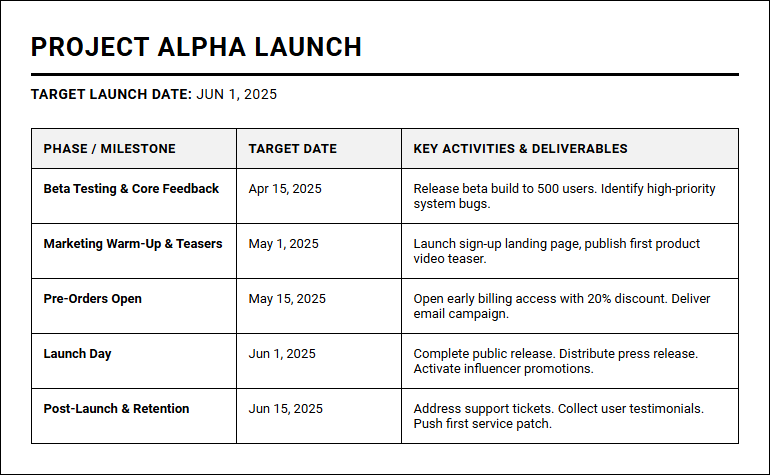
Coordinating a product launch often fails due to fragmented timelines and missed dependencies. While securing capital through standard funding sources provides the financial runway, executing the rollout requires meticulous timeline management. A dedicated printable calendar grants teams the absolute visibility needed to synchronize cross-functional tasks. However, success stipulates disciplined daily updates rather than passive tracking. Leading e-commerce brands and software startups rely on these visual tools to maintain momentum. Below, we outline how to leverage these trackers to streamline your launch roadmap.
Create Your Product Launch Timeline Calendar
Done customizing?
Product Launch Timeline Calendar - Good to Know
Go-To-Market Roadmap
A Go-To-Market (GTM) roadmap is a strategic blueprint that aligns product development, marketing, sales, and customer success teams for a unified product launch. This document establishes clear market positioning, target audience demographics, pricing models, and distribution channels. By mapping out these critical elements, organizations ensure every department operates with a shared vision, minimizing friction during the launch lifecycle.
- Cross-Functional Alignment: Ensures product, sales, and marketing move in lockstep.
- Risk Mitigation: Identifies potential market entry barriers early in the process.
- Value Proposition: Defines how the product solves specific customer pain points.
To maximize market impact, a GTM roadmap must integrate quantitative KPIs and qualitative goals, providing a holistic framework for measuring market penetration. Continuous cross-functional collaboration and real-time feedback loops ensure the product meets external demand effectively.
Workback Schedule
A workback schedule is a reverse-planning methodology that starts with the final launch date and plans backward to the present day. This technique is indispensable for complex projects with immovable deadlines, ensuring that every prerequisite task is identified and scheduled in a logical, chronological sequence.
- Define the final launch or delivery date.
- Identify major project milestones leading up to the launch.
- Establish task durations and assign operational responsibilities.
- Build in contingency buffers for high-risk dependencies.
By establishing milestones in reverse, project managers can realistically assess feasibility, allocate resources efficiently, and identify potential bottlenecks before they threaten the timeline. This structured approach fosters accountability across teams, as each contributor clearly understands when their deliverables are due to prevent downstream delays, keeping the overall project healthy.
Gantt Chart
The Gantt chart remains a cornerstone of visual project management, offering a timeline-based overview of project schedules, task durations, and overlapping activities. By plotting tasks along a horizontal axis, team leaders can instantly comprehend the sequence of operations and the current progress of each deliverable.
"Visualizing project timelines through Gantt charts transforms abstract deadlines into actionable, time-phased realities for cross-functional teams."
Modern Gantt charts go beyond simple scheduling by illustrating team assignments, resource utilization, and task relationships. This visual clarity is vital for stakeholders, providing an accessible status report without requiring deep dives into granular task lists. Utilizing dynamic Gantt software allows teams to adjust timelines in response to changing project dynamics, instantly propagating updates across the entire scheduling framework.
Critical Path Method
The Critical Path Method (CPM) is an analytical, step-by-step project management technique used to identify the longest sequence of dependent tasks that determines the shortest possible duration of a project. By pinpointing these critical activities, project managers can focus their supervision and resources where delays would directly impact the final completion date.
- Float Identification: Distinguishes tasks that have scheduling flexibility from those that do not.
- Resource Optimization: Directs key personnel to high-impact activities.
- Bottleneck Prevention: Highlights potential delay points in the project lifecycle.
Implementing CPM empowers organizations to optimize resource allocation, manage project risks proactively, and streamline operational efficiency. It provides a rigorous, data-driven framework for decision-making, enabling teams to evaluate the impact of schedule changes and prioritize tasks that are absolutely vital to meeting project deadlines on schedule.
Phased Rollout
A phased rollout involves releasing a new product or service in stages rather than a single, all-at-once deployment. This strategic approach mitigates operational risks by introducing the solution to small, controlled user segments before executing a full-scale global launch. During the initial phases, teams closely monitor performance metrics, system stability, and user feedback.
Subsequent phases expand the release to larger demographics, incorporating iterative improvements based on real-world data collected from early adopters. This incremental methodology safeguards brand reputation, ensures continuous system stability, and allows customer support teams to manage incoming inquiries effectively without becoming overwhelmed by a sudden deluge of user requests.
Dependency Mapping
Dependency mapping is the process of identifying, visualizing, and managing the relationships between different project tasks, teams, and technical components. In complex development environments, a single delay can trigger a cascading failure across multiple departments if dependencies are not clearly understood and documented.
- Logical Relationships: Identifies which tasks must finish before others can begin.
- Cross-Team Coordination: Clarifies handoffs between design, engineering, and marketing.
- Technical Sequencing: Ensures software architecture prerequisites are built in the correct order.
By mapping these linkages, project managers can identify critical choke points and establish contingency plans early in the lifecycle. This practice facilitates open communication, ensuring that upstream developers and downstream marketers remain fully synchronized.
Launch Window
Determining the optimal launch window is a strategic decision that heavily influences a product's market adoption, media coverage, and commercial viability. This process involves analyzing external factors such as seasonal market trends, competitor activity, industry events, and consumer behavior patterns.
Launching too early can result in an incomplete user experience, while launching too late may mean missing critical market opportunities or seasonal purchasing spikes. By identifying a strategic window, organizations can align their marketing campaigns, sales outreach, and public relations efforts for maximum market resonance. A well-timed launch leverages external momentum, ensuring the product enters the market when consumer demand and media attention are at their peak.
Milestone Tracking
Milestone tracking serves as a high-level monitoring mechanism, focusing on key achievements and significant events rather than daily task progress. Milestones act as checkpoints throughout the project lifecycle, signaling the completion of major phases such as prototype approval, beta testing, or compliance certification.
- Phase Gates: Formally closing one phase before starting the next.
- Progress Indicator: Providing clear, high-level status updates to executives.
- Risk Signals: Identifying early when key deadlines are slipping.
Tracking these critical events provides leadership teams and external stakeholders with a clear overview of project health without clogging communication channels with minutiae. Celebrating these milestones boosts team morale and reinforces momentum, while missing a milestone serves as an early warning system indicating that the project requires corrective action.
Sprint Backlog
In Agile methodologies, the sprint backlog is a curated list of user stories, tasks, and bug fixes designated for completion during an upcoming development cycle. Culled from the broader product backlog during sprint planning, these items represent the immediate priorities agreed upon by the development team and product owner.
- Daily Commitment: Serves as the team's focus for the duration of the sprint.
- Iterative Planning: Allows for quick adjustments based on immediate feedback.
- Clear Scope: Prevents unauthorized additions or feature creep during active development.
A well-defined sprint backlog ensures that developers have absolute clarity on their immediate goals, minimizing distractions. Throughout the iteration, the team updates the backlog daily, tracking progress through burn-down charts, which fosters continuous value delivery and rapid adaptability.
Post-Launch Retrospective
The post-launch retrospective is a vital continuous improvement practice designed to evaluate the successes and failures of a completed project. By gathering key team members and stakeholders, organizations can analyze performance data, operational workflows, and cross-functional communication dynamics.
This process encourages open, constructive dialogue to identify what went well and what challenges were encountered during the execution phase. Documenting these insights generates a repository of historical data and actionable recommendations that inform future project planning, ensuring that the organization continuously refines its product launch processes, optimizes resource efficiency, and avoids repeating past mistakes in subsequent initiatives.
Leave a comment