
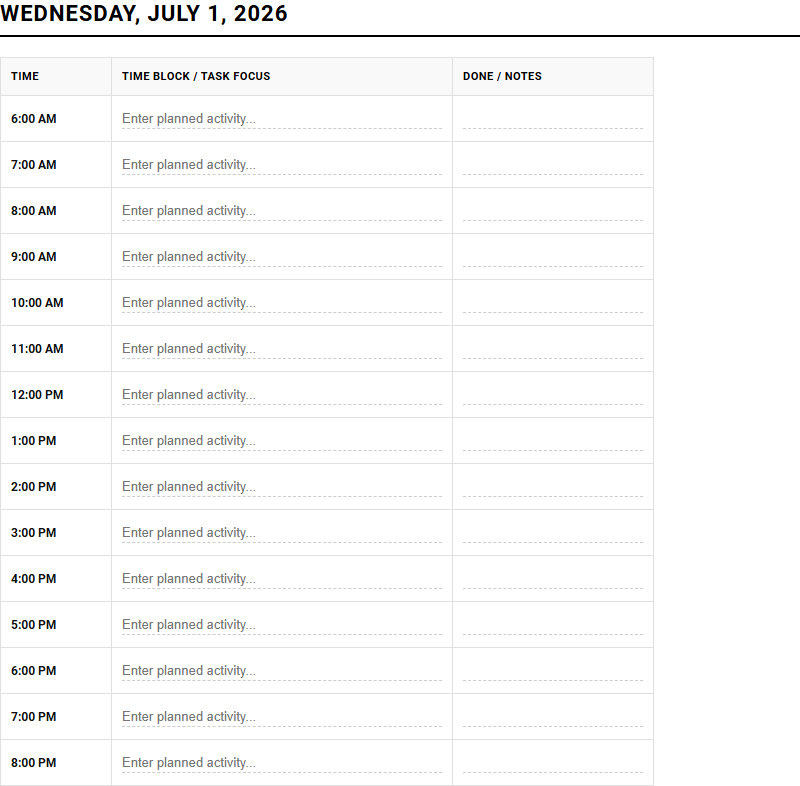
Managing a chaotic workday leaves professionals feeling reactive, struggling to protect their focus. While digital alerts and traditional to-do lists offer basic scheduling, they often fail to prevent cognitive overload. A printable Daily Time Blocking Calendar grants absolute visual control over your day, provided you actively commit to these fixed periods. Executives use this tool to secure uninterrupted blocks for strategic planning. Below, we explore how to implement this system to optimize your daily productivity.
Create Your Daily Time Blocking Calendar
Done customizing?
Daily Time Blocking Calendar - Good to Know
Advanced Time Management and Productivity Strategies
Mastering your daily schedule requires a blend of structured methodology and cognitive awareness. Below are ten proven framework strategies to optimize your workflow, manage energy levels, and elevate your daily output.
Time boxing
Time boxing is a highly effective productivity strategy where you allocate a fixed, rigid limit to a specific activity in advance. Unlike open-ended to-do lists, this method forces you to commit to a dedicated timeframe, binding your focus to a single goal. By establishing these strict temporal boundaries, you naturally foster a healthy sense of urgency that actively combats procrastination and prevents perfectionism from stalling your progress.
To implement this technique successfully, consider the following steps:
- Estimate the required effort honestly and select an appropriate time frame.
- Set a physical or digital timer to create a visual countdown.
- Treat the end of the time box as a definitive stop point to assess your progress.
This structured discipline ensures that low-priority tasks do not bleed into your high-value creative windows, allowing you to maintain consistent, predictable momentum throughout your entire workday.
Task batching
Task batching involves grouping similar, low-effort tasks together and completing them in one dedicated session. This approach minimizes cognitive friction by reducing the mental setup time required to transition between disparate activities. Instead of answering emails sporadically, filing reports incrementally, and updating spreadsheets intermittently, you consolidate these administrative duties into targeted operational blocks.
By compartmentalizing these responsibilities, you protect your brain from the exhausting drag of constant mental reorientation. This practice is particularly beneficial for managing routine daily operations, such as:
- Processing inbox communications and replying to team messages.
- Handling repetitive financial invoicing and expense tracking.
- Scheduling social media updates and reviewing weekly performance metrics.
Consolidating these micro-tasks allows you to clear your plate efficiently, leaving larger, uninterrupted spaces in your calendar for complex strategic thinking and creative exploration.
Day theming
Day theming is a macro-level organizational strategy designed for professionals who manage diverse responsibilities. By dedicating an entire operational day to a single, overarching theme, you eliminate the cognitive dissonance that comes from wearing too many hats simultaneously. For example, a business founder might designate Mondays for administrative oversight, Tuesdays for marketing initiatives, and Wednesdays for product development.
This thematic division provides deep mental clarity, allowing you to wake up each morning with a singular, clear-cut objective. Rather than constantly reacting to shifting external demands, you align your intellectual resources toward a unified goal. This method dramatically simplifies your weekly planning process and ensures that critical, long-term strategic projects receive dedicated, undivided attention instead of being repeatedly sidelined by urgent but less important daily fires.
Deep work blocks
Deep work blocks are dedicated periods of distraction-free isolation designed for cognitively demanding tasks. Coined by productivity expert Cal Newport, deep work requires the total elimination of all shallow distractions, including instant messaging, phone notifications, and casual web browsing. During these intensive sessions, your brain can reach a state of deep cognitive flow, allowing you to solve complex problems, write sophisticated code, or produce high-level creative content.
"To produce at your peak level you need to work for extended periods with full concentration on a single task free from distraction."
To maximize the efficacy of these blocks, schedule them during your periods of peak mental alertness. Protect these sacred hours aggressively by communicating your unavailability to colleagues and setting digital boundaries, ensuring your cognitive capacity is directed solely toward your most valuable work.
Chronotype scheduling
Chronotype scheduling is the practice of aligning your professional daily agenda with your biological internal clock. Every individual possesses a unique circadian rhythm, often categorized into distinct animal chronotypes: Lions (early risers), Bears (aligned with the sun), Wolves (night owls), or Dolphins (light, irregular sleepers). Recognizing your specific biological disposition allows you to schedule your most demanding intellectual work during peak alert windows.
Instead of forcing a standardized eight-to-five schedule that conflicts with your physiology, you structure your day around your natural energy highs and lows. Morning-oriented individuals should tackle analytical tasks early, leaving routine meetings for the afternoon. Conversely, late-day performers should protect their evenings for high-concept strategic planning, transforming how comfortably and efficiently they achieve consistent, high-quality output.
Buffer blocks
Buffer blocks are intentional, structured periods of unscheduled time built into your calendar to absorb the inevitable disruptions of the workday. Many professionals fall into the trap of back-to-back scheduling, leaving zero room for unexpected emergencies, delayed meetings, or essential physical recovery. By proactively integrating buffer blocks, you construct a resilient scheduling cushion that prevents your entire day from derailing when a single task runs over time.
These brief intervals, typically lasting fifteen to thirty minutes, serve multiple practical functions:
- They provide vital space to stretch, hydrate, and rest your eyes from screen strain.
- They allow you to quickly process urgent, unexpected requests without delaying existing projects.
- They offer a mental reset, helping you transition mindfully to your next scheduled commitment.
Ultradian rhythm planning
Ultradian rhythm planning leverages the natural biological cycles of the human brain, which typically operate in ninety-minute waves of high-frequency focus followed by roughly twenty minutes of lower cognitive activity. Rather than forcing continuous, flatline focus over an unnatural eight-hour stretch, this method encourages you to ride these physiological waves to maximize output while preventing severe cognitive burnout.
To practice this biological scheduling method, work with intense concentration for ninety minutes, then immediately transition into a genuine, restorative break of fifteen to twenty minutes. During this downtime, step completely away from digital work-walk outside, practice deep breathing, or tidy your physical workspace. This rhythmic oscillation between exertion and recovery preserves your cognitive stamina, keeping your mind fresh, creative, and highly productive throughout the day.
Hyper-scheduling
Hyper-scheduling is an extreme, highly detailed variation of time blocking where every single minute of your day is mapped out on your calendar. From your morning coffee and email review to strategic project sessions and personal exercise, every activity occupies a specific, visual block of time. This granular methodology removes the paralyzing paradox of choice, transforming your calendar into a highly detailed, step-by-step roadmap for daily execution.
While this rigorous approach may initially seem restrictive, it actually provides a profound sense of personal freedom by revealing exactly how much usable time you have. By assigning a clear, explicit purpose to every hour, you eliminate passive downtime and mindlessly drifting onto distracting websites, ensuring that your daily actions align perfectly with your broader professional and personal goals.
Energy mapping
Energy mapping is a reflective productivity strategy focused on tracking your subjective vitality levels throughout the day rather than merely managing your hours. Because time is a finite resource but energy is highly variable, pairing tasks with your physiological readiness is crucial for sustained efficiency. For one week, track your mental focus, physical energy, and motivation hourly on a scale from one to ten.
Once you identify your recurring daily peaks and troughs, map your responsibilities accordingly:
- High Energy: Strategic brainstorming, complex problem-solving, and critical decision-making.
- Medium Energy: Collaborative team meetings, routine communication, and structured project planning.
- Low Energy: Organizing files, submitting expense reports, and basic data entry.
This systematic alignment ensures you never waste precious mental peaks on mindless administrative tasks.
Context switching mitigation
Context switching mitigation is the deliberate practice of reducing the mental friction caused by jumping rapidly between unrelated tasks. Research indicates that when you switch from one project to another, a portion of your cognitive attention remains fixed on the previous activity. This phenomenon, known as attention residue, significantly degrades your focus, increases error rates, and accelerates mental fatigue.
To mitigate this costly cognitive drain, implement strict operational boundaries:
- Close all irrelevant browser tabs, communication channels, and document files before starting a new project.
- Establish clear communication protocols to limit disruptive real-time notifications.
- Utilize browser profiles or dedicated virtual desktops to keep projects strictly separated.
By protecting your attention from constant fragmentation, you preserve your cognitive energy and complete complex projects with far greater speed and precision.
Leave a comment