
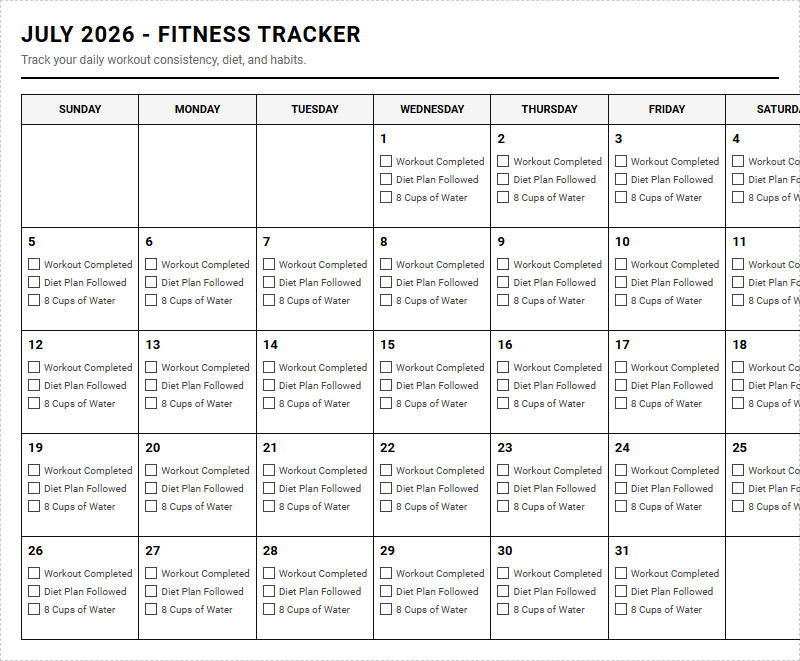
Many fitness enthusiasts struggle to sustain workout consistency, losing sight of incremental gains. While allocating standard funding sources to gym memberships provides a foundation, financial investment alone rarely guarantees habit formation.
Fortunately, a printable Fitness and Workout Progress Calendar grants a tangible visual feedback loop that digital apps lack. Under the stipulation of honest, daily self-reporting, this tool utilizes concrete strategies like the "don't break the chain" method to cement routines. Below, we outline how to leverage this calendar to systematically optimize your training.
Create Your Fitness and Workout Progress Calendar
| Sunday | Monday | Tuesday | Wednesday | Thursday | Friday | Saturday |
|---|
Done customizing?
Fitness and Workout Progress Calendar - Good to Know
Progressive overload
To stimulate continuous physiological adaptations, you must systematically challenge your body beyond its accustomed limits. This foundational athletic principle is known as progressive overload. Without a progressive increase in physical stress, muscle fibers adapt to the current stimulus and cease to grow or gain strength.
Implementing this strategy requires more than just adding heavy iron to a barbell. Athletes can manipulate several variables to achieve a progressive training stimulus, ensuring steady progression without risking injury:
- Resistance: Incrementally increasing the weight lifted.
- Repetitions: Performing more reps with the same resistance.
- Volume: Increasing the total number of sets per muscle group.
- Density: Shortening rest intervals between working sets.
- Tempo: Slowing down the eccentric phase to increase time under tension.
By carefully tracking these training variables in a detailed training log, you ensure that every workout forces your neuromuscular system to adapt, rebuild, and grow stronger over time.
Workout streak
Maintaining a continuous chain of scheduled training sessions builds profound psychological momentum. A workout streak shifts your mindset from sporadic, motivation-dependent exertion to an automated daily routine. When you view exercise as a non-negotiable daily appointment, the friction of decision-making disappears.
The behavioral science behind a successful streak involves positive reinforcement and habit loop preservation. Tracking your consecutive active days creates a visual representation of commitment that becomes increasingly difficult to break. To protect and sustain your streak over months or years, consider these strategies:
- Define a minimal viable effort for low-energy days (e.g., 10 minutes of mobility work).
- Use visual calendars or digital applications to track daily completion.
- Focus on consistency over perfection; a light active session keeps the streak alive.
By protecting your streak, you reinforce a powerful athletic identity, transforming fitness from a temporary goal into a permanent lifestyle anchor.
Deload week
Accumulated systemic fatigue can quietly degrade athletic performance, impair hormonal balance, and elevate injury risks. A deload week is a planned, temporary reduction in training volume and intensity designed to facilitate physiological recovery. Rather than stopping physical activity entirely, you step back to allow your joints, connective tissues, and central nervous system to fully recuperate.
"True progress does not happen during the workout itself; it occurs during the recovery periods when the body repairs and supercompensates."
During a typical deload, you cut your training volume by approximately 30% to 50% and reduce the working weights to about 60% of your normal intensity. This intentional reduction allows microscopic muscle tears to heal completely, replenishes depleted glycogen stores, and restores neurotransmitter sensitivity, ensuring you return to heavy training stronger, refreshed, and ready to break past previous performance plateaus.
Training volume
Training volume represents the total quantitative work performed during a specific timeframe, typically calculated on a weekly basis. It serves as one of the primary drivers of muscle hypertrophy and muscular endurance. Finding the optimal volume sweet spot is crucial for maximizing physical adaptation while avoiding the pitfalls of overtraining.
The basic mathematical formula used to calculate training workload is structured as follows:
| Variable | Description | Example Metric |
|---|---|---|
| Sets | The number of distinct exercise rounds. | 4 working sets |
| Reps | The repetitions performed per set. | 10 repetitions |
| Load | The amount of weight or resistance used. | 100 kilograms |
Adjusting this total workload allows athletes to fine-tune their programs for specific outcomes, balancing systemic fatigue against the recovery capabilities of their unique biology.
Active recovery
Sitting idle on rest days can actually prolong muscle soreness and delay metabolic clearance. Active recovery involves engaging in low-intensity, non-taxing physical activity that stimulates blood circulation without inducing additional muscular damage. This practice accelerates healing by delivering oxygenated, nutrient-rich blood directly to damaged muscle tissues.
By keeping your heart rate in a light aerobic zone, you facilitate the removal of metabolic cellular waste products that accumulate during intense training sessions. Ideal active recovery activities include:
- brisk walking in nature to lower stress hormones,
- easy cycling to flush metabolic waste from the quadriceps,
- dynamic mobility flows to restore joint range of motion,
- and lap swimming for low-impact, full-body vascular flow.
Using these low-intensity modalities ensures you stay mobile, reduce joint stiffness, and prepare your body to handle the demands of your next high-intensity training session.
Periodization microcycle
In structured athletic programming, periodization organizes long-term goals into manageable, highly focused time blocks. A microcycle is the smallest structural unit of this planning system, typically spanning a single week. It functions as the tactical building block for larger training phases, focusing on precise physical stimuli.
- Microcycle Focus
- The specific physiological quality targeted during the week, such as absolute strength, hyper-trophy, power development, or recovery.
- Daily Variation
- The strategic distribution of heavy, medium, and light training days to manage fatigue accumulation.
- Progression Tracking
- The micro-adjustments made to loading parameters based on immediate performance feedback.
By carefully designing each microcycle to build upon the last, coaches and athletes can systematically manipulate training stress, leading to predictable peaks in athletic performance and minimal risks of plateaus.
Rate of Perceived Exertion
The Rate of Perceived Exertion (RPE) is a subjective rating scale used to quantify the intensity of physical effort during exercise. Based on the modified Borg scale, it typically ranges from 1 to 10, with 1 representing absolute rest and 10 representing a maximal, all-out physical effort.
This auto-regulation tool allows lifters to adjust training weights dynamically based on real-time daily physiological readiness. For example, consider this practical application of the scale:
- RPE 7: The load is challenging, leaving exactly 3 repetitions in reserve.
- RPE 8: The effort is heavy, leaving exactly 2 repetitions in reserve.
- RPE 9: The set is extremely difficult, leaving only 1 repetition in reserve.
Utilizing RPE prevents injuries because it accounts for external stressors like poor sleep, nutritional deficits, or mental fatigue, keeping your workouts safe and highly productive.
Workout split
A workout split is an organizational framework that divides your training sessions by targeting specific muscle groups, movement patterns, or physical attributes on designated days of the week. This structured division ensures that every muscle group receives sufficient stimulation while allowing other tissues adequate time to rest and rebuild.
Choosing the right division depends on your training experience, availability, and specific fitness goals. Some of the most highly validated splits include:
- Push/Pull/Legs: Groups upper-body pushing, upper-body pulling, and lower-body movements.
- Upper/Lower: Alternates focused sessions between the upper and lower halves of the body.
- Full Body: Stimulates all major muscle groups during every single training session.
By organizing your weekly schedule around a scientifically structured split, you optimize muscle protein synthesis cycles and balance fatigue, ensuring consistent, injury-free physical progress.
Habit stacking
Establishing a consistent exercise routine can be difficult when relying purely on willpower. Habit stacking is a powerful cognitive behavioral strategy that simplifies this process by anchoring a new fitness habit to an established, automatic daily routine. Instead of trying to fabricate motivation, you leverage existing neural pathways.
"By linking your desires to pre-established habits, you create a seamless cascade of positive behavioral actions."
To implement this technique effectively, utilize a simple trigger formula: "After I [Current Habit], I will [New Fitness Habit]." For example, you might decide that after you pour your morning coffee, you will perform five minutes of active mobility stretches. By utilizing these highly predictable triggers, your new fitness habits require far less mental energy, gradually becoming automatic parts of your lifestyle.
Consistency index
While individual high-intensity workouts are satisfying, long-term physical transformation is determined by your consistency index. This analytical metric measures the percentage of scheduled workouts you actually complete over a defined timeframe, such as a month, quarter, or year. It prioritizes persistent effort over sporadic perfection.
A high consistency index is the single greatest predictor of athletic success. Consider the profound compounding benefits of maintaining steady training efforts:
- 90%+ Consistency: Triggers reliable, compounding physiological adaptations and rapid skill acquisition.
- 70% Consistency: Maintains current physical baselines but results in slow, erratic progress.
- Below 50% Consistency: Leads to detraining effects, stagnation, and frequent physical setbacks.
Shifting your primary focus from immediate, short-term results to maintaining a near-perfect consistency index ensures that your habits remain sustainable, leading to remarkable physical transformations over time.

Leave a comment