
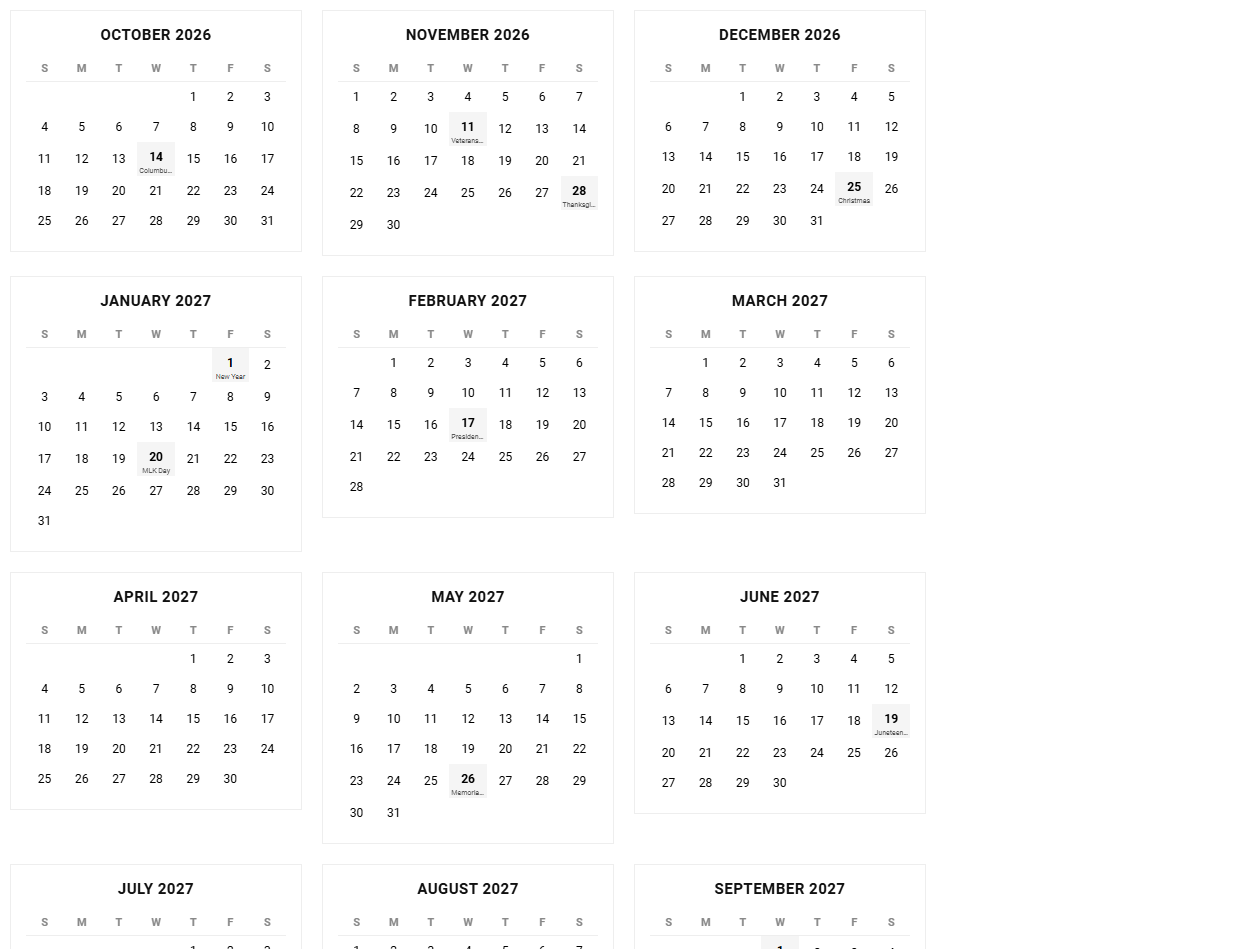
Aligning operational planning with financial reporting deadlines often creates chaotic scheduling bottlenecks for administrators. While funding sources like federal grants or corporate allocations dictate your cash flow, tracking these milestones alongside statutory holidays is notoriously difficult. Fortunately, a structured printable Fiscal Year Calendar grants teams the visibility needed to coordinate operations. Note that while fiscal cycles vary-such as July-to-June schedules-observances remain fixed. Below, we outline how to utilize these calendars to optimize your annual timeline.
Create Your Fiscal Year Calendar with Holidays
Done customizing?
Fiscal Year Calendar with Holidays - Good to Know
Fiscal Calendar Template
A structured fiscal calendar template serves as the financial backbone for any modern enterprise. Unlike a standard Gregorian calendar, this specialized framework aligns an organization's financial reporting with its actual business cycle. By defining custom start and end dates for the financial year, companies can track revenue, manage budgets, and generate reports that accurately reflect seasonal trends and operational patterns.
Implementing a standardized template offers several distinct advantages for accounting departments:
- Consistent Comparison: Facilitates accurate year-over-year financial analysis.
- Resource Allocation: Helps managers align staffing and inventory with historical peak periods.
- Stakeholder Transparency: Provides investors with predictable, scheduled financial disclosures.
Whether your organization begins its fiscal year in January, April, or October, utilizing a robust template ensures that your ledger remains balanced, compliant, and perfectly synchronized with your strategic corporate objectives throughout the entire twelve-month cycle.
4-4-5 Retail Calendar
The 4-4-5 retail calendar is a highly structured accounting method widely adopted within the retail, consumer goods, and manufacturing sectors. This system divides the calendar year into four equal quarters, with each quarter consisting of exactly 13 weeks. These 13 weeks are further broken down into three distinct multi-week periods: a four-week month, followed by another four-week month, and concluding with a five-week month.
This systematic division addresses a major flaw in the traditional calendar: the varying number of days and weekends in any given month. Under the 4-4-5 framework:
- Every corresponding period has the exact same number of weekends, which is crucial since retail sales spike dramatically during Saturdays and Sundays.
- Comparing March sales directly to February sales becomes mathematically logical and highly actionable.
By eliminating calendar shift, inventory planners and financial analysts can forecast demand with superior precision.
Federal and Bank Holidays
Navigating the complex landscape of federal and bank holidays is critical for maintaining seamless financial transactions and payroll schedules. These designated days, recognized by the national government and the central banking system, result in the closure of major financial institutions, stock exchanges, and federal agencies. Consequently, electronic funds transfers, wire processing, and automated clearing house (ACH) settlements are routinely paused.
To avoid costly liquidity shortages or delayed employee compensation, treasury departments must proactively integrate these dates into their cash flow forecasting models. Planning around these closures requires a multi-step approach:
- Adjusting payroll submission deadlines to ensure early processing.
- Scheduling vendor payments around non-transactional banking days.
- Communicating potential delays to international clients unfamiliar with localized holidays.
Proactive management of these holiday closures preserves organizational credibility and prevents unexpected operational disruptions.
Tax Deadline Calendar
An accurate tax deadline calendar is an indispensable compliance tool designed to protect businesses from severe financial penalties, interest charges, and costly state or federal audits. Throughout the fiscal year, corporations are subject to a continuous stream of filing obligations, including corporate income tax, quarterly estimated taxes, sales and use taxes, and employee payroll withholdings. Missing a single filing milestone can jeopardize a company's financial standing and reputational integrity.
Maintaining compliance requires a highly organized tracking system that highlights critical dates for diverse tax authorities, such as the Internal Revenue Service (IRS) and local municipal agencies. Organizations should implement automated digital reminders and establish a clear internal workflow for document gathering. By systematically preparing tax provisions months in advance, financial officers can optimize deductions, manage cash reserves efficiently, and maintain a seamless relationship with regulatory bodies.
13-Period Accounting Calendar
The 13-period accounting calendar offers an innovative alternative to the traditional twelve-month system by dividing the fiscal year into exactly 13 equal periods of 28 days each. Because every period consists of precisely four weeks, each reporting interval begins and ends on the exact same day of the week. This structural consistency completely eliminates the reporting anomalies caused by months of unequal lengths and varying weekend distributions.
This accounting structure is particularly beneficial for businesses with high-frequency transactions, such as restaurants, lodging, and retail operations. The primary advantages include:
- Perfect alignment of weekly payroll cycles with monthly operational reporting.
- Simplified cost allocations for recurring fixed expenses like rent and utilities.
- More accurate operational KPIs that reflect genuine consumer behavior rather than calendar quirks.
This methodology empowers decision-makers with highly comparable data across all intervals.
Quarterly Planning Calendar
A dynamic quarterly planning calendar serves as a bridge between high-level long-term strategy and daily operational execution. By breaking the fiscal year into manageable 90-day increments, organizations can establish clear Key Performance Indicators (KPIs) and track progress without becoming overwhelmed by the scope of annual objectives. This cycle encourages teams to remain agile, pivoting quickly in response to shifting market conditions and competitive pressures.
During each quarterly cycle, leadership teams should schedule dedicated checkpoints to review performance, reallocate capital, and refine marketing or product development roadmaps. Dividing major initiatives into distinct quarterly milestones ensures accountability across all departments. This disciplined pacing maintains corporate momentum, fosters continuous improvement, and ensures that cross-functional teams remain highly collaborative and focused on achieving the organization's most critical strategic milestones before the year draws to a close.
Financial Year-End Schedule
The financial year-end schedule is a rigorous, high-stakes timeline that guides an accounting department through the complex process of closing the general ledger. This critical period involves a comprehensive reconciliation of all accounts, physical inventory audits, asset depreciation calculations, and the finalization of balance sheets and income statements. Accurate year-end closing is essential for producing reliable financial reports for auditors, lenders, and shareholders.
To ensure a smooth transition into the next fiscal cycle, organizations must adhere to a strict sequence of operational milestones:
- Reconciling bank accounts and resolving outstanding transaction discrepancies.
- Reviewing accounts receivable to identify and write off bad debt.
- Verifying accounts payable to ensure all liabilities are properly recorded.
Establishing a comprehensive checklist minimizes errors, accelerates the external audit process, and ensures strict compliance with standard accounting principles.
Corporate Holiday Calendar
A well-defined corporate holiday calendar is a vital component of human resource management and employee engagement strategies. This calendar outlines the specific paid days off, observational holidays, and corporate closures that an organization officially recognizes throughout the calendar year. Transparently communicating these dates well in advance helps employees balance their professional duties with personal commitments, which significantly boosts overall workplace morale and productivity.
Beyond employee satisfaction, this calendar is essential for operational planning. HR departments must align corporate holidays with regional labor laws and industry standards to maintain competitive benefits packages. Simultaneously, operational managers must coordinate shift schedules, customer support availability, and project deadlines around these planned closures. By balancing employee rest with operational continuity, businesses maintain a healthy workplace culture while consistently meeting client obligations and service level agreements.
Government Fiscal Year
The government fiscal year dictates the budget cycles, funding allocations, and procurement schedules for public sector entities and defense contractors. In the United States, for example, the federal government's fiscal year begins on October 1st and concludes on September 30th of the following calendar year. This specific timing influences trillions of dollars in public spending, grant distributions, and legislative appropriations across various federal agencies.
For private businesses, particularly those operating within government contracting, understanding this unique calendar is crucial for capturing revenue. The final quarter of the government fiscal year often sees a surge in public spending, colloquially known as the "use-it-or-lose-it" period, as agencies rush to obligate remaining budgetary funds. Aligning your sales pipeline and proposal submission schedules with this public sector cycle is a strategic necessity for securing valuable government contracts.
Operational Calendar
An operational calendar is the primary blueprint that coordinates the daily physical activities, supply chain logistics, and production schedules of an enterprise. While financial calendars focus on monetary reporting, the operational calendar concentrates on resource utilization, physical capacity, and output deadlines. It serves as the single source of truth for manufacturing facilities, warehousing operations, logistics coordinators, and frontline service delivery teams.
Integrating the operational calendar with broader financial and sales calendars is essential for maximizing corporate efficiency. This integration ensures that raw material deliveries align with scheduled production runs, preventing costly warehouse bottlenecks or project delays. Furthermore, a visible operational calendar allows managers to proactively plan maintenance downtime, schedule safety training, and optimize staffing levels. It transforms high-level corporate strategy into organized, daily execution on the facility floor.
Leave a comment