
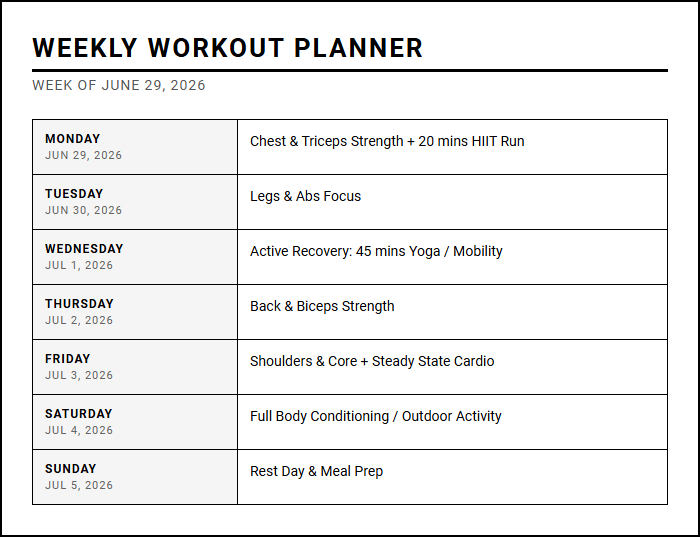
Maintaining fitness consistency is a perpetual struggle for many. While digital tracking apps offer automated reminders, they often lack the immediate physical presence required to build lasting habits. A physical Habit & Fitness Trackers printable calendar grants the tangible visual accountability crucial for daily momentum. Success with this tool, however, stipulates a disciplined daily commitment to manual logging-a practice utilized by competitive cross-trainers to maintain peak performance. Below, we break down how this Weekly Workout Planner optimizes your routine for sustainable success.
Create Your Weekly Workout Planner
Done customizing?
Weekly Workout Planner - Good to Know
Progressive overload
Progressive overload is the foundational cornerstone of strength training and muscle hypertrophy. To force an adaptive response from musculoskeletal tissues, you must subject them to tension levels they have not previously experienced. This continuous adaptation is achieved by systematically manipulating training variables over time, ensuring the body never fully acclimates to a specific workload.
Athletes can implement this principle through several structured methodologies:
- Increasing the absolute resistance or weight lifted on the barbell.
- Adding more repetitions or completed sets within a specific training session.
- Improving execution quality by slowing down the movement and enhancing form.
- Decreasing rest intervals to force greater metabolic efficiency.
Consistently tracking these variables ensures that your training stimulus remains challenging, driving long-term physiological improvements in bone density, connective tissue integrity, and overall muscular power.
Push-pull-legs split
The Push-pull-legs (PPL) split is a highly effective, anatomically logical training split designed to maximize recovery and optimize hypertrophic stimulation. By grouping muscles based on their mechanical functions, this split allows complete synergy during workouts while ensuring designated muscle groups rest completely on alternating days.
The standard rotation typically divides training sessions into three specific categories:
- Push: Targeting the pectorals, anterior deltoids, and triceps using pressing motions.
- Pull: Focusing on the latissimus dorsi, rhomboids, rear deltoids, and biceps through rowing variations.
- Legs: Dedicating a full session to the quadriceps, hamstrings, glutes, and calves.
This layout prevents overlapping fatigue. Because the biceps are rested during push days and triceps are rested during pull days, athletes can train with high intensity during consecutive sessions without risking systemic overtraining or acute joint stress.
Active recovery
Active recovery involves engaging in low-intensity, non-taxing physical activity to facilitate the healing of damaged muscle fibers. Unlike passive rest, which relies on complete immobility, active recovery keeps the heart pumping at a gentle rate. This moderate elevation in blood circulation delivers oxygen-rich blood and vital nutrients to fatigued tissues while accelerating the removal of metabolic waste products accumulated during intense exercise.
"Movement is medicine. Low-impact aerobic movement increases systemic lymphatic flow, allowing athletes to return to their primary sports with reduced soreness."
Ideal active recovery modalities include leisurely walking, mobility drills, cycling at a conversational pace, or swimming laps. Keeping these sessions strictly below the anaerobic threshold ensures the central nervous system recovers fully, preparing the body for the upcoming high-intensity training cycle without adding residual structural damage.
Zone 2 cardio
Zone 2 cardio refers to aerobic exercise performed at an intensity where lactate clearance matches lactate production, corresponding to roughly 60% to 70% of an individual's maximum heart rate. This intensity allows you to maintain a steady conversation without gasping for breath, relying almost exclusively on the aerobic energy pathway.
Prioritizing this low-intensity zone offers profound cardiovascular adaptations:
- Significantly increases mitochondrial density within slow-twitch muscle fibers.
- Enhances the heart's stroke volume, allowing more blood to pump per beat.
- Improves metabolic flexibility by teaching the body to oxidize fat as a primary fuel source.
Establishing a robust aerobic base through Zone 2 training decreases resting heart rate and accelerates recovery between heavy strength sets, creating an efficient cardiovascular foundation for athletes of all disciplines.
Deload week
A deload week is a planned, temporary reduction in training volume and intensity designed to alleviate systemic fatigue. Heavy, structured resistance training places immense stress not only on skeletal muscles but also on the central nervous system, joints, tendons, and ligaments. Over time, this cumulative stress can lead to plateaued performance, hormonal imbalances, and overuse injuries.
Implementing a deload involves reducing overall working sets by roughly 30% to 50% or dropping the working weights to about 60% of your maximum capability. This brief period of active decompression allows microscopic joint damage to heal and restores hormonal baselines. Consequently, taking a structured step back every four to eight weeks preserves career longevity and prepares your neuromuscular system to handle progressive, heavier loads with renewed vigor during the subsequent training block.
Hybrid training
Hybrid training is a physical preparation philosophy that simultaneously targets multiple, often contrasting fitness qualities. Instead of focusing solely on powerlifting or dedicating oneself entirely to endurance sports, a hybrid athlete balances strength, muscular hypertrophy, and aerobic capacity. This multidimensional approach challenges the traditional "interference effect" by proving that human physiology can adapt to diverse physical demands concurrently.
Achieving this balance requires precise planning and recovery management:
- Structuring running workouts far enough from heavy leg training to prevent joint strain.
- Consuming adequate carbohydrates to fuel both endurance and strength sessions.
- Prioritizing sleep to allow the body to synthesize adaptations from different stimuli.
This methodology builds resilient, highly functional individuals capable of running a marathon and deadlifting heavy weights within the same weekly training cycle.
Rate of perceived exertion
The Rate of Perceived Exertion (RPE) scale is a subjective measurement of exercise intensity, commonly utilizing the modified Borg scale of 1 to 10. In modern strength training, RPE is closely tied to "reps in reserve" (RIR). For instance, an RPE of 8 indicates that an athlete completed a set with exactly two repetitions remaining in the tank before reaching absolute muscular failure.
This system provides a framework for autoregulation, which is crucial for managing daily performance fluctuations:
- An RPE of 10 represents maximum effort with zero reps left.
- An RPE of 9 indicates one rep left in reserve.
- An RPE of 8 signifies two reps remaining.
- An RPE of 7 indicates three reps remaining.
By relying on biofeedback rather than static percentages, RPE helps prevent overtraining on days when external stressors, poor sleep, or inadequate nutrition have lowered your physical work capacity.
Mobility flow
A mobility flow is a sequence of active movements designed to increase the functional range of motion around joints. Unlike static stretching, which lengthens muscles passively, mobility flows involve continuous movement through complete physiological pathways. This dynamic movement pattern activates stabilizing muscles, lubricates joint capsules with synovial fluid, and enhances neuromuscular coordination.
Incorporating a daily sequence brings several immediate physical benefits:
- Alleviates chronic tightness from prolonged sedentary behavior.
- Prepares the central nervous system for explosive movements.
- Enhances proprioception, allowing for safer, deeper squats and overhead presses.
By linking movements such as deep lunges, thoracic spine rotations, and hip openers, athletes can maintain joint health, reduce injury risks, and establish an optimal path for force transfer during intense, load-bearing exercises.
Periodization
Periodization is the systematic planning of athletic training to reach peak performance during a specific competition window or phase. By dividing a long-term training program into distinct, manageable blocks, coaches can manipulate volume, intensity, and specificity to maximize physiological adaptations while minimizing the risk of overtraining.
A classic periodization structure is divided into three distinct cycles:
- Macrocycle: The entire training year or multi-year plan focusing on the ultimate goal.
- Mesocycle: A block lasting several weeks, focusing on a specific attribute like hypertrophy, strength, or power.
- Microcycle: A weekly training unit detailing daily exercises, sets, and recovery periods.
This structured progression ensures that strength is systematically built upon a foundation of muscular volume, which is then refined into peak power and sports-specific execution.
Time under tension
Time under tension (TUT) refers to the total duration a muscle group is held under strain during a set of an exercise. This metric is controlled by manipulating the tempo of each repetition, which consists of the eccentric (lowering), isometric (pause), and concentric (lifting) phases of a movement. For example, a squat performed with a 4-second descent, a 2-second pause, and a 1-second ascent maximizes the mechanical load on the quadriceps.
By intentionally slowing down repetitions, you can maximize localized metabolic stress and trigger micro-tears in the muscle fibers, both of which are key drivers of hypertrophy. Managing TUT ensures that momentum does not take over the lift, keeping the targeted musculature fully engaged through the entire range of motion to secure optimal growth and strength adaptations.
Leave a comment