
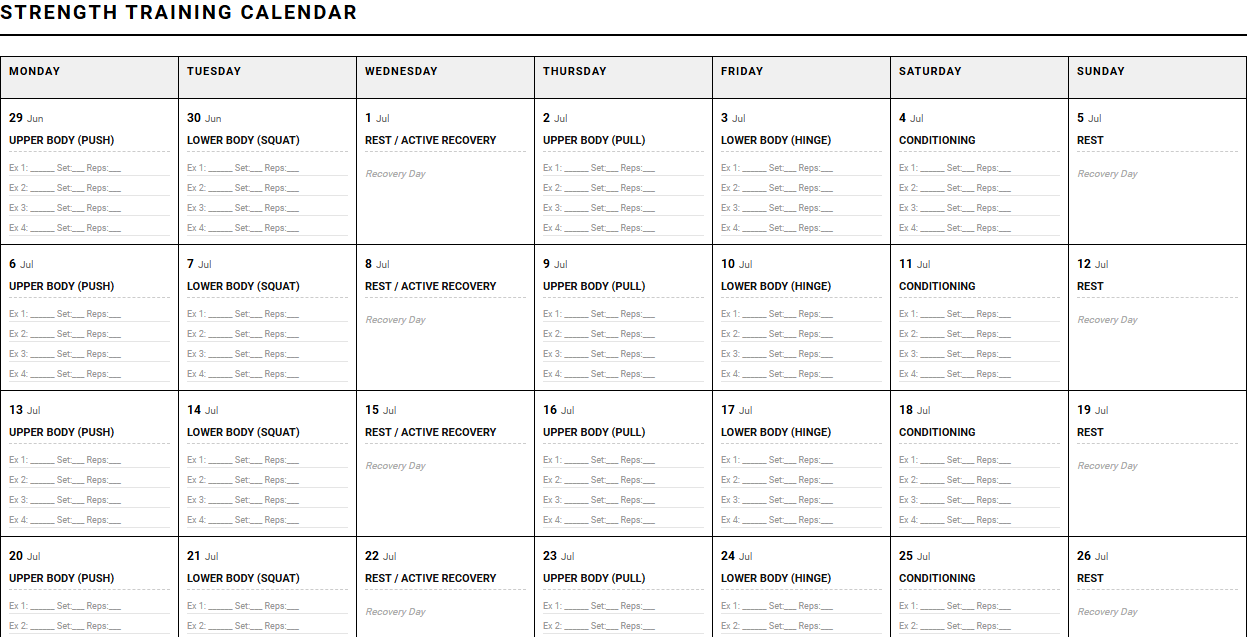
Consistency in strength training is notoriously difficult to maintain when progress stalls. While many lifters rely on complex mobile apps, these often cause screen distraction. A dedicated printable calendar tracker provides immediate visual accountability, though its efficacy requires daily, honest logging. By systematically tracking metrics like progressive overload, target reps, and RPE, you establish clear patterns of growth. Below, we examine how to leverage this printable tool to optimize your lifting routine.
Create Your Strength Training Tracker
Done customizing?
Strength Training Tracker - Good to Know
Progressive overload
The foundation of all athletic progression relies on progressive overload. This fundamental principle dictates that the human body must be subjected to a physiological demand greater than what it has previously experienced to stimulate adaptation. Simply repeating the exact same workout weekly leads to stagnation rather than growth.
Athletes can implement this law of training through several variables:
- Intensity: Gradually increasing the resistance or weight on the barbell.
- Volume: Performing additional repetitions or adding sets to an exercise.
- Density: Shortening rest periods to force the muscles to recover faster.
- Frequency: Increasing the number of times a specific movement pattern is trained weekly.
By systematically manipulating these metrics, trainees trigger ongoing hypertrophy and strength gains. Consistent, incremental improvements ensure that the neuromuscular system is continuously challenged, forcing the muscle fibers to repair, rebuild, and grow stronger over time.
One-Rep Max calculator
A One-Rep Max (1RM) calculator serves as an invaluable tool for strength athletes, allowing them to estimate their maximal lifting capacity without the physical toll of a true maximum effort lift. Testing a true 1RM can disrupt central nervous system recovery and increase injury risk, making mathematical estimations highly practical.
These calculators utilize established scientific formulas, such as the Epley or Brzycki equations, to project maximum strength. For instance, the Epley formula calculates 1RM using the following structure:
1RM = w * (1 + r / 30), where w is the weight lifted and r is the number of repetitions completed.
By entering submaximal training data-such as lifting 225 pounds for 5 repetitions-the calculator provides a reliable benchmark. Coaches use these estimations to design percentage-based training programs, ensuring that athletes train at precise intensities tailored to their current physiological capabilities.
Rate of Perceived Exertion
The Rate of Perceived Exertion (RPE) scale is a subjective measurement of exercise intensity, helping athletes auto-regulate their workouts. Originally adapted from the Gunnar Borg scale, modern strength training utilizes a modified 1-to-10 system popularized by powerlifting coach Mike Tuchscherer.
Each numerical value corresponds directly to the level of difficulty experienced during a set:
- RPE 10: Maximal effort; no additional repetitions could be performed.
- RPE 9: Highly strenuous; exactly one repetition was left in the tank.
- RPE 8: Heavy; two more repetitions could have been completed.
- RPE 7: Moderate; three repetitions remained before failure.
Using RPE allows lifters to adjust training weights based on daily readiness. Factors like sleep, stress, and nutrition affect performance, and RPE ensures that a target intensity is met even when strength fluctuates day to day.
Reps in Reserve
Closely aligned with the RPE scale, Reps in Reserve (RIR) is a practical metric used to quantify proximity to muscular failure. RIR asks a simple question: "How many more clean reps could you have performed before your muscles failed?" If a lifter finishes a set of squats and determines they could have done two more reps, they have trained at 2 RIR.
This tracking method is highly effective for hypertrophy-focused training. Research indicates that sets carried within a range of 1 to 3 RIR maximize muscle protein synthesis while keeping systemic fatigue manageable. Training constantly to absolute failure (0 RIR) increases recovery time exponentially without offering proportional benefits in muscle growth.
Implementing RIR empowers trainees to maintain high-quality movement patterns, safeguard joint health, and accumulate the necessary training volume required for long-term athletic development without overtraining.
Velocity-Based Training
Velocity-Based Training (VBT) represents a technological evolution in strength coaching, moving beyond subjective feedback to objective data. By utilizing linear position transducers, accelerometers, or camera-based systems, VBT tracks the precise speed of the barbell during a lift, measured in meters per second (m/s).
Barbell velocity corresponds directly with load and fatigue. For example, as a lifter approaches failure, concentric speed decreases in a predictable pattern. VBT offers several advantages:
- Real-time feedback: Knowing the speed of each rep motivates athletes to maximize intent.
- Fatigue monitoring: A sudden drop in velocity warns of systemic exhaustion.
- Load adaptation: If the bar moves faster than expected, the system prompts a weight increase.
By measuring velocity profiles, coaches can target specific physiological traits, such as explosive power, starting strength, or absolute strength, with extreme precision.
Volume load tracking
To quantify total physical work, serious trainees rely on volume load tracking. This metric measures the total tonnage lifted during a training session or week. The basic equation for volume load is simple: Sets × Repetitions × Weight. For instance, performing 3 sets of 10 repetitions at 200 pounds results in a volume load of 6,000 pounds.
Tracking this cumulative tonnage provides a clear bird's-eye view of an athlete's progress over months of training. It prevents the common pitfall of assuming progress is only made by adding weight to the bar. Increasing volume load through additional sets or repetitions is equally viable for promoting muscular hypertrophy.
However, volume load must be monitored carefully. Uncontrolled increases in weekly volume can exceed the body's recovery capacity, leading to overuse injuries, joint strain, and chronic fatigue.
Mesocycle planning
Effective training requires structure, which is where mesocycle planning becomes crucial. A mesocycle represents a specific block of training, typically lasting four to six weeks, designed to develop a particular physical attribute such as hypertrophy, strength, or power. It sits between microcycles (weekly plans) and macrocycles (annual plans).
A standard mesocycle follows a structured progression:
- Introduction: Establishing a baseline and adapting to the exercises.
- Accumulation: Gradually increasing intensity or volume week over week.
- Overreach: Pushing the body to its adaptive limits in the final week.
- Deload: A planned reduction in training volume to allow for supercompensation and recovery.
This cyclical approach prevents training plateaus. By systematically shifting focus and scheduling recovery blocks, athletes can continually make progress without burning out.
Personal Record tracker
A Personal Record (PR) tracker is more than a list of achievements; it is a psychological driver and a vital diagnostic tool. In strength training, PRs can be categorized into absolute strength PRs (one-rep maxes) and rep PRs (e.g., a personal best weight for five repetitions).
Documenting these milestones allows athletes to visualize their strength trajectory over time. It provides tangible evidence that a training program is working, boosting confidence during challenging workouts. Furthermore, a PR tracker helps identify when progress has stalled, signaling that it is time to alter the program variables or schedule a deload week.
Modern training systems automatically calculate estimated 1RM PRs from submaximal sets, celebrating minor progress and keeping athletes highly engaged and motivated to achieve their next level of performance.
Workout log app
Transitioning from traditional pen-and-paper logs to a digital workout log app has revolutionized how lifters manage their training data. These applications offer streamlined data entry, instant calculations, and interactive visualizations of training progress over time.
A high-quality workout log app provides several key features:
- Historical data retrieval: Easily view past performances of any exercise.
- Rest timers: Built-in countdowns to keep training sessions efficient.
- Plate calculators: Instant graphics showing exactly which plates to load onto the bar.
- Data exporting: The ability to share training logs directly with a coach or trainer.
By removing the friction of manual tracking, these apps allow lifters to focus entirely on their physical execution. Accurate digital logs serve as a permanent archive, providing deep insights into long-term athletic trends.
Muscle group split analysis
A muscle group split analysis evaluates how training volume is distributed across different anatomical regions of the body over a training cycle. Whether utilizing a Full Body, Upper/Lower, or Push/Pull/Legs layout, balancing volume distribution is vital for balanced muscular development and injury prevention.
An effective split analysis monitors key structural metrics:
- Weekly set count: Ensuring each muscle group receives optimal stimulation (typically 10-20 sets per week).
- Antagonist balance: Keeping a healthy ratio of pushing movements to pulling movements to protect joint health.
- Recovery windows: Verifying that targeted muscle groups have at least 48 hours of rest before being trained again.
Evaluating these patterns prevents under-training lag and protects against over-training injuries, ensuring that the body adapts symmetrically and efficiently.
Leave a comment