
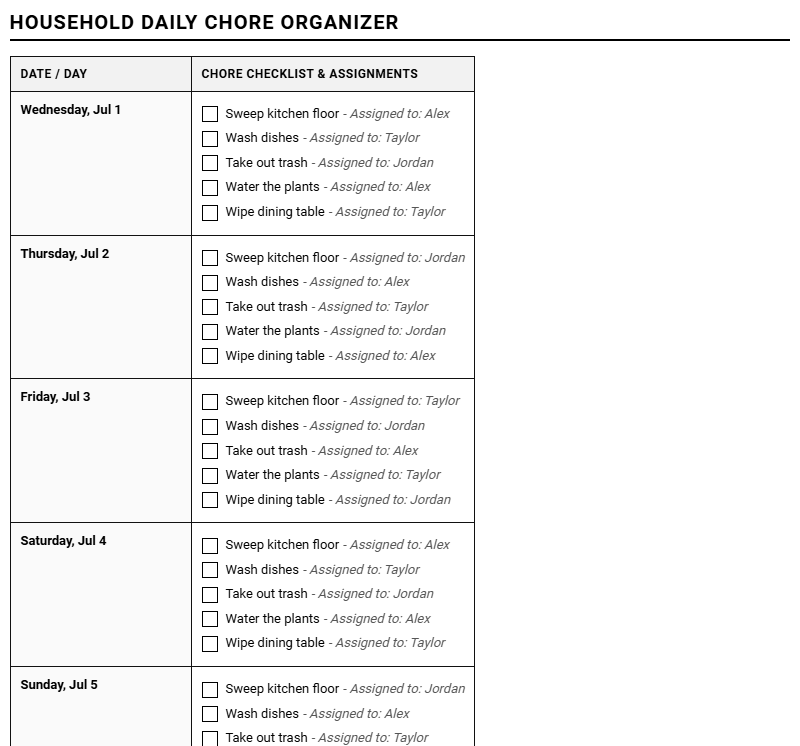
Managing a household can feel like an endless, overwhelming cycle of chaotic chores. While standard digital calendars offer basic scheduling, they often fail to streamline complex domestic routines. A dedicated Daily Agendas printable calendar grants families the visual structure needed to restore domestic order. However, effective organization requires the stipulation that you establish realistic daily expectations. By implementing specific templates like zone-cleaning schedules and daily chore rotations, you can maintain a balanced home. Below, we explore how to optimize your household organizer for lasting efficiency.
Create Your Chore And Household Daily Organizer
Done customizing?
Chore And Household Daily Organizer - Good to Know
Fair Play Method
The Fair Play Method, created by Eve Rodsky, revolutionizes how domestic labor is divided at home. Instead of simply splitting tasks, this system focuses on the concept of total task ownership. This means one person is responsible for the conception, planning, and execution of a card, or chore, rather than just doing the physical labor when asked.
By using a metaphorical deck of cards, couples can visual and reallocate domestic burdens. This approach effectively minimizes resentment and fosters a cooperative partnership. Key elements of this system include:
- Visualizing the Deck: Identifying all hidden household tasks, from pet care to holiday planning.
- Defining Minimum Standards: Establishing agreed-upon expectations for how and when a task is completed.
- Card Reallocation: Regularly transferring cards based on individual capacity and current life circumstances.
Implementing this framework shifts the household dynamic from micromanagement to true, respectful collaboration, allowing both partners to thrive.
Family Command Center
A Family Command Center acts as the central nervous system of a busy household. Strategically placed in a high-traffic area, such as the kitchen or entryway, this physical hub organizes schedules, mail, meal plans, and daily reminders. It bridges the gap between digital schedules and physical coordination for family members of all ages.
To build an efficient command center, consider integrating these functional components:
- A Large Calendar: A color-coded monthly calendar displaying school events, appointments, and deadlines.
- Mail Sorters: Labeled bins for incoming mail, school permission slips, and bills.
- A Dry-Erase Board: A space for immediate weekly menus, grocery lists, and quick family notes.
By consolidating administrative tasks into one visible location, you reduce morning chaos. This dedicated space ensures that every family member stays informed, prepared, and aligned with daily expectations.
FlyLady System
The FlyLady System, developed by Marla Cilley, is a beloved housekeeping methodology that prioritizes progress over perfection. Designed for those feeling overwhelmed by clutter, it breaks home maintenance down into manageable, bite-sized routines. The philosophy encourages practitioners to take "baby steps" to build sustainable, lifelong habits.
The system is anchored by several core principles that simplify daily housekeeping:
- Shining Your Sink: A simple daily ritual that serves as a visual anchor for a clean home.
- 27-Fling Boogie: A rapid decluttering exercise where you quickly discard or donate 27 items.
- 15-Minute Timers: Working in short, focused bursts to prevent physical and mental burnout.
By eliminating the pressure of marathon cleaning sessions, this structured routine helps individuals establish a peaceful, self-reinforcing rhythm that gradually transforms chaotic spaces into serene sanctuaries.
Daily Reset Routine
A Daily Reset Routine is a deliberate, short sequence of tasks designed to restore your living space to a functional baseline. Rather than a deep clean, this routine focuses on tidying up the high-impact areas of your home, ensuring that you wake up or return to a peaceful environment. It acts as a transitional buffer between different phases of the day.
Implementing a successful daily reset involves focusing on high-priority zones:
- The Kitchen Countertops: Clearing dishes, wiping down surfaces, and emptying the sink.
- High-Traffic Floors: A quick sweep or vacuum of the main living room and entryway.
- Surface Decluttering: Returning misplaced toys, mail, and cups to their designated homes.
Spending just fifteen to twenty minutes on these tasks each evening prevents clutter from accumulating, significantly lowering stress levels and preparing your home for the day ahead.
Zone Cleaning
The concept of Zone Cleaning involves dividing your home into distinct physical areas and rotating deep-cleaning efforts through them on a scheduled basis. Instead of attempting to clean the entire house in a single, exhausting day, you focus your deep-cleaning energy on one specific zone each week, while maintaining the rest of the home with basic daily habits.
A typical monthly zone rotation might look like this:
- Week 1: The entryway and front porch.
- Week 2: The kitchen, pantry, and dining area.
- Week 3: The bathrooms and guest bedrooms.
- Week 4: The master bedroom and main living spaces.
This systematic approach guarantees that every corner of your home receives thorough attention over a month-long cycle, keeping dirt and clutter from building up without demanding your entire weekend.
Mental Load Delegation
Addressing Mental Load Delegation is crucial for creating harmony in any shared household. The mental load refers to the invisible cognitive labor of running a home-planning, organizing, predicting needs, and keeping track of deadlines. True delegation requires transferring the cognitive responsibility of a task, not just the physical execution.
To successfully delegate the mental load, households should adopt specific strategies:
- Identify Invisible Tasks: Write down all planning duties, like scheduling doctor appointments or tracking grocery supplies.
- Delegate Entire Projects: Hand over complete ownership of a category, such as meal planning, from research to grocery shopping.
- Build Trust: Allow the delegated partner to execute the task in their own way without constant oversight.
By restructuring how tasks are conceived and managed, families can achieve a fair division of emotional and cognitive labor, preventing chronic caregiver burnout.
Gamified Chores
Using Gamified Chores transforms boring household maintenance into an engaging, interactive experience for both children and adults. By applying game-design elements like points, levels, challenges, and rewards to daily cleaning tasks, households can boost intrinsic motivation and inject fun into otherwise monotonous routines.
You can easily gamify your household duties through several creative methods:
- Point-Based Systems: Assign points to tasks based on difficulty, which can be redeemed for fun privileges.
- Beat-the-Clock Challenges: Setting a timer and trying to finish a chore before the alarm sounds.
- Mystery Chores: Writing chores on cards with hidden rewards or fun twists on the back.
Gamification turns routine tasks into cooperative play, helping children develop responsibility while maintaining a clean, organized home. This playful approach replaces nagging with excitement, fostering a lighthearted household dynamic.
Chore Rotation Schedule
A Chore Rotation Schedule prevents resentment and burnout by ensuring that household tasks are distributed fairly over time. Instead of permanently assigning unpopular chores to a single person, a rotating schedule distributes these tasks equally among all household members. This cultivates shared responsibility and teaches everyone valuable life skills.
To design an effective chore rotation system, follow these structured steps:
- Categorize by Frequency: Group chores into daily, weekly, and monthly tasks.
- Establish Rotation Intervals: Swap assignments weekly or bi-weekly to keep routines fresh and fair.
- Accommodate Preferences and Skills: Match chores to ages and abilities while maintaining equity.
A transparent, rotating schedule removes ambiguity and prevents arguments over who does what. It ensures the home runs smoothly while teaching the valuable lesson that keeping a home clean is a collective team effort.
Time Blocking
Time Blocking is a highly productive time-management method that involves dedicating specific blocks of time to targeted household chores. Rather than cleaning haphazardly throughout the day, you allocate fixed, uninterrupted periods for specific maintenance tasks, allowing for deep focus and efficient execution.
A well-structured time-blocking schedule might include the following segments:
- The Morning Block (20 mins): Unloading the dishwasher, making beds, and starting a load of laundry.
- The Focused Cleaning Block (45 mins): Concentrating entirely on vacuuming, dusting, and wiping down bathrooms.
- The Evening Block (15 mins): Returning items to their designated places and preparing coffee for the morning.
By scheduling cleaning tasks as non-negotiable appointments, you prevent chores from expanding to fill your entire day. This approach gives you back control over your personal schedule, leaving more time for relaxation.
Digital Chore Board
A Digital Chore Board modernizes household organization by moving task management to smart devices. Using shared apps, task managers, or family organizer platforms, households can track responsibilities, set recurring reminders, and coordinate schedules in real-time, whether at home or on the go.
Transitioning to a digital system offers several distinct advantages for modern families:
- Automated Reminders: Push notifications remind family members of their scheduled tasks without the need for constant nagging.
- Shared Accountability: Live progress tracking allows everyone to see completed chores instantly.
- Centralized Notes: Attach specific instructions, grocery lists, or feedback directly to individual tasks.
Integrating technology into household management streamlines communication, reduces paper clutter, and provides a clear, collaborative platform that adapts to the busy schedules of modern life.
Leave a comment