
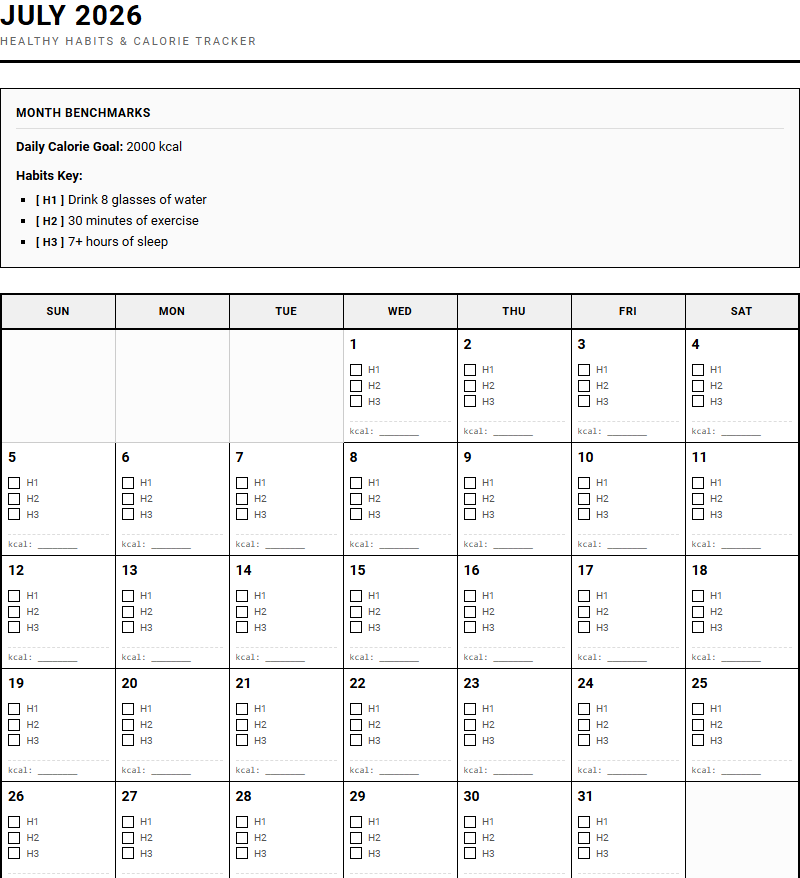
Maintaining consistent healthy eating and calorie tracking amidst a chaotic family schedule is a persistent struggle for busy households. While families often look to traditional health investments-such as paid nutrition apps or premium coaching-as primary resources, true success requires a practical foundation. Our printable Healthy Habits Calendar grants immediate, visual structure to daily routines. Mindful of the stipulation that lasting change requires incremental commitment, this guide uses concrete examples like macro-target logging to outline the strategic setup detailed below.
Create Your Healthy Habits and Calorie Tracking Calendar
Done customizing?
Healthy Habits and Calorie Tracking Calendar - Good to Know
Calorie deficit
Achieving a calorie deficit is the fundamental cornerstone of weight reduction. This physiological state occurs when the energy you expend exceeds the energy you consume through food and beverages. To establish a sustainable deficit, individuals must accurately calculate their baseline energy needs and adjust their daily intake accordingly.
Rather than adopting extreme restrictions, a moderate deficit of 300 to 500 calories per day promotes safe, long-term fat loss while preserving vital lean muscle tissue. Combining dietary adjustments with increased physical activity optimizes this metabolic process.
- Metabolic Rate: Your body pulls from stored fat reserves to bridge the energy gap.
- Sustainability: Gentle deficits prevent the severe hunger cues that trigger overeating.
- Composition: Pair this deficit with resistance training to ensure you lose fat, not muscle tissue.
Consistently maintaining this balance allows the body to systematically tap into adipose tissue for fuel, leading to gradual and permanent body composition improvements.
Habit stacking
Building a healthier lifestyle relies heavily on behavioral psychology, where habit stacking serves as an incredibly effective strategy. This method involves anchoring a new, desired behavior onto an existing, deeply ingrained daily routine. By leveraging established neural pathways, you eliminate the cognitive friction associated with starting a new habit from scratch.
For instance, if you already drink a cup of coffee every morning, you can stack a new habit of drinking a full glass of water immediately beforehand. This sequence creates a seamless transition that requires minimal willpower.
- Identify an unbreakable current daily anchor, such as brushing your teeth.
- Define the new positive action clearly, like performing five air squats.
- Link them directly: "After I brush my teeth, I will immediately do five squats."
Over time, these stacked behaviors compound, transforming complex lifestyle changes into automatic, effortless rituals that support your long-term wellness goals.
Macronutrient tracking
While managing energy intake is crucial, the specific sources of those calories dictate your body composition and overall vitality. Macronutrient tracking involves monitoring the daily intake of proteins, carbohydrates, and dietary fats to optimize physical performance and metabolic health.
Protein is essential for muscle repair, immune function, and satiety. Carbohydrates provide the primary fuel source for high-intensity exercise and brain function, while dietary fats regulate hormone production and nutrient absorption. Balancing these three macronutrients ensures your body functions optimally during periods of body recomposition.
- Proteins: Aim for lean meats, fish, tofu, and legumes to support muscle synthesis.
- Carbohydrates: Focus on complex fibers like oats, quinoa, and nutrient-dense vegetables.
- Fats: Incorporate monounsaturated sources such as avocados, olive oil, and raw nuts.
Tailoring these ratios to your specific activity level and metabolic profile enhances recovery, stabilizes energy fluctuations, and prevents muscle degradation.
TDEE logging
Your Total Daily Energy Expenditure (TDEE) represents the cumulative number of calories your body burns in a twenty-four-hour period. This figure comprises your basal metabolic rate, the thermic effect of food, purposeful exercise, and non-exercise activity thermogenesis. Recording and monitoring this variable is vital for precise nutritional planning.
TDEE logging involves tracking your daily caloric intake alongside body weight fluctuations over several weeks. Because online calculators only provide generalized estimates, real-world data tracking allows you to discover your true maintenance threshold.
By identifying your actual energy output, you can make highly informed dietary adjustments. If your weight remains completely stable over three weeks of consuming a specific average calorie target, you have successfully determined your real-world maintenance TDEE, removing the guesswork from your fitness strategy.
Mindful eating index
The mindful eating index is a behavioral framework designed to measure and improve your psychological relationship with food. Rather than focusing strictly on nutritional metrics, mindfulness emphasizes the sensory experience of eating, recognizing true physiological hunger cues, and identifying emotional triggers that lead to compulsive overeating.
Practicing mindfulness requires slowing down during meals, eliminating screens or distractions, and thoroughly chewing each bite. This allows your stretch receptors and satiety hormones, like leptin, to effectively signal your brain when you are comfortably full.
- Sensation: Notice the textures, aromas, and flavors of your meals.
- Awareness: Distinguish between emotional cravings and genuine physical hunger.
- Pacing: Spend at least twenty minutes consuming a meal to allow satiety signals to register.
Cultivating these habits fosters a peaceful connection with nutrition, reducing episodes of stress-induced eating and promoting automatic portion control.
Intermittent fasting window
Utilizing an intermittent fasting window shifts the focus from what you eat to when you eat. This dietary protocol divides your day into a specific fasting period and a designated eating phase, helping to naturally regulate calorie intake and optimize hormonal health.
During the fasting state, insulin levels drop significantly, which facilitates easier access to stored body fat for energy. Common approaches include the 16:8 method, where you fast for sixteen hours and consume your daily meals within an eight-hour timeframe. This structured schedule simplifies meal planning and dramatically reduces late-night snacking.
Fasting also promotes cellular autophagy, a natural cleanup process where your body clears out damaged cellular components. By consolidating your nutritional intake, you can enjoy larger, more satisfying meals while effortlessly maintaining a calorie-controlled lifestyle.
Non-scale victories
Relying solely on the bathroom scale can lead to frustration, as daily weight fluctuates due to water retention, glycogen storage, and digestive cycles. Focusing on non-scale victories (NSVs) provides a comprehensive, motivating assessment of your physical transformation and overall health progress.
NSVs encompass all the positive changes occurring in your body and mind that cannot be measured by a scale. Tracking these diverse markers keeps motivation high and reinforces the benefits of your lifestyle changes.
- Physical changes: Your clothes fit looser, and your muscle definition improves.
- Performance gains: You experience increased strength, stamina, and faster workout recovery.
- Mental clarity: You benefit from stabilized mood, improved focus, and deeper sleep quality.
Recognizing these holistic improvements ensures you appreciate the profound systemic benefits of healthy living, far beyond a simple numeric value.
Hydration streak
Maintaining a consistent hydration streak is one of the simplest yet most transformative habits for physical optimization. Water is essential for cellular energy production, joint lubrication, cognitive function, and efficient digestion. Even mild dehydration can mimic hunger cues, leading to unnecessary calorie consumption.
Establishing a daily hydration target and tracking your success over consecutive days builds momentum. Tracking a streak gamifies the process, making it rewarding to reach for water instead of sugary beverages. Proper hydration also helps flush out metabolic waste products and minimizes water retention.
For optimal metabolic function, aim to consume at least two to three liters of water daily, adjusting for climate and perspiration rates. Keeping a reusable water bottle nearby serves as a constant visual cue to maintain your hydration streak every single day.
Satiety score
To prevent hunger from undermining your nutritional goals, prioritizing foods with a high satiety score is essential. This index measures how effectively a specific food keeps you feeling full and satisfied after consumption, directly influencing your subsequent desire to eat.
Foods rich in dietary fiber, lean protein, and water content naturally boast the highest satiety scores. These foods expand the stomach lining, triggering physical fullness signals, and digest slowly, which stabilizes blood sugar levels and prevents sudden energy crashes.
- Choose whole, unprocessed foods like potatoes, oatmeal, and white fish.
- Incorporate bulky vegetables to add volume to your meals without excess calories.
- Limit highly processed foods that combine fats and simple sugars, as they stimulate appetite.
By structuring meals around high-satiety ingredients, you can effortlessly manage hunger and adhere to a caloric deficit without feeling deprived.
Energy balance tracking
The core mechanism of weight management rests on energy balance tracking, which is the relationship between energy input and energy output. By monitoring both sides of this thermodynamic equation, you gain total clarity over your metabolic trajectory and body composition goals.
Input is quantified through diligent food journaling, while output is calculated via basal metabolic rate combined with daily movement. Tracking this balance helps you identify patterns, such as periods of under-eating that might lead to subsequent binge eating, or hidden calories that stall your weight loss progress.
Using digital tracking applications or physical journals allows for real-time adjustments. Understanding this dynamic equilibrium empowers you to make objective, data-driven modifications to your daily diet and exercise regimen, ensuring consistent, predictable progress toward your fitness aspirations.
Leave a comment