
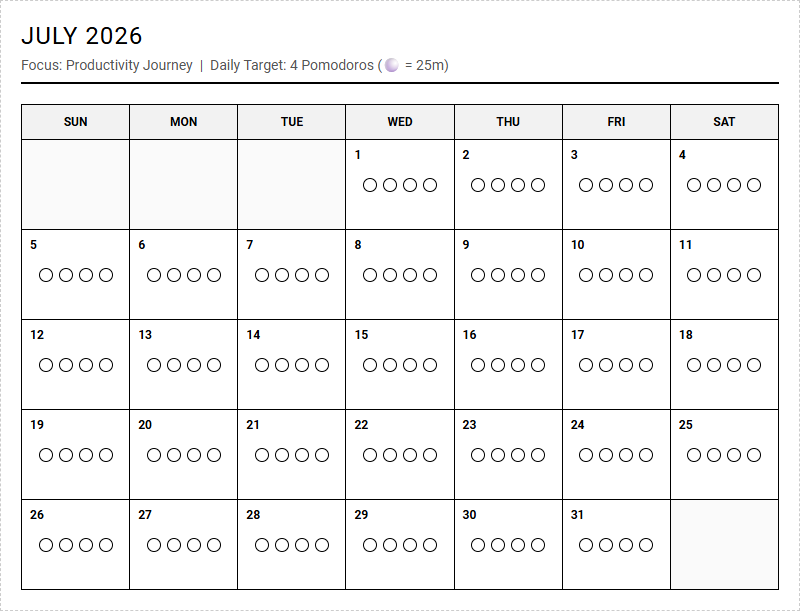
Professionals frequently struggle to maintain deep focus amidst constant digital distractions. While standard professional development budgets fund expensive training, practical daily tools are often overlooked. Our printable Pomodoro Technique Productivity Calendar bridges this gap, granting users immediate cognitive relief through structured time blocking. Please note the stipulation: success requires adhering strictly to the 25-minute work intervals. Below, we outline how this physical calendar optimizes your daily workflow and restores your attention span.
Create Your Pomodoro Technique Productivity Calendar
Done customizing?
Pomodoro Technique Productivity Calendar - Good to Know
Time Blocking
Time blocking is a highly effective productivity technique where you divide your day into dedicated segments of time. Instead of working from a generic, overwhelming to-do list, you assign a specific task or category of work to each defined block on your calendar. This method forces you to commit to your priorities and actively prevents multitasking, which often drains mental energy. By visually organizing your day, you create a concrete blueprint that guides your focus. To successfully implement time blocking, consider these key steps:
- Assess your daily priorities before the day begins.
- Estimate the realistic duration of each task.
- Insert buffer times to accommodate unexpected interruptions.
This structural approach minimizes decision fatigue, as you always know what to work on next. Consequently, you can dedicate your full cognitive capacity to one objective at a time, significantly increasing your overall daily output and reducing the anxiety associated with unstructured schedules.
Ultradian Rhythm
Understanding the ultradian rhythm is crucial for maintaining high-level cognitive performance throughout the workday. Human biology naturally operates in cycles of peak energy followed by periods of exhaustion, typically lasting around 90 to 120 minutes. Rather than forcing yourself to work continuously, aligning your efforts with these biological waves optimizes efficiency. During the first 90 minutes of the cycle, your brain experiences a state of high alertness, making it the perfect window for deep, complex work. Following this peak, a 15 to 20-minute recovery phase begins, where focus naturally declines. Working against this rhythm leads to burnout and cognitive fatigue. To leverage this natural cycle, you should identify your peak energy windows, commit to deep work for 90-minute stretches, and honor the subsequent recovery period with rest. Embracing these natural biological patterns ensures sustained productivity without sacrificing physical or mental well-being.
Timeboxing
Timeboxing differs from time blocking by setting a strict, unyielding limit on how much time you allocate to a specific task. Instead of working on a project until it is finished, you dedicate a fixed "box" of time-such as 45 minutes-and stop immediately when the timer expires. This technique leverages Parkinson's Law, which states that work expands to fill the time available for its completion. By introducing a healthy sense of urgency, timeboxing forces you to work more efficiently and abandon perfectionism. It is particularly effective for open-ended tasks or chores you tend to procrastinate on. To maximize results, define your goals clearly before starting the timer, eliminate potential distractions, and reflect on your progress once the timebox closes. This disciplined constraint transforms intimidating, endless projects into manageable, highly focused sessions that prevent mental fatigue and keep your momentum high.
Task Batching
Task batching is the practice of grouping similar, low-effort tasks together and completing them in a single dedicated session. This strategy directly combats the high cognitive cost of context switching, which occurs when you constantly jump between different types of work. For instance, instead of answering emails continuously throughout the day, you might batch this task into two 30-minute intervals. Common categories for batching include:
- Administrative duties and invoicing.
- Content creation and writing.
- Return phone calls and team messages.
By processing similar activities consecutively, your brain maintains a consistent operational flow state. This reduces mental friction, conserves intellectual energy, and allows you to complete routine tasks much faster than if they were scattered randomly across your weekly schedule, leading to a much cleaner and more organized workflow.
Focus Sprint
A focus sprint is a short, highly concentrated burst of productivity designed to build momentum and overcome procrastination. Typically lasting between 20 to 30 minutes, a sprint requires absolute concentration on a single, well-defined objective. During this period, all notifications are silenced, and external interruptions are strictly prohibited. The psychology behind the focus sprint relies on lowering the barrier to entry; it is far easier to commit to working intensely for twenty minutes than to contemplate a grueling, multi-hour session. Once the sprint begins, the friction of starting quickly dissipates, often leading to an extended state of flow. Utilizing simple tools like a mechanical timer or a dedicated application can enhance the experience. Upon completion, a brief period of active recovery prepares your mind for subsequent tasks, allowing you to sustain a high velocity of quality output throughout the day.
Chrono-productivity
Chrono-productivity is the practice of aligning your daily work schedule with your biological chronotype-your body's natural disposition to sleep and wake at certain times. Traditional society often favors "larks" (morning people), but research shows that "owls" (night people) and "third birds" (intermediate types) have vastly different peak performance hours. By identifying your unique chronotype, you can strategically schedule demanding cognitive tasks during your peak alertness windows. Conversely, routine and administrative work should be relegated to your natural energy troughs. Applying this framework shifts the focus from merely managing time to managing vital energy. Working in harmony with your internal biological clock reduces stress, enhances creativity, and dramatically improves the quality of your output, proving that when you work is just as important as how you work to achieve optimal professional results.
Micro-breaks
Incorporating micro-breaks into your daily routine is an essential strategy for preventing physical strain and mental fatigue. A micro-break is a brief pause, lasting anywhere from 30 seconds to two minutes, taken every 20 to 30 minutes of continuous work. During these intervals, you might stand up, stretch, look away from your screen to rest your eyes, or take a few deep breaths. These tiny moments of disconnect are remarkably powerful; they reset your attention span, reduce muscle tension, and lower stress levels. Research indicates that frequent, brief interruptions actually help sustain overall focus over long periods, preventing the steep decline in performance associated with prolonged sitting. By actively scheduling these minute pauses, you protect your long-term health, maintain a consistent baseline of cognitive clarity throughout the entire day, and avoid the afternoon slump that plagues many office workers.
Time Auditing
Time auditing is a diagnostic process used to uncover the discrepancy between how you think you spend your time and how you actually spend it. To perform a successful audit, you must meticulously document every activity throughout your day, in 15-minute increments, for at least one week. This raw data provides invaluable insights into time-wasting habits, frequent distractions, and inefficient workflows. Once the audit is complete, categorize your activities into distinct buckets:
- High-value deep work that moves major projects forward.
- Necessary administrative tasks and communication.
- Unproductive distractions, meetings, and interruptions.
Analyzing these results allows you to make informed, data-driven adjustments to your daily schedule. This practice empowers you to reclaim lost hours, establish healthier professional boundaries, and align your daily actions more closely with your long-term goals.
Theme Days
Theme days involve dedicating entire days of the week to specific categories of work, creating deep cognitive focus and structural clarity. For example, a business owner might designate Mondays for administrative tasks, Tuesdays and Wednesdays for product development, Thursdays for marketing, and Fridays for team meetings. This macro-level organization eliminates the daily anxiety of deciding what to prioritize and prevents the disruptive mental switching between wildly different tasks. By focusing on one overarching theme per day, you allow your brain to dive deeper into complex problem-solving. This method is highly favored by executives and creatives alike, as it establishes a predictable, rhythmic weekly structure. Consequently, you experience fewer distractions, deeper immersion in your projects, and a more profound sense of control over your professional calendar, which boosts cumulative weekly progress.
Hyperfocus Intervals
Hyperfocus intervals are extended periods of deliberate, uninterrupted concentration designed for tackling your most complex and creative challenges. Unlike shorter sprints, these intervals typically last between 60 to 90 minutes, allowing the mind to fully enter a state of deep flow where complex connections are made. Achieving this state requires rigorous preparation: you must completely eliminate potential environmental distractions, silence all digital notifications, and clearly define the boundary of your objective before beginning. During a hyperfocus interval, your subconscious mind aligns fully with your conscious goals, resulting in exceptional clarity and rapid progress. Because this level of intense mental exertion consumes significant cognitive resources, these intervals must be followed by deliberate, restorative rest. Consistently integrating these deep sessions into your weekly schedule dramatically elevates the quality, depth, and sophistication of your intellectual output.
Leave a comment