
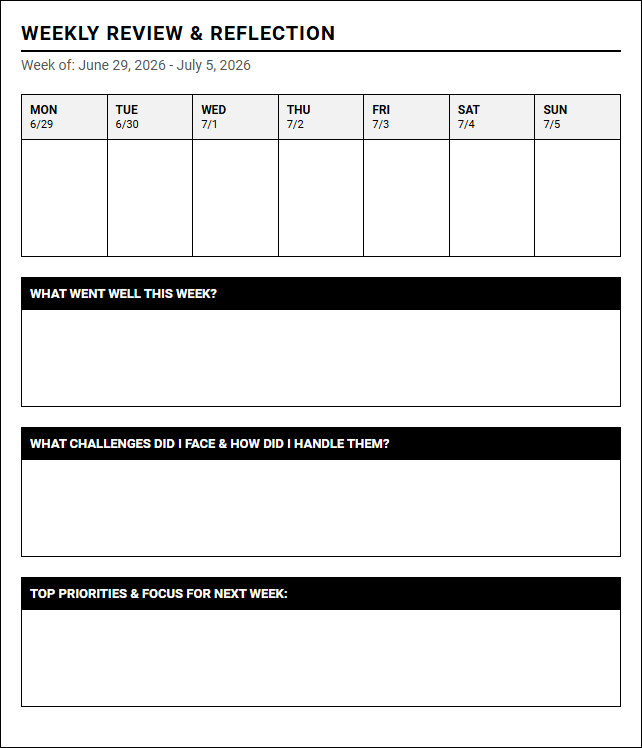
Many professionals struggle to maintain momentum, often losing sight of long-term strategic goals amidst daily chaos. While standard digital calendars help manage basic appointments, they rarely facilitate deep cognitive alignment. Our printable Weekly Review and Reflection Calendar grants you the structural clarity needed to recalibrate, stipulating that sustainable productivity requires active weekly evaluation rather than passive scheduling. By tracking concrete metrics like weekly highlight achievements, this tool transforms busywork into structured growth. Below, we explore how to integrate this system into your routine.
Create Your Weekly Review and Reflection Calendar
| Mon | Tue | Wed | Thu | Fri | Sat | Sun |
|---|---|---|---|---|---|---|
| What went well this week? |
|---|
| What challenges did I face & how did I handle them? |
|---|
| Top priorities & focus for next week: |
|---|
Done customizing?
Weekly Review and Reflection Calendar - Good to Know
Sunday Reset Ritual
The Sunday Reset Ritual is a dedicated practice designed to transition your mind and environment from the hectic pace of the past week into a state of calm readiness for the next. This ritual focuses heavily on physical and digital organization, ensuring that you do not carry unnecessary clutter into your Monday morning.
- Physical decluttering: Clear your desk, organize your workspace, and wash any lingering coffee mugs.
- Digital organization: Empty your desktop downloads folder, archive old temporary files, and organize your desktop screen.
- Environmental prep: Prep your clothes, water your plants, and set up your physical planner or notebook.
By dedicating sixty minutes to these small, foundational tasks, you establish a clean slate. This structured routine minimizes decision fatigue when the new week begins, allowing you to focus your mental energy immediately on high-priority objectives rather than administrative upkeep.
GTD Weekly Review
Implementing a formal Getting Things Done (GTD) Weekly Review ensures that your productivity system remains trusted, functional, and completely up to date. Without this critical maintenance step, even the best organizational systems eventually break down due to outdated tasks and unmanaged inputs.
- Get Clean: Gather all loose papers, receipts, business cards, and digital notes, channeling them into your primary inbox.
- Get Current: Review your calendar items from the past two weeks and look ahead at upcoming events for the next month.
- Get Creative: Review your "Someday/Maybe" lists to see if any dormant projects should be activated now.
Consistently executing this review transforms your relationship with your work. Instead of feeling overwhelmed by hidden, forgotten commitments, you gain complete clarity over your commitments, project statuses, and next physical actions.
Time Blocking
Time blocking is a highly effective time management methodology where you divide your day into distinct, dedicated segments of time. Instead of working from an open-ended, overwhelming to-do list, you assign specific tasks to designated chronological blocks on your calendar, creating a realistic daily roadmap.
"When you assign a specific time slot to every single task, you eliminate the cognitive load of deciding what to work on next, fostering deep focus."
To implement this successfully, group similar tasks together-such as answering emails or making phone calls-and schedule them during a single, dedicated block. Be sure to build in buffer times between blocks to accommodate unexpected interruptions, meetings that run over, or short rest breaks. This strategic scheduling ensures that your most important cognitive work receives your peak daily energy.
Brain Dump
A comprehensive brain dump serves as a vital cognitive release valve when your mental bandwidth is completely saturated. When you attempt to hold multiple tasks, ideas, and random reminders in your active working memory, your focus suffers, leading to heightened anxiety and decreased performance.
To execute a proper brain dump, grab a blank piece of paper or a digital document and write down absolutely everything occupying your mind. Do not attempt to organize, filter, or edit your thoughts during this initial phase; simply extract them.
- Unfinished professional projects
- Personal errands and household chores
- Random ideas, creative inspirations, and future goals
- Vague worries, anxieties, or outstanding communications
Once your mind is completely empty, you can systematically categorize, prioritize, or discard each item, converting raw mental chaos into structured, actionable tasks.
Energy Mapping
Energy mapping is the practice of aligning your daily schedule with your natural biological rhythms rather than trying to force equal productivity across every hour. Throughout the day, our focus, analytical capabilities, and creative drive naturally peak and valley in predictable cycles.
By tracking your energy levels hourly for a week, you can identify your personal peak windows. Label your daily phases carefully:
- High Energy: Perfect for deep focus work, strategic planning, or complex problem-solving.
- Medium Energy: Ideal for collaborative meetings, routine emails, and administrative tasks.
- Low Energy: Best suited for filing, organizing, or purely mechanical tasks.
Scheduling your most demanding creative work during your high-energy windows allows you to complete difficult projects in less time and with far less mental strain, maximizing your natural cognitive flow.
Habit Tracker
A habit tracker is a visual feedback system designed to monitor your daily consistency with specific routines. This tool capitalizes on the psychological satisfaction of checking off a completed action, which reinforces positive behavior and builds long-term momentum.
| Habit Name | Mon | Tue | Wed | Thu | Fri |
|---|---|---|---|---|---|
| 8 Hours Sleep | ✓ | ✓ | ✗ | ✓ | ✓ |
| 30 Min Reading | ✓ | ✓ | ✓ | ✓ | ✗ |
Tracking your habits prevents you from lying to yourself about your actual progress. It transforms abstract goals into concrete data, highlighting patterns of avoidance and helping you understand exactly what triggers your consistency or inconsistency over time.
Weekly Wins
The Weekly Wins practice is a conscious exercise in positive reinforcement and self-reflection. In our rush to tackle the next challenge, we frequently overlook our current achievements, which can lead to burnout, chronic dissatisfaction, and a distorted sense of progress.
At the end of each week, write down three to five specific accomplishments, no matter how small they might seem. These wins can range from completing a major project ahead of schedule to maintaining a calm composure during a difficult meeting.
"Acknowledging your incremental progress trains your brain to look for success patterns, building the intrinsic motivation necessary to sustain long-term efforts."
Documenting these milestones regularly creates a valuable history of personal growth that you can review during challenging times to rebuild your confidence and perspective.
Reflection Prompts
Using structured reflection prompts at the close of the week encourages intentional self-honesty, moving you beyond superficial status updates and deep into meaningful self-evaluation. These targeted questions help you analyze what truly worked, what failed, and why.
- What was the single most significant bottleneck that slowed down my progress this week?
- Did my actual time spent align with my highest stated priorities, or did I get distracted?
- What is one valuable lesson I can extract from my frustrations or failures over the past seven days?
Answering these questions honestly prevents you from repeating identical unproductive behaviors week after week. It converts raw, everyday experience into structured wisdom, ensuring that your personal and professional growth remains continuous, intentional, and highly strategic.
Life Audit
A quarterly or monthly Life Audit is a comprehensive assessment of your current alignment across various areas of life, such as career, health, relationships, finance, and personal development. It serves as a high-level reality check to ensure your daily habits support your long-term vision.
To perform an audit, rate your current satisfaction in each category on a scale from one to ten. Next, write down the concrete reasons behind each score, highlighting any major discrepancies between your values and your daily actions.
- Career: Are your daily projects moving you toward your ultimate professional goals?
- Health: Are your current sleep, nutrition, and exercise habits sustainable?
- Relationships: Are you investing quality time in the people who matter most?
This macro-level diagnostic tool helps you identify creeping imbalances before they manifest as deep personal crises, allowing you to realign your path.
Weekly Preview
The Weekly Preview is the final, essential step in your planning process, transforming your collected reflections and audits into an actionable roadmap for the upcoming seven days. This process bridges the gap between high-level strategy and daily execution.
During your preview, identify your top three non-negotiable objectives for the week. By narrowing your focus to just three core priorities, you prevent yourself from diluting your attention across too many competing projects.
Review your upcoming calendar, prepare necessary materials for key meetings, and deliberately block out time for your priorities before your schedule fills up with other people's demands. This proactive approach empowers you to control your calendar, enter Monday with clear direction, and move through your week with absolute intention and calm confidence.
Leave a comment