
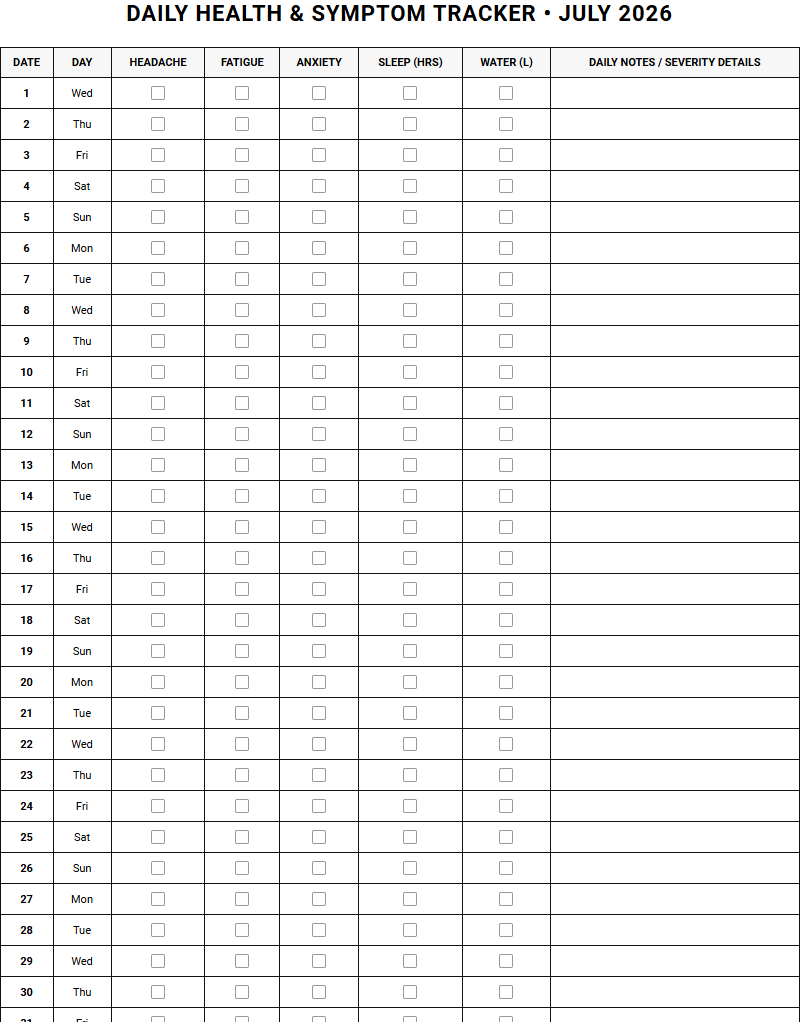
Managing chronic symptoms often feels overwhelming and disorganized. While health insurance or wellness stipends fund standard clinical visits, the crucial day-to-day tracking falls entirely on the patient. The Daily Agendas printable calendar changes this, granting individuals immediate agency over their wellness data. Although not a diagnostic tool, this structured layout helps manage expectations during medical consultations, providing concrete proof for conditions like long COVID. Below, we outline how to maximize this resource for better health outcomes.
Create Your Daily Health And Symptom Tracker
Done customizing?
Daily Health And Symptom Tracker - Good to Know
Symptom trigger mapping
Symptom trigger mapping serves as the foundation of modern personalized wellness. By systematically recording environmental, dietary, and emotional variables alongside physical symptoms, individuals can uncover hidden correlations that dictate their daily health. Using structured digital journals or dedicated applications, users document potential catalysts such as pollen counts, specific ingredients, sleep deficits, and stress levels. Over time, statistical analysis reveals precise patterns, transforming subjective observations into actionable, objective data.
Key elements to track include:
- Dietary intake and specific ingredient tracking.
- Environmental exposures like humidity, AQI, and pollen.
- Emotional states and acute psychological stressors.
By isolating these variables, individuals can proactively modify their environments and behaviors, effectively neutralizing threats before symptoms manifest. This methodical approach empowers patients to take control of their healing journeys with confidence and precision.
Heart rate variability tracking
Heart rate variability (HRV) tracking has emerged as a premier metric for assessing autonomic nervous system function. Unlike static pulse measurements, HRV measures the microscopic fluctuations in time between consecutive heartbeats, reflecting the dynamic balance between the sympathetic (fight-or-flight) and parasympathetic (rest-and-digest) nervous systems. High HRV generally signals a resilient, adaptable cardiovascular system capable of handling physical and psychological stress, while low HRV suggests systemic fatigue or impending illness.
To optimize recovery, individuals should monitor several key trends:
- Morning baseline readings: Taken immediately upon waking to gauge daily readiness.
- Post-exercise recovery rates: Used to assess cardiovascular adaptation and training intensity.
- Sleep-state HRV trends: Monitored during the night for deep restorative analysis.
Integrating HRV tracking into daily routines allows for precise training adjustments, stress management interventions, and early detection of physiological strain, promoting long-term resilience.
Wearable biometric integration
Wearable biometric integration synthesizes continuous data streams from smartwatches, rings, and patches into a cohesive health dashboard. Modern sensors continuously capture vital metrics such as peripheral oxygen saturation, skin temperature, resting heart rate, and electrodermal activity. By consolidating these disparate data points, users gain a real-time, holistic view of their physiological state, moving away from episodic clinical checks toward continuous wellness monitoring.
"The integration of continuous biometric monitoring represents a paradigm shift from reactive treatment to proactive, personalized health preservation."
This interconnected ecosystem enables instant feedback loops. For instance, an unexpected spike in skin temperature combined with a drop in oxygen levels can alert a user to an impending infection hours before physical symptoms emerge. Managing these insights ensures timely interventions and optimized daily habits.
Chronic pain logging
Chronic pain logging transcends simple pain scales by capturing the qualitative, temporal, and spatial characteristics of discomfort. Utilizing multi-dimensional tracking methods, patients document pain intensity, quality (such as throbbing, burning, or sharp), and precise anatomical locations. This meticulous documentation provides healthcare providers with invaluable context, replacing vague recollections with precise historical data.
| Pain Type | Common Trigger | Relief Method |
|---|---|---|
| Neuropathic | Cold weather | Gentle heat therapy |
| Nociceptive | Prolonged sitting | Active stretching |
This granular logging helps identify cyclic patterns, evaluates the efficacy of pharmacological or physical therapies, and fosters a collaborative relationship between patients and clinicians, resulting in highly customized pain management strategies.
Gut-brain axis tracking
Gut-brain axis tracking explores the complex, bidirectional communication channel linking the gastrointestinal tract and the central nervous system. Emerging research underscores how microbiome health directly influences mood, cognitive function, and systemic inflammation. By tracking digestive symptoms alongside psychological states, individuals can map how specific meals impact mental clarity or how emotional stress triggers gastrointestinal distress.
Core aspects of gut-brain monitoring include:
- Stool consistency, bloating severity, and digestion frequency logging.
- Post-prandial cognitive performance and sudden mood swings.
- Vagus nerve stimulation exercises and their immediate digestive outcomes.
Identifying these intricate connections enables targeted dietary interventions, such as prebiotic integration or elimination diets, coupled with stress-reduction techniques like mindfulness, to cultivate a harmonious digestive system and enhanced cognitive vitality.
Cognitive load monitoring
Cognitive load monitoring evaluates the mental effort exerted during daily tasks, helping individuals prevent mental fatigue and burnout. In an era dominated by digital distractions and demanding work environments, measuring executive function, focus duration, and mental exhaustion is vital. Users can track cognitive performance using reaction time tests, memory challenges, or qualitative self-assessments throughout the workday.
By identifying peak productivity windows and recognizing early signs of cognitive decline-such as brain fog, increased error rates, or irritability-individuals can implement structured pacing strategies. Incorporating techniques like the Pomodoro method, strategic cognitive breaks, and minimizing multitasking helps maintain optimal brain performance. Protecting cognitive reserves ensures sustained mental sharpness, creativity, and emotional regulation across personal and professional domains.
Sleep architecture analysis
Sleep architecture analysis delves deep into the cyclical structure of sleep, examining the distribution of light, deep, and rapid eye movement (REM) sleep stages. Quality sleep is not merely about duration; it relies on completing healthy, uninterrupted sleep cycles. By utilizing advanced polysomnography or consumer-grade sleep trackers, individuals can evaluate their sleep efficiency, sleep onset latency, and wake-after-sleep-onset (WASO) duration.
Key phases of sleep architecture to optimize include:
- Deep Sleep: Essential for physical recovery, tissue repair, and immune system support.
- REM Sleep: Crucial for cognitive consolidation, learning retention, and emotional processing.
- Light Sleep: Serves as the transitional bridge between deeper restorative states.
Analyzing these stages empowers users to adjust sleep hygiene habits, refine evening routines, and optimize bedroom environments, fostering deep, restorative rest.
Somatic tracking
Somatic tracking involves cultivating a heightened awareness of internal bodily sensations, serving as a powerful tool for nervous system regulation. Unlike cognitive analysis, somatic tracking encourages individuals to notice physical sensations-such as muscle tension, chest tightness, temperature shifts, or visceral vibrations-without judgment. This practice helps bridge the gap between mind and body, allowing individuals to process stored stress and trauma.
Benefits of regular somatic tracking:
- Disruption of chronic stress loops and habitual physical tension patterns.
- Enhanced emotional self-regulation and psychological resilience.
- Improved interoception and intuitive understanding of bodily needs.
By learning to sit with and observe these physical sensations, individuals can gradually down-regulate overactive nervous systems. This somatic awareness fosters a profound sense of safety and presence within one's physical body.
Biomarker logging
Biomarker logging tracks internal physiological health through periodic blood, saliva, or urine testing. Monitoring metrics such as fasting glucose, lipid profiles, inflammatory markers like hs-CRP, and hormone levels provides an objective, internal view of bodily functions. Unlike external biometric tracking, biomarker analysis captures cellular and metabolic health changes that occur over weeks or months.
Essential biomarkers to monitor regularly include:
Vitamin D and B12levels for energy production and immune resilience.HbA1c and fasting insulinfor long-term metabolic health.Cortisol and DHEAratios to assess chronic stress adaptation.
Consistently logging these biological indicators helps identify subclinical deficiencies or imbalances long before clinical disease develops. This data-driven approach allows for precise dietary, supplemental, and lifestyle adjustments tailored to your unique biology.
Flare-up forecasting
Flare-up forecasting leverages historical data and predictive modeling to anticipate and prevent sudden symptom escalations in chronic conditions. By synthesizing data from trigger mapping, biometric sensors, and sleep analysis, predictive algorithms can identify the subtle physiological warning signs that precede a physical relapse. This shift from reactive management to active prevention is revolutionary for chronic disease care.
The forecasting process involves:
- Aggregating diverse biometric, environmental, and behavioral datasets.
- Identifying early deviation markers, such as a sudden drop in resting HRV.
- Implementing immediate preemptive therapeutic protocols.
By recognizing these subtle shifts, individuals can proactively reduce their cognitive load, adjust their therapies, and prioritize restorative practices, successfully mitigating or completely averting an impending flare-up.
Leave a comment