
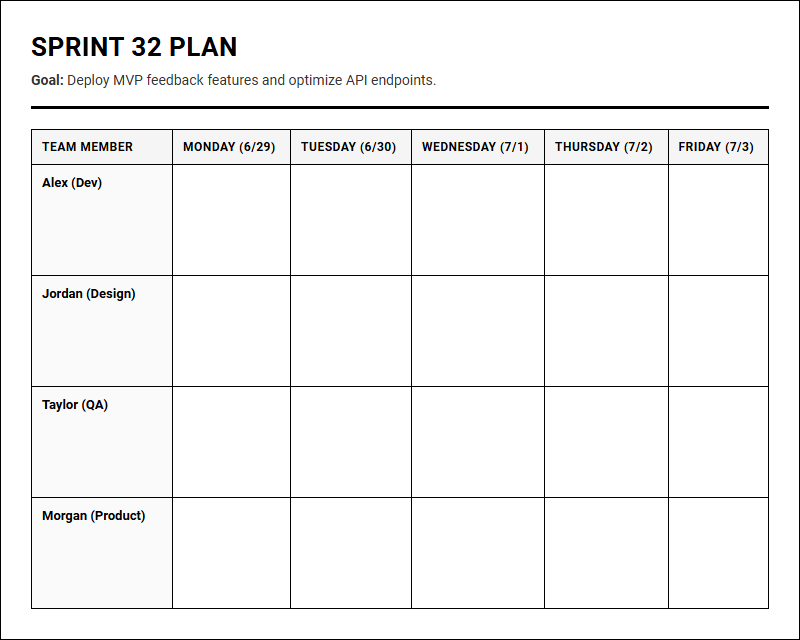
Aligning cross-functional teams during rapid sprint cycles often leads to fragmented communication and missed milestones. While securing capital funding or operational budgets establishes your infrastructure, resources alone cannot guarantee seamless execution.
Our Business & Project Trackers printable calendar grants teams the immediate visual clarity required to maintain momentum. Note the stipulation that this Weekly Team Sprint Planner requires daily stand-up alignment to be fully effective. Highly successful in agile product marketing groups, the following overview outlines how to integrate this tool to streamline your upcoming weekly cycles.
Create Your Weekly Team Sprint Planner
Done customizing?
Weekly Team Sprint Planner - Good to Know
Sprint Goal
The Sprint Goal serves as the high-level objective established for the iteration, providing a clear focus and a shared purpose for the Scrum team. Rather than merely completing a random assortment of tasks, the team rallies around this singular milestone to deliver tangible value. It acts as a guiding star during decision-making processes, allowing developers to pivot their technical implementation details as long as the overarching objective remains viable and respected.
A well-defined goal fosters collaboration and prevents team members from working in isolated silos. It is crafted collaboratively during sprint planning through the following steps:
- Analyzing the highly prioritized items in the product backlog.
- Identifying a cohesive theme that addresses a specific user need.
- Formulating a concise, measurable statement that defines success.
By establishing this clear focus, stakeholders and team members align their expectations, ensuring that every effort expended directly supports the broader product vision and strategic milestones.
Sprint Backlog
The Sprint Backlog is a dynamic repository of work selected by the development team for execution during the current iteration. It comprises a highly curated subset of product backlog items, accompanied by a practical, detailed plan for delivering the corresponding product increment. This backlog is owned exclusively by the developers, who continuously update it throughout the sprint as new information emerges and tasks progress from initiation to completion.
To ensure maximum transparency and operational efficiency, the sprint backlog is often visualized using task boards. This visualization categorizes items into distinct developmental phases:
- To Do: Items scheduled for development but not yet started.
- In Progress: Active tasks currently being worked on by developers.
- Done: Completed work that fully meets the team's strict Definition of Done.
This structural arrangement ensures that work remains visible, manageable, and highly adaptable to daily technical discoveries.
Capacity Planning
Capacity Planning is a foundational ceremony designed to determine the actual availability of the development team for an upcoming iteration. Unlike static velocity metrics, capacity accounts for real-world variables such as planned vacations, public holidays, company meetings, and dedicated maintenance time. By calculating the realistic hours or days available, the team avoids the common pitfall of overcommitting to deliverables, which frequently leads to burnout and compromised software quality.
To execute capacity planning effectively, teams typically employ a structured calculation formula:
Total Capacity = (Daily Working Hours × Sprint Days × Team Members) - Planned Absences
Understanding this realistic availability empowers the product owner to prioritize backlog items effectively, ensuring that the team commits only to what can realistically be completed. This analytical approach stabilizes sprint delivery, establishes trust with stakeholders, and supports a sustainable, healthy development pace.
Daily Standup
The Daily Standup, often referred to as the Daily Scrum, is a brief, 15-minute synchronization event designed to foster alignment and inspect progress toward the Sprint Goal. Held at the same time and place every day, this timeboxed ceremony encourages team members to share crucial progress updates and identify potential impediments that could delay delivery. It is not a status reporting meeting for management, but rather a collaborative planning session for the developers.
To maintain momentum, participants structure their updates around three core pillars:
- What was accomplished yesterday to help the team achieve the goal.
- What will be focused on today to move closer to that objective.
- Any blockers or obstacles that are currently hindering progress.
This quick feedback loop enhances daily collaboration, eliminates communication silos, and allows the team to adapt their tactical plan immediately.
Velocity Tracking
Velocity Tracking is an analytical practice used to measure the average amount of work a development team completes during a single iteration. Typically quantified in story points or completed tasks, velocity provides a historical benchmark that assists in forecasting future product delivery timelines. By analyzing performance trends over several past sprints, product owners can make data-driven predictions regarding when specific features will be ready for production release.
However, velocity must be interpreted with caution. It is a highly localized metric unique to each individual team, meaning it should never be used to compare different teams' productivity. A sudden drop in velocity often signals underlying systemic issues, such as:
- Unclear requirements or frequent scope creep.
- Technical debt and complex legacy code limitations.
- External dependencies and communication bottlenecks.
Tracking this metric consistently helps teams stabilize their delivery pipeline and improve long-term planning accuracy.
Kanban Board
A Kanban Board is an agile project management tool designed to help visualize work, limit work-in-progress, and maximize efficiency. It utilizes cards, columns, and continuous improvement concepts to enable teams to visualize their workflows and optimize the delivery of value. By mapping out steps from initial ideation to final deployment, team members can identify inefficiencies and bottlenecks in real time, allowing for immediate process adjustments.
The standard layout of a digital or physical board typically includes:
- Visual Signals: Cards representing individual tasks or user stories.
- Columns: Representing specific stages of the workflow (e.g., Backlog, Design, Code Review, Testing).
- Work in Progress Limits: Restricting the maximum number of cards allowed in a column at one time.
This transparent framework ensures that the entire organization maintains clear visibility into the development pipeline, promoting accountability and collaboration.
WIP Limits
WIP (Work in Progress) Limits are fixed constraints set by agile teams to restrict the maximum number of tasks that can exist in any active workflow stage simultaneously. By implementing these strategic boundaries, teams shift their operational focus from merely starting new tasks to successfully finishing existing ones. This practice directly combats the productivity-draining effects of multitasking and frequent context switching, which often delay overall delivery timelines.
Applying strict WIP limits offers several measurable advantages to software development workflows:
- Highlights Bottlenecks: Instantly reveals areas where work is piling up.
- Improves Flow: Encourages team members to collaborate on resolving blocks before pulling new work.
- Reduces Cycle Time: Ensures individual user stories are completed much faster.
By enforcing these limits, teams create a highly efficient, pull-based system that optimizes resource allocation and increases throughput.
Story Point Estimation
Story Point Estimation is a relative estimation technique used by agile teams to gauge the overall effort, complexity, and risk associated with implementing a specific backlog item. Instead of using highly volatile and inaccurate hourly estimates, teams compare tasks against one another using a relative scale, such as the modified Fibonacci sequence (1, 2, 3, 5, 8, 13, 20). This approach removes the pressure of precise time tracking and focuses instead on cognitive complexity.
To establish accurate estimates, developers evaluate three core dimensions of a task:
- Complexity: How difficult or intricate is the feature to design and code?
- Effort: How much physical or mental labor is required to complete it?
- Uncertainty: Are there unknown dependencies or technologies involved?
This collaborative exercise aligns team expectations and builds a realistic understanding of technical requirements.
Retrospective Action Items
Retrospective Action Items are the concrete, measurable change initiatives formulated at the end of a Sprint Retrospective meeting. While the retrospective serves as a dedicated space for reflecting on past processes, the resulting action items represent the tangible commitment to continuous improvement. Without capturing these actionable tasks, retrospectives risk becoming repetitive complaining sessions rather than engines for positive organizational and cultural change.
To ensure successful implementation, effective action items are structured using specific criteria:
- Ownership: Assigned to a single team member who champions its completion.
- Clarity: Defined with a clear, unambiguous outcome rather than vague goals.
- Traceability: Tracked on the active task board alongside regular development work.
This disciplined focus on self-improvement guarantees that the team's processes evolve continuously, boosting efficiency and morale sprint after sprint.
Timeboxing
Timeboxing is a core time management strategy that allocates a fixed, maximum unit of time to an activity, ceremony, or task. In agile methodologies, timeboxes are strictly enforced to prevent scope creep, reduce perfectionism, and maintain a predictable developmental rhythm. Once the allocated time for a designated box expires, the activity must cease immediately, encouraging participants to focus strictly on the most high-value outcomes.
This practice is applied systematically across all major framework events, including:
- Sprint Planning: Scaled proportionally to the length of the upcoming sprint.
- Daily Standups: Limited strictly to 15 minutes to keep updates concise and focused.
- Spikes: Time-limited research tasks designed to gather critical technical information quickly.
Enforcing these strict temporal boundaries instills strong operational discipline, ensuring that teams maintain momentum while preventing valuable resources from being wasted on diminishing returns.
Leave a comment