
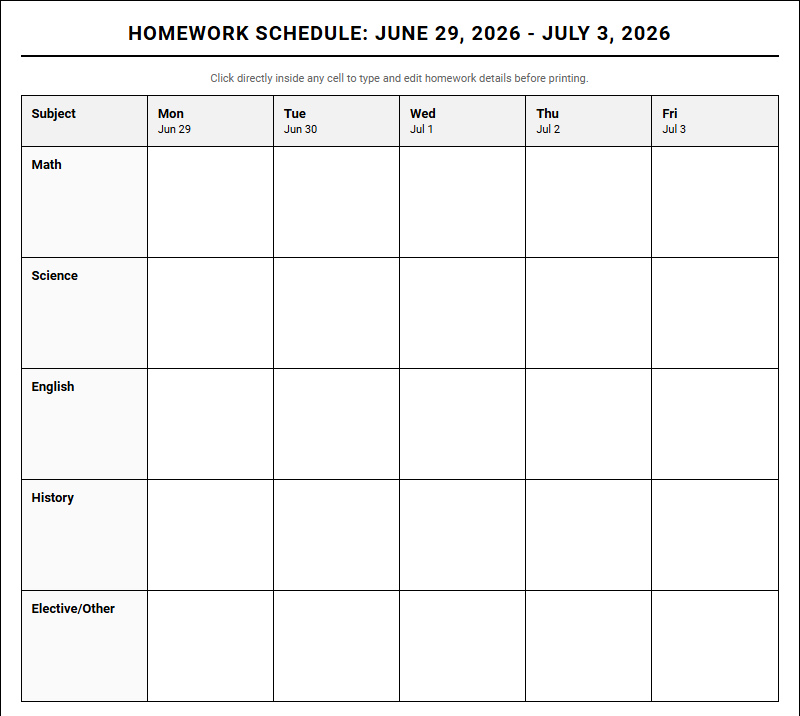
Managing daily homework loads often overwhelms busy families. While school districts frequently utilize standard funding sources to provide digital portals, these platforms can lack personal engagement. Implementing a printable daily homework schedule grants students ownership over their time. Provided they commit to consistent daily entry, this physical tool-like our popular color-coded block layout-fosters essential executive function skills. Below, we review the optimal printable calendar formats to streamline your student's academic routine.
Create Your Daily Homework Schedule
| Subject | Mon | Tue | Wed | Thu | Fri |
|---|
Done customizing?
Daily Homework Schedule - Good to Know
Time blocking
Time blocking is a highly effective time management method where you divide your day into distinct blocks of time. Each block is dedicated to completing a specific task, or group of tasks, and only those specific tasks. Instead of keeping an open-ended, overwhelming to-do list, you proactively assign dedicated slots on your calendar to protect your focus.
- Establishes clear boundaries for daily academic responsibilities.
- Minimizes cognitive load by eliminating constant decision-making.
- Reduces the temptation to multitask throughout the study day.
By scheduling your day into dedicated segments, you cultivate a deep sense of control over your schedule. When you enter a block, your mind is primed for that single objective, allowing you to immerse yourself fully in the work. This disciplined structure ensures that high-priority academic tasks receive the undivided attention they require to be completed efficiently and with a higher level of cognitive depth.
Study tracker
A study tracker acts as a visual roadmap of your academic progress and daily learning milestones. By systematically logging your study hours, subjects, and specific topics, you gain invaluable data-driven insights into your study habits. Keeping an accurate tracker ensures you remain fully accountable to your educational goals over the semester.
- Identify subjects that require more dedication and review.
- Monitor the time spent on various academic projects.
- Visualize your progress to maintain high levels of motivation.
Whether you choose a digital spreadsheet or a physical journal, the act of tracking transforms abstract study goals into tangible metrics. It removes the guesswork from your preparation, allowing you to see exactly where your energy is going. Over time, analyzing these patterns helps you optimize your study sessions, ensuring that no subject is neglected and that your preparation is perfectly balanced.
Homework routine
Establishing a consistent homework routine is crucial for long-term academic success and stress reduction. Setting a fixed time and a distraction-free environment every day helps build a powerful habit loop. When your brain associates a specific cue, such as sitting at your designated desk at 4:00 PM, with focused academic study, entering a state of deep work becomes almost effortless.
"The secret to building a sustainable study habit lies in the consistency of your daily environmental cues."
A structured routine eliminates the daily struggle of deciding when, where, and how to start your assignments. It transforms homework from a dreaded chore into an automatic, natural part of your daily rhythm. By prioritizing consistency, you build momentum that carries you through challenging academic periods, making deadline rushes and late-night cramming sessions a thing of the past.
Pomodoro sessions
The Pomodoro Technique is a classic time-management system that pairs focused work intervals with brief, rejuvenating rest periods. Typically, you work intensely on a single task for 25 minutes, followed by a short 5-minute break. This cycle is repeated four times before you reward yourself with a longer, more substantial break of 15 to 30 minutes.
This structured approach trains the brain to focus effectively for short bursts and directly combats the urge to procrastinate. During the focus interval, all distractions are strictly avoided, creating a sanctuary for deep work. The frequent breaks prevent mental fatigue, keeping your mind fresh, alert, and receptive to new information throughout extended study periods. It is an ideal method for breaking down large, intimidating academic projects into highly manageable pieces.
Notion study planner
Utilizing a Notion study planner elevates your academic organization to a sophisticated digital masterpiece. Notion allows you to build customized databases, track assignment deadlines, link comprehensive lecture notes, and centralize all your essential study materials into one highly accessible digital hub. By customizing templates, you can construct an aesthetic and functional dashboard that mirrors your unique learning style.
This dynamic platform serves as a central brain for your academic life, ensuring you never lose track of a syllabus or a project deadline again. You can easily integrate active recall databases, track your revision progress, and filter tasks by priority or subject. The versatility of a digital planner ensures that your study materials evolve alongside your curriculum, providing a seamless, organized, and interactive experience that traditional paper planners simply cannot match.
Task batching
Task batching is the productivity practice of grouping similar, low-effort tasks together and completing them all in a single, dedicated session. Instead of constantly switching between answering emails, writing essays, reading articles, and solving math equations, you dedicate specific windows of time to uniform activities. This deliberate grouping minimizes the heavy switching cost associated with multitasking.
- Grouping all administrative tasks, such as responding to group project messages.
- Completing all weekly reading assignments in one dedicated block.
- Drafting multiple short-form responses or outline notes sequentially.
When you batch tasks, you maintain a singular mental state, which drastically improves your efficiency and speed. It prevents the cognitive fragmentation that occurs when you bounce rapidly between different types of work. Consequently, you complete your administrative chores much faster, leaving large, uninterrupted blocks of time for creative and analytical academic work.
Spaced repetition schedule
A spaced repetition schedule leverages the psychological spacing effect to dramatically enhance long-term memory retention. Instead of cramming vast amounts of information right before an exam, you review materials at systematically increasing intervals. For example, you might review a concept after one day, then three days, then a week, then two weeks, and finally after a month.
This systematic timing interrupts the natural forgetting curve, forcing your brain to retrieve the information just as it is about to slip away. By spacing out your reviews, you signal to your brain that the information is highly valuable and needs to be stored in your long-term memory. Implementing this schedule ensures that you retain complex academic concepts effortlessly, making final exam preparation a calm review rather than an intense, stressful learning experience.
Micro-study sessions
Micro-study sessions utilize the small, often wasted pockets of time that occur throughout your busy day. Instead of waiting for a massive, uninterrupted three-hour block to open up before you open a book, you can actively study during a ten-minute bus ride, a five-minute queue, or the brief intermission between your afternoon classes.
These brief sessions are incredibly effective for quick, highly focused review tasks, such as:
- Reviewing digital flashcards on your mobile device.
- Reading over a single page of condensed lecture summaries.
- Listening to an educational podcast during a brief walk.
These small pockets of time accumulate rapidly over the course of a week, turning idle moments into productive learning opportunities. By adopting this approach, you reduce the pressure on your evening study sessions, freeing up valuable personal time while maintaining high academic performance.
Active recall log
An active recall log shifts your study strategy away from passive reading and toward active retrieval practice. Rather than repeatedly highlighting a textbook or rereading your notes, you force your brain to actively retrieve information from memory. This cognitive effort strengthens your neural pathways, solidifying your understanding of the material.
- Write down a series of highly specific questions based on your lectures.
- Answer the questions from memory without looking at your source notes.
- Log your performance and highlight the specific areas that require revision.
By keeping a structured log of your recall attempts, you easily identify the gaps in your knowledge. This targeted approach prevents the illusion of competence, ensuring you focus your valuable study time on the concepts you actually struggle with, rather than wasting time reviewing what you already know.
Homework triage
Homework triage is a strategic prioritization framework designed to handle overwhelming workloads during busy academic periods. Just like medical triage in an emergency room, you assess and categorize your assignments based on their urgency, grade weight, and overall complexity. This ensures you always tackle high-impact, immediate tasks first.
By categorizing your assignments into distinct priority levels, you avoid the paralysis of analysis that often accompanies a heavy workload. You allocate your peak energy hours to the most demanding tasks, while leaving routine, low-stakes assignments for when your mental energy begins to wane. This systematic approach ensures that even under extreme academic pressure, your performance remains optimal and your key deadlines are always met with confidence.
Leave a comment