
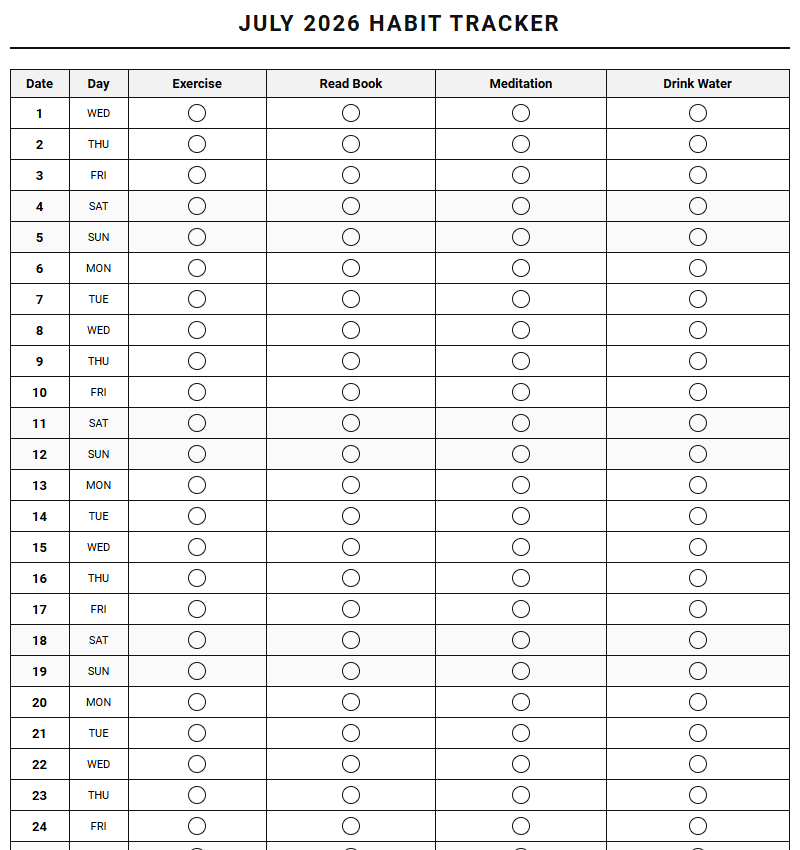
Maintaining daily consistency is a universal challenge, as many individuals struggle to sustain new routines. While digital notification apps and complex planners are standard tracking tools, they often lead to screen fatigue. A yearly printable habit tracker calendar grants immediate tactile visibility, reinforcing progress at a single glance. Success, however, is stipulated on placing this physical sheet in a prominent, high-traffic area. Whether tracking daily hydration or morning meditation, this visual system builds lasting momentum. Below, we outline how to optimize your yearly layout.
Create Your Habit Tracker Calendar
Done customizing?
Habit Tracker Calendar - Good to Know
Habit Stacking
Habit stacking is a powerful behavioral design method popularized by productivity experts. This strategy relies on pairing a new, desired behavior with an already established daily routine. Instead of associating your new habit with a specific time or location, you anchor it to an existing trigger that your brain performs automatically every day.
To implement this successfully, you can utilize a simple, structured formula:
- "After I [Current Habit], I will [New Habit]."
For example, if you want to practice mindfulness, you might say: "After I pour my morning coffee, I will meditate for two minutes." This technique leverages the pre-existing neural pathways in your brain, making the adoption of the new behavior significantly easier. By anchoring your aspirations to established realities, you remove the friction of decision-making, ensuring consistent progress without relying solely on fluctuating willpower.
Don't Break the Chain
Originally attributed to comedian Jerry Seinfeld, the "Don't Break the Chain" strategy is a highly visual and psychological approach to consistency. The premise is straightforward: you obtain a prominent yearly wall calendar and a red marker. Every day that you complete your target task, you draw a large red "X" over that specific date.
As the days progress, a physical chain of red marks begins to emerge. Your primary objective shifts from the complexity of the habit itself to a simple, daily visual challenge:
"Just don't break the red chain."
This method exploits our natural aversion to losing progress. Seeing a long, uninterrupted sequence of achievements provides a profound sense of momentum. It shifts your focus from long-term, daunting goals to the immediate, manageable task of protecting your daily streak, reinforcing your commitment through tangible visual feedback.
Streak Tracking
Streak tracking digitizes and gamifies the concept of continuous daily action. In modern productivity apps, a streak represents the consecutive number of days you have successfully completed a specific action. This numerical representation of consistency acts as a powerful psychological motivator, transforming abstract effort into quantifiable success data.
When using streak tracking, individuals often experience several key psychological shifts:
- Loss Aversion: The desire to protect a 50-day streak outweighs the momentary temptation to skip a day.
- Visual Progress: Watching the counter tick upward provides an immediate dopamine hit.
However, successful streak tracking requires a balanced mindset. Many experts suggest implementing a "never miss twice" rule to prevent a single broken streak from completely derailing your long-term momentum, allowing room for life's inevitable interruptions while maintaining overall consistency.
Keystone Habits
A keystone habit is a singular, foundational routine that naturally encourages the development of other positive behaviors. Coined by Charles Duhigg in his research on behavioral psychology, these habits do not just change one aspect of your life; they initiate a cascading ripple effect that transforms unrelated areas of your daily routine.
Common examples of keystone habits include:
- Regular physical exercise, which often leads to better nutrition and improved sleep.
- Daily journaling, which fosters heightened self-awareness and better time management.
- Making your bed every morning, which establishes an immediate sense of order and discipline.
By focusing your energy on cultivating just one keystone habit, you create a structural shift. The confidence and discipline gained from mastering this pivotal behavior make adopting subsequent healthy habits feel natural, effortless, and highly sustainable over time.
Micro-habits
The concept of micro-habits involves scaling down a desired behavior to its absolute smallest, most effortless iteration. When a goal is too ambitious, cognitive friction and resistance often prevent us from starting. By reducing the habit to a task that takes less than two minutes, you bypass the brain's natural resistance to change.
Consider these simple transformations to understand the methodology:
- Instead of reading one book a week, commit to reading one page a night.
- Instead of doing a thirty-minute workout, commit to doing one push-up.
The philosophy here is that establishing the routine of showing up is far more important than the scale of the initial achievement. Once the tiny behavior becomes automatic, you can gradually scale it up. Starting small ensures that even on your lowest-energy days, progress remains entirely achievable.
Gamification
Gamification is the strategic integration of game mechanics-such as points, levels, challenges, and rewards-into non-game contexts like personal habit development. By transforming routine tasks into quest-like experiences, you tap into the brain's intrinsic reward systems, making personal development feel engaging and fun rather than chore-like.
To gamify your daily life, consider incorporating these interactive elements:
- Assigning experience points (XP) to difficult tasks like studying or cleaning.
- Creating a virtual "store" where you can exchange accumulated points for real-life rewards.
This approach reframes tedious responsibilities as exciting challenges. Whether you use specialized applications or design a custom paper-based system, gamification shifts your perspective. It turns the arduous journey of self-improvement into an interactive adventure, sustaining your long-term engagement through playfulness and structured milestones.
Habit Loop
Understanding the habit loop is essential for anyone wishing to systematically alter their behavior. This neurological loop, consisting of three distinct phases, governs every habit we possess. By deconstructing this loop, we gain the power to consciously reprogram our automated actions.
The three components of the loop operate in a continuous cycle:
- The Cue: A environmental trigger that tells your brain to go into automatic mode.
- The Routine: The physical, mental, or emotional behavior that you execute.
- The Reward: The positive feedback that helps your brain determine if this loop is worth remembering.
To change an unproductive habit, you must identify the underlying cue and reward. By keeping the same trigger and satisfaction but swapping in a healthier routine, you successfully rewire the loop, creating lasting behavioral transformation.
Visual Cueing
Visual cueing is the deliberate design of your physical environment to make positive triggers unavoidable and negative temptations invisible. Our visual sense is the most dominant of all human senses; therefore, what we see directly influences our immediate choices and automated responses throughout the day.
You can optimize your surroundings using these practical adjustments:
- Place your running shoes directly beside your bed to prompt morning exercise.
- Keep a large water bottle on your desk to encourage constant hydration.
- Store healthy snacks at eye level in the pantry while hiding sweets in hard-to-reach cabinets.
When you redesign your environment to display clear visual cues, you remove the need for constant conscious effort. Your surroundings actively nudges you toward your goals, making the correct choice the most obvious and accessible option in any given room.
Identity-Based Habits
Focusing on identity-based habits requires shifting your attention from what you want to achieve to who you wish to become. Most people fail to sustain changes because they focus entirely on outcome-based goals, such as losing twenty pounds or writing a book, without addressing their underlying self-image.
True behavior change is identity change. The process involves two simple steps:
- Decide the type of person you want to be (e.g., a healthy person, a writer, a reliable friend).
- Prove it to yourself with small, daily wins that reinforce this new identity.
Every action you take is a vote for the type of person you wish to become. When your behaviors align with your core identity, habit maintenance ceases to feel like a struggle. It becomes an authentic expression of who you already are, leading to deep, permanent personal evolution.
Friction Reduction
Friction reduction is the practice of removing physical and mental obstacles between yourself and a positive habit. The law of least effort dictates that humans naturally gravitate toward the option that requires the least amount of energy. Therefore, success lies in making good habits incredibly easy to perform.
To implement this principle, consider these strategic preparation techniques:
- Lay out your work clothes and pack your lunch the night before to streamline your morning.
- Keep your guitar on a stand in the living room rather than packed away in a closet.
Conversely, you can increase friction for bad habits, such as unplugging the television to discourage mindless watching. By proactively smoothing the path for your desired routines, you minimize the reliance on willpower. You ensure that when the time comes to act, the barrier to entry is virtually non-existent.
Leave a comment