
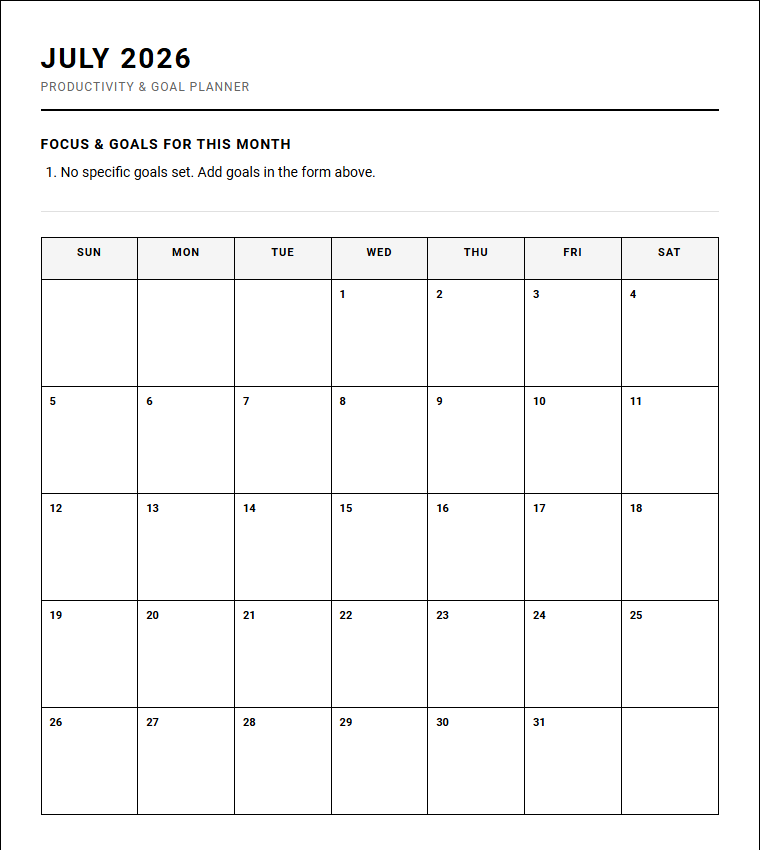
Many professionals struggle to align daily tasks with long-term objectives. While securing standard funding sources drives business growth, execution relies on structured time management. Incorporating a robust productivity and goal planner grants users immediate clarity and focus. Stipulation: sustained success requires daily tracking rather than occasional scheduling. Using the Daily Agendas printable calendar, individuals can easily map macro-goals into hourly milestones. Below, we explore strategic ways to implement these layouts to optimize your daily workflow.
Create Your Productivity And Goal Planner
- Define your goals above and click update.
- Stay consistent and track your progress daily.
- Review and reflect at the end of the month.
| Sun | Mon | Tue | Wed | Thu | Fri | Sat |
|---|
Done customizing?
Productivity And Goal Planner - Good to Know
Mastering Modern Productivity: Essential Frameworks and Tools
Explore these proven strategies, methodologies, and digital resources designed to optimize your workflow, improve focus, and enhance your daily life balance.
Time blocking
Time blocking is a highly effective time management methodology where you divide your day into dedicated segments of time. Instead of keeping an open-ended, overwhelming to-do list, you proactively assign specific tasks or categories of work to distinct chronological blocks on your calendar. This practice encourages deep work by minimizing context switching, a common productivity killer that occurs when jumping rapidly between unrelated tasks.
To implement this system successfully, consider the following approach:
- Estimate the precise duration required for each task prior to scheduling.
- Incorporate buffer times between blocks to account for unexpected delays or short rests.
- Consolidate minor administrative tasks, such as reading emails, into a single daily block.
By transforming your abstract daily schedule into a structured, visual map, you gain immediate clarity on your actual capacity. This structured approach helps prevent overcommitment, ensures critical priorities receive undivided attention, and establishes clear boundaries between your professional responsibilities and personal free time.
Habit stacking
Coined by productivity experts, habit stacking is a powerful behavioral design strategy that leverages your existing daily routines to build new, positive habits. Instead of attempting to summon willpower to perform a new action out of nowhere, you anchor the new behavior directly onto an established, automatic trigger that you already perform daily without fail.
The core scientific formula behind this methodology is straightforward and highly actionable:
"After [Current Habit], I will [New Habit]."
For example, if you want to practice daily mindfulness, you might decide that immediately after pouring your first cup of coffee each morning (current habit), you will sit quietly and meditate for exactly three minutes (new habit). Linking these neurological pathways minimizes the mental friction of initiating new behaviors. Over time, these linked behaviors merge into a singular, effortless routine, greatly accelerating your personal development and long-term behavioral consistency.
SMART goals
The SMART goal-setting framework is a highly structured methodology designed to transform vague, ambiguous aspirations into actionable, highly realistic targets. By defining your objectives through these precise criteria, you eliminate ambiguity and establish a clear, verifiable roadmap to track your personal or organizational progress.
An effective goal must systematically satisfy five distinct, interconnected dimensions:
- Specific: Define your desired outcome with absolute clarity, leaving no room for misinterpretation.
- Measurable: Establish concrete metrics or indicators to track progress and definitively confirm completion.
- Achievable: Ensure the objective remains realistic and attainable given your current skills and resources.
- Relevant: Align the target with your broader long-term values, overarching vision, and current priorities.
- Time-bound: Assign a strict target date or deadline to foster focus and prevent chronic procrastination.
Applying this robust framework ensures your energy is directed toward high-impact results rather than unstructured, unproductive busywork.
Pomodoro technique
Developed by Francesco Cirillo in the late 1980s, the Pomodoro technique is a highly popular time management method designed to maximize sustained mental focus while systematically preventing cognitive fatigue. The system relies on breaking down complex, demanding work into short, highly concentrated intervals separated by brief, restorative breaks.
The standard operational cycle of this productivity workflow consists of these steps:
- Select a single, well-defined task that requires your full focus.
- Set a dedicated timer for exactly 25 minutes and work with zero interruptions.
- Stop immediately when the timer rings and enjoy a restorative 5-minute break.
- Repeat this precise cycle four times, then reward yourself with a longer 20 to 30-minute break.
These brief, frequent intervals of rest prevent mental exhaustion, encourage sustained focus, and build momentum. This technique trains your brain to resist external distractions and manage internal impulses during work periods.
Digital planner
A digital planner serves as a modern, highly customizable electronic alternative to traditional paper-based organization systems. Utilizing applications on devices like tablets, smartphones, and laptops, these digital tools allow users to seamlessly consolidate calendars, daily schedules, project plans, habit trackers, and personal journals into a single, cohesive, and easily searchable database.
Key advantages of transitioning to a digital planning system include:
- Instant synchronization across multiple devices, ensuring your schedule is accessible anywhere.
- Eco-friendly functionality that eliminates physical paper waste and storage issues.
- Advanced features like automated recurring reminders, hyperlinked navigation, and media integration.
By allowing you to easily drag, drop, edit, and duplicate entries without messy erasing, these flexible platforms streamline your organizational workflow. This adaptability enables you to quickly pivot plans in response to the rapid, unpredictable changes of modern life.
OKRs
OKRs, which stands for Objectives and Key Results, is a goal-setting framework popularized by major tech giants like Intel and Google. This highly collaborative methodology is used by individuals and organizations alike to align efforts, foster accountability, and drive measurable growth. It bridges the gap between high-level vision and daily execution.
The architecture of this framework is split into two essential components:
- Objectives:
- Qualitative, inspiring, and action-oriented goals that describe what you want to achieve.
- Key Results:
- Quantitative, measurable outcomes that define exactly how you will achieve the objective.
Typically set on a quarterly basis, these indicators are aggressively aspirational, pushing teams to think outside standard operational limits. By focusing energy on a small set of high-impact goals, this framework creates deep alignment and clarity across all levels of an organization.
Notion template
A Notion template is a pre-configured workspace layout designed within the versatile, all-in-one productivity software application, Notion. Because the platform offers a blank canvas composed of flexible, modular blocks, these pre-made templates serve as invaluable jumping-off points for organizing personal lives, projects, and entire corporate databases.
Users utilize these templates to quickly set up a wide variety of productivity systems:
- Project management databases utilizing Kanban boards, Gantt charts, and calendar views.
- Personal dashboards incorporating budget trackers, meal planners, and reading lists.
- Resource centers that centralize meeting notes, company wikis, and standard operating procedures.
By eliminating the tedious process of building databases, relations, and aesthetic layouts from scratch, templates democratize efficient system design. This allows you to immediately focus on executing your work rather than managing your software tools.
Time boxing
While sharing similarities with time blocking, time boxing introduces a crucial psychological shift by placing a strict, non-negotiable limit on the amount of time dedicated to a specific activity. Instead of scheduling a block of time to work on a task until it is completed, you commit to stopping work on that task the exact moment your predefined "box" of time expires.
This strict constraint leverages Parkinson's Law, which states that work expands to fill the time available for its completion. By limiting the time window, you force your brain to focus on the essential aspects of the task, ignoring minor details and perfectionist tendencies that often lead to project delays.
This strategy is highly effective for tackling open-ended tasks, administrative duties, or projects that frequently suffer from scope creep. It ensures you maintain steady progress across multiple domains without letting a single task dominate your schedule.
Wheel of life
The Wheel of life is a powerful visual assessment tool used in personal coaching to help individuals evaluate their current level of satisfaction across various life domains. This holistic framework typically represents your life as a circle divided into eight distinct, vital slices, such as career, finances, health, family, romance, personal growth, fun, and physical environment.
To utilize this tool, you rate your current satisfaction in each category on a scale from 1 to 10, then plot these points to draw a visual boundary. This simple exercise quickly highlights areas of neglect, illustrating where your energy is misaligned and where balance needs restoring.
Regularly reassessing your wheel provides a clear benchmark for personal development. This visual indicator guides you to set meaningful, well-rounded goals that support true happiness, health, and holistic fulfillment across your entire life journey.
Monotasking
In a world saturated with digital distractions, monotasking-the practice of dedicating your undivided attention to one single task at a time-stands as a vital antidote to the myth of productive multitasking. Modern cognitive science demonstrates that the human brain cannot efficiently process multiple high-cognition tasks simultaneously; instead, it rapidly switches between them, creating significant cognitive friction and errors.
Embracing a single-focus workflow delivers several key benefits:
- Significantly reduces cognitive load and mitigates daily mental fatigue.
- Improves the depth, quality, and creative output of your work.
- Fosters a sense of mindfulness and calm throughout your busy workday.
By intentionally closing extra browser tabs, silencing non-essential notifications, and committing fully to the task at hand, you cultivate deep focus. This intentional practice leads to faster completion times, fewer errors, and a more satisfying, less stressful working experience.
Leave a comment