

Managing daily dinner schedules and rising grocery costs often leads to chaotic meal times and wasted food. While families typically rely on traditional budgeting apps or grocery funding systems to control these expenses, a physical Family & Meal Planners printable calendar grants immediate, tactile organization over your kitchen.
Although successful implementation stipulates a brief weekly inventory commitment, households tracking dry goods and scheduling themed dinner nights report significant savings. Below, we outline how to effectively leverage your pantry inventory and weekly meal scheduler.
Create Your Pantry Inventory and Weekly Meal Scheduler
| Item | Qty | Action |
|---|
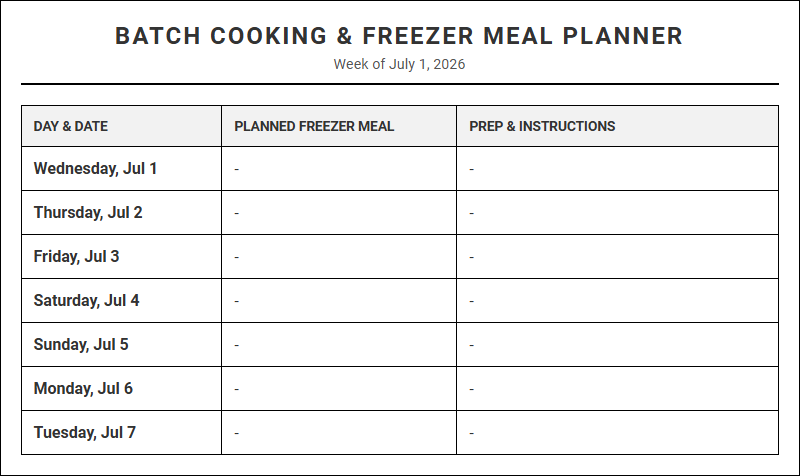
| Day / Date | Meals |
|---|
Done customizing?
Pantry Inventory and Weekly Meal Scheduler - Good to Know
First Expired, First Out (FEFO)
The First Expired, First Out (FEFO) method is a highly strategic inventory management workflow designed to drastically reduce food waste in domestic kitchens. Unlike traditional storage habits where newly purchased groceries are pushed to the front, FEFO mandates that items with the nearest expiration dates are positioned prominently at eye level. This systematic organization ensures that perishable goods are consumed before they lose their nutritional value or spoil.
Implementing this workflow requires a minor shift in daily habits but yields massive financial and environmental dividends. When unpacking groceries, take an extra two minutes to rotate your stock:
- Place new dairy products behind older ones.
- Bring older produce to the front crisper drawer.
- Label decanted dry goods with clear, visible expiration dates.
By establishing this visual hierarchy, you eliminate the common phenomenon of forgotten ingredients rotting in the deep recesses of your refrigerator shelves.
Capsule Pantry
Borrowing a philosophy from minimalist fashion, a Capsule Pantry focuses on a curated selection of highly versatile, high-quality ingredients that can be combined into dozens of distinct meals. Instead of cluttering shelves with single-use specialty spices or niche grains that sit idle for months, this approach prioritizes foundational staples. Think of versatile components like extra virgin olive oil, canned chickpeas, whole grains, and basic aromatics.
A well-structured capsule pantry relies on strategic categorization:
- Bases: Brown rice, quinoa, and durable pasta.
- Proteins: Canned beans, lentils, and high-quality tinned fish.
- Flavor Enhancers: Dijon mustard, soy sauce, and apple cider vinegar.
This streamlined inventory simplifies decision-making, reduces cognitive fatigue when planning dinner, and ensures that every item purchased has a guaranteed purpose. Consequently, your kitchen becomes a model of efficiency, keeping food waste to an absolute minimum.
Zero-Waste Cooking
Embracing Zero-Waste Cooking requires shifting your culinary perspective from consuming only prime cuts and pristine produce to appreciating the utility of every plant and animal part. This culinary philosophy treats food scraps not as garbage, but as valuable culinary building blocks. Vegetable peelings, herb stems, and onion skins can be collected in a freezer bag and transformed into rich, savory vegetable stock.
"True culinary sustainability is achieved when we view every ingredient as a resource with multiple lifecycles."
Similarly, stale bread can be blitzed into homemade breadcrumbs, and wilted greens can be blended into a vibrant pesto. By adopting a root-to-stem and nose-to-tail mindset, you unlock complex depths of flavor while drastically shrinking your household carbon footprint. This proactive approach turns potential waste into delicious, cost-effective culinary creations.
Batch Cooking
Batch Cooking is a highly effective organizational strategy that involves preparing large quantities of foundational ingredients or complete meals during a single cooking session. Instead of preparing a new meal from scratch every evening, you invest a block of time over the weekend to roast large trays of vegetables, cook big pots of grains, and braise versatile proteins. This structured approach saves hours of labor throughout the busy workweek.
To maximize the efficiency of your batch cooking, partition your yields into airtight glass containers. This preservation method keeps food fresh and easily accessible:
- Portion Control: Divide meals into individual lunch-sized servings.
- Modular Components: Keep ingredients separate to allow for creative reassembly.
- Freezer Reserves: Freeze half of your batch to enjoy during exceptionally busy weeks.
This foresight guarantees nutritious, home-cooked options are always ready, neutralizing the temptation of expensive, unhealthy takeout options.
Digital Pantry Inventory
Transitioning to a Digital Pantry Inventory bridges the gap between technology and domestic efficiency. By utilizing digital spreadsheets or specialized mobile applications, home cooks can maintain a real-time ledger of their kitchen contents. This modern approach eliminates guesswork, preventing you from purchasing duplicate ingredients during your weekly grocery run because you could not recall if you had cumin or tomato paste at home.
Modern digital inventory systems offer several distinct advantages:
- Barcode Scanning: Instantly log items as they enter your kitchen.
- Automatic Alerts: Receive notifications before ingredients reach their expiration.
- Recipe Integration: Generate meal suggestions based exclusively on your current inventory.
Maintaining a digital record transforms your phone into a powerful kitchen assistant, optimizing your grocery budget and ensuring no ingredient goes unnoticed or unused.
Ingredient-First Meal Planning
Traditional meal planning often starts with a recipe, leading to a long list of specific, single-use ingredients that ultimately go to waste. In contrast, Ingredient-First Meal Planning reverses this dynamic. This methodology begins by assessing what is already in your refrigerator, particularly perishables nearing the end of their shelf life, and building a menu around those specific components.
To succeed with this technique, categorize your meal planning into three logical steps:
- Evaluate your crisper drawer for items requiring immediate consumption.
- Match these perishable ingredients with stable items in your capsule pantry.
- Select a flexible recipe framework, such as a frittata, stir-fry, or grain bowl.
This dynamic planning method cultivates culinary creativity and ensures that your meal choices are driven by resource conservation rather than rigid, wasteful recipes.
Shelf-Life Tracker
A meticulous Shelf-Life Tracker is an indispensable tool for anyone serious about minimizing kitchen waste. This system involves logging the purchase dates of fresh produce, meats, and dairy, and cross-referencing them with their average storage lifespans. Unlike arbitrary manufacturer dates, a customized tracker focuses on the actual, real-world longevity of food stored under your specific kitchen conditions.
By understanding that berries typically last three days while hearty root vegetables can survive for weeks, you can prioritize your weekly meal consumption schedule. Consider keeping a small dry-erase board on your refrigerator door to highlight high-priority items:
"Eat Me First: Spinach, Fish, Avocados."
This simple visual cue serves as a constant, gentle reminder for household members, guiding their snacking and cooking choices toward the items that need attention first.
Smart Grocery Syncing
In modern households, food waste often occurs due to poor communication between family members. Smart Grocery Syncing solves this issue by utilizing collaborative, cloud-based grocery lists that sync in real-time across multiple mobile devices. When one household member notices the milk is low, they add it to the shared digital list, instantly updating everyone else.
This synchronization prevents the costly duplication of perishable items. Many smart apps also allow you to categorize lists by store aisle, optimizing your shopping route and preventing impulse purchases. By coordinating your household shopping through a unified digital platform, you streamline the purchasing process, control your food budget, and ensure that every item brought into your home is genuinely needed and accounted for.
Meal Prep Rotation
Avoiding culinary boredom is key to sustaining a healthy home-cooking routine, and a structured Meal Prep Rotation is the perfect solution. Eating the exact same meal five days in a row can lead to palate fatigue, often resulting in discarded portions. A smart rotation system involves preparing modular components that can be easily transformed into entirely different flavor profiles throughout the week.
For example, a large batch of seasoned shredded chicken can be utilized across various distinct culinary styles:
- Monday: Combined with black beans and corn for Mexican-style street tacos.
- Wednesday: Tossed with crisp vegetables and ginger dressing for an Asian-inspired salad.
- Friday: Simmered in a rich tomato sauce over pasta for a comforting Italian dinner.
This variety keeps your meals engaging and delicious while utilizing the same efficient base ingredients.
Leftover Makeover
The concept of the Leftover Makeover elevates day-old meals from uninspiring repeats into exciting, secondary culinary creations. Reheating a meal in the microwave often compromises its texture and appeal. Instead, view leftovers as pre-cooked ingredients that significantly reduce the preparation time of your next meal, saving you both energy and effort.
With a little imagination, yesterday's dinner can easily become today's gourmet lunch:
- Transform leftover roasted vegetables into a rich, velvety blended soup.
- Convert Sunday's pot roast into filling for savory Tuesday night empanadas.
- Turn plain white rice into a high-heat, crispy garlic fried rice.
By mastering a few simple, transformative cooking techniques, you can ensure that every single bite of food purchased is enjoyed to its fullest potential.
Leave a comment