
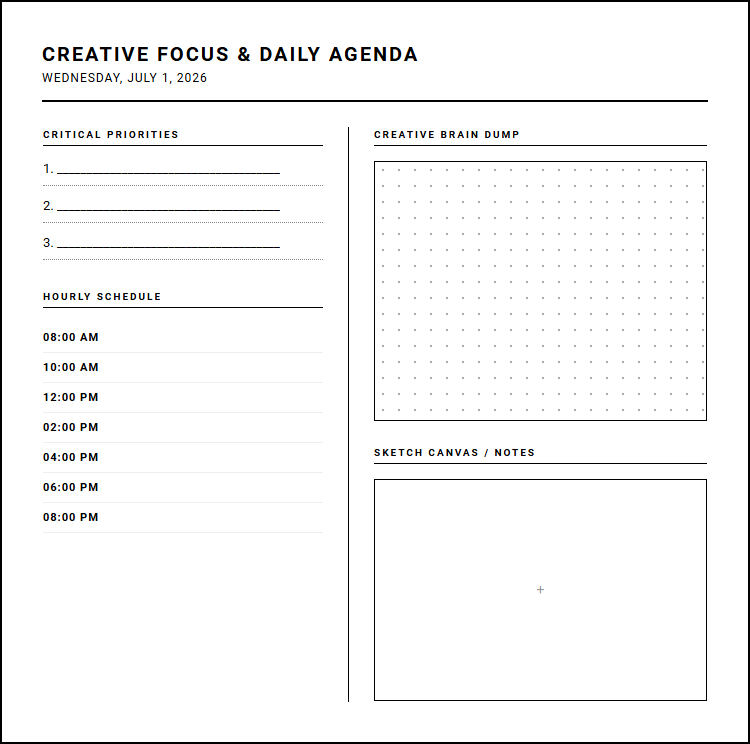
Creatives often struggle to channel chaotic inspiration into structured execution. While standard funding sources and traditional project management tools secure resources, they rarely support raw ideation. The Creative Brain Dump And Sketch Agenda printable calendar solves this, as it grants designers the spatial freedom to map uninhibited thoughts. Under the stipulation that unstructured layouts require personal discipline, features like dedicated thumbnail sketching grids and mind-mapping zones provide necessary guardrails. Below, we examine how to leverage this daily agenda to streamline your workflow.
Create Your Creative Brain Dump And Sketch Agenda
|
Critical Priorities
1. ______________________________________
2. ______________________________________
3. ______________________________________
Hourly Schedule
08:00 AM
10:00 AM
12:00 PM
02:00 PM
04:00 PM
06:00 PM
08:00 PM
|
Creative Brain Dump
Sketch Canvas / Notes
+
|
Done customizing?
Creative Brain Dump And Sketch Agenda - Good to Know
Visual and Analog Ideation Methodologies
Explore ten transformative techniques designed to unlock creativity, organize complex thoughts, and streamline your cognitive workflow through analog and semantic structuring.
Sketchnoting
Sketchnoting is a dynamic method of note-taking that integrates words and drawings to create memorable visual maps of information. By combining text, shapes, arrows, and simple illustrations, practitioners can capture the essence of lectures, books, or meetings in real time. This dual-coding approach engages both the linguistic and visual processing centers of the brain, leading to significantly higher retention rates and deeper comprehension.
When you practice sketchnoting, you are not merely transcribing spoken words; instead, you actively filter, synthesize, and translate concepts into personal iconography. This active listening strategy prevents cognitive overload and transforms passive consumption into an active, creative dialogue with the material. Key components of this practice include:
- Visual hierarchy using bold headers and varied font sizes
- Connectors like lines, dashes, and pointers to show relationships
- Frames and containers to group related ideas together
Mind Mapping
Developed as a tool to mirror the brain's natural associative thinking patterns, Mind Mapping begins with a single central concept and radiates outward. This hierarchical structure allows users to explore complex subjects without the constraints of linear writing. By placing the primary subject in the center of the page, you can freely branch out into subtopics, which then fracture into finer details, creating an organic web of interconnected thoughts.
This technique is incredibly effective for brainstorming sessions, project planning, and organizing dense research. It allows your mind to jump between ideas spontaneously, capturing sudden flashes of inspiration while maintaining a clear overview of the entire conceptual landscape. To maximize the effectiveness of a mind map, consider incorporating these structural elements:
- Use single keywords or short phrases per branch for maximum flexibility.
- Employ distinct colors to categorize different conceptual branches.
- Incorporate simple icons to represent key milestones or high-priority nodes.
Visual Journaling
Visual Journaling serves as a highly personal sanctuary where art meets introspection. Unlike traditional diaries that rely solely on written prose, a visual journal welcomes watercolor, collage, sketches, and calligraphy to express complex internal emotional landscapes. This multi-medium format provides a therapeutic release, allowing individuals to process experiences and emotions that are often difficult to articulate through language alone.
The beauty of this practice lies in its absolute lack of rigid rules. A single page might contain a dark, abstract wash of ink representing stress, juxtaposed against a carefully detailed sketch of a flower symbolizing hope. By physicalizing abstract thoughts onto paper, you create a tangible record of your psychological and creative growth over time. It is a powerful practice for self-discovery, stress reduction, and artistic experimentation, serving as a safe playground for raw, unfiltered self-expression.
Ideation Canvas
An Ideation Canvas is a structured, visual framework designed to guide teams and individuals through the systematic process of brainstorming and problem-solving. Typically laid out as a large, segmented grid, the canvas forces thinkers to address specific facets of a challenge, such as target audience, resource constraints, value propositions, and distribution channels. This spatial arrangement ensures that no critical angle of a project is overlooked during the initial creative frenzy.
By compartmentalizing brainstorming into designated zones, the canvas transforms chaotic ideation into an organized, actionable strategy. It encourages collaboration, as team members can easily contribute ideas using color-coded sticky notes. This visual methodology democratizes the creative process, allowing quiet participants to contribute equally and enabling the entire team to see how disparate pieces of a business or creative puzzle align to form a cohesive, structured whole.
Rapid Logging
At the core of the analog productivity movement sits Rapid Logging, a streamlined method of organizational notation designed to capture information quickly and efficiently. Utilizing a minimalist system of symbols, rapid logging categorizes daily entries into distinct classifications, such as tasks, events, and notes. This clean, bulleted approach strips away the narrative fluff of traditional journaling, leaving behind a concise, actionable, and highly organized daily record.
The speed of rapid logging makes it sustainable for busy individuals who want to track their life without spending hours writing. By quickly jotting down thoughts as they occur, you free up valuable mental bandwidth, reducing anxiety and increasing focus on the task at hand. Over time, these brief entries build a reliable index of your life, providing an invaluable historical archive of your personal and professional achievements, habits, and daily responsibilities.
Thumbnail Sketching
Before committing precious time and resources to a full-scale project, artists and designers rely on Thumbnail Sketching to explore composition and layout rapidly. These tiny, low-fidelity drawings are executed quickly and in great numbers, allowing creators to test different perspectives, lighting schemes, and structural arrangements in a matter of minutes. Because of their small size, there is no room for distracting details, forcing the creator to focus solely on essential shapes and balance.
This rapid experimentation prevents artists from becoming prematurely attached to their first idea, which is rarely the strongest. By producing dozens of miniature variations, you exhaust obvious solutions and push through to highly original compositions. Thumbnail sketching is a vital preparatory phase in graphic design, illustration, and filmmaking, ensuring that the foundational architecture of the final piece is rock-solid before any high-fidelity execution begins.
Mood Boarding
To establish the aesthetic direction and emotional resonance of a project, designers and directors curate a Mood Board. This collage of images, typography, color swatches, textures, and found objects acts as a visual anchor for any creative endeavor. Whether compiled digitally or physically pinned to a foam board, these elements work in tandem to convey a specific feeling, tone, or atmosphere that words alone often fail to capture accurately.
In collaborative environments, a mood board serves as a crucial alignment tool, ensuring that clients, stakeholders, and creative teams are working toward a unified vision. By referencing the board throughout the production process, designers can make consistent stylistic choices, keeping the project cohesive and on-brand. It is an essential step in fashion design, interior styling, branding, and cinematic pre-production, translating abstract concepts into a concrete sensory guide.
Stream of Consciousness
The practice of Stream of Consciousness writing or drawing involves transferring every passing thought directly onto the page without pause, editing, or self-censorship. Often referred to as "morning pages," this exercise requires the pen to keep moving continuously, capturing the raw, unpolished, and sometimes chaotic inner monologue of the subconscious mind. It is a psychological detox tool designed to clear mental clutter and bypass the inner critic.
By giving yourself permission to produce nonsensical, messy, or repetitive work, you break down the perfectionist barriers that frequently cause creative block. Hidden deep within this unfiltered output, you will often find surprising insights, unresolved emotional themes, and brilliant seeds of new ideas that your conscious mind would have otherwise dismissed as illogical. It is a powerful ritual for unlocking creative flow and cultivating psychological clarity.
Doodle Planner
A Doodle Planner merges the structured world of scheduling with the playful, cognitive benefits of casual drawing. Instead of relying solely on rigid grids and plain text lists, this system encourages users to integrate small doodles, borders, and hand-lettered elements directly into their daily agendas. This whimsical approach transforms the mundane chore of time management into an engaging, visually stimulating, and highly personalized creative ritual.
Doodling while planning has been shown to improve concentration, memory retention, and spatial awareness. It keeps the mind anchored during long planning sessions and makes interacting with your schedule a joyful experience rather than a stressful reminder of obligations. By turning your planner into an evolving work of art, you foster a healthy, positive relationship with productivity, ensuring that your daily task lists are met with enthusiasm and creative energy.
Scribble Space
Every creative mind requires a dedicated, boundary-free zone known as a Scribble Space. This is a deliberate area on a page, whiteboard, or scrap paper where there are absolutely no expectations of neatness, logic, or aesthetic appeal. It is a chaotic sandbox designed for testing pen ink, scratching out frustration, testing color combinations, or simply letting your hand wander in mindless, geometric scribbles while processing complex thoughts.
Having a designated, messy space removes the intimidating pressure of the pristine blank page. It invites mistakes, celebrates imperfection, and serves as a low-stakes starting point for deeper work. When you allow your pen to glide without purpose, you stimulate motor-sensory pathways that help calm the nervous system, lower stress, and gently ease your brain into a relaxed state of open awareness, laying the groundwork for spontaneous breakthroughs.
Leave a comment