
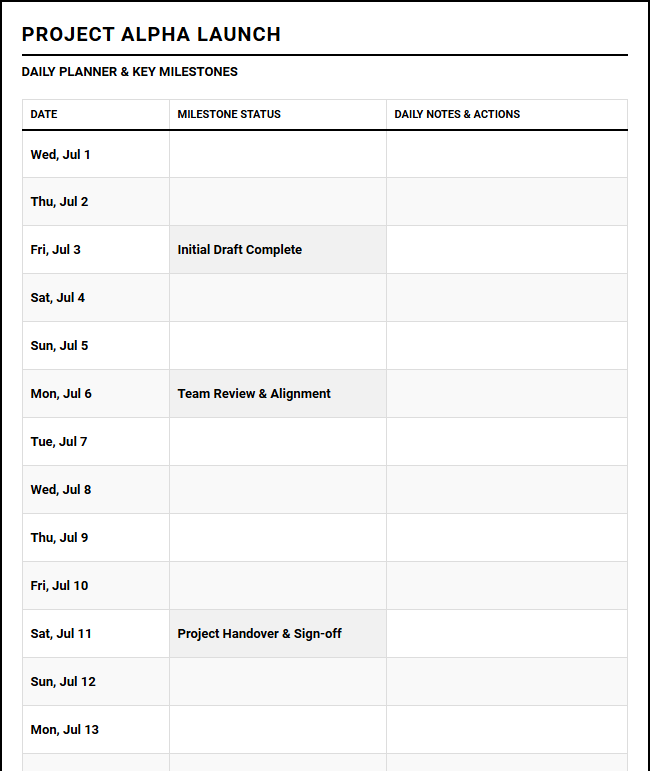
Managing complex project milestones often leads to missed deadlines and team misalignment. While enterprise software and standard resource allocations provide baseline tracking, a tactile Daily Agendas printable calendar grants managers immediate cognitive clarity. However, these planners must be integrated systematically to be effective. For instance, agile sprint coordinators use physical milestone trackers to maintain daily velocity. Below, we outline how to leverage these printable daily planners to streamline your delivery timeline.
Create Your Project Milestone Daily Planner
Done customizing?
Project Milestone Daily Planner - Good to Know
Time blocking
Time blocking is a highly effective cognitive workflow strategy where you divide your day into distinct, dedicated blocks of time. Instead of keeping an open-ended to-do list, you assign specific tasks to precise hours of the day. This practice minimizes the mental fatigue associated with constant context switching and decision-making.
To implement this methodology successfully, consider the following structural approach:
- Focus Blocks: Dedicate uninterrupted 90-minute intervals to high-priority cognitive tasks.
- Admin Blocks: Group shallow tasks like emails, messaging, and paperwork into a single 30-minute afternoon slot.
- Buffer Blocks: Allocate flexible 15-minute windows to handle unexpected delays and rest.
By scheduling your day, you create a realistic blueprint of your capacity. This visual commitment establishes firm boundaries, helping you defend your time against external interruptions, meetings, and low-value activities that drain productivity.
Micro-milestones
When facing massive, complex projects, paralysis often sets in due to the sheer volume of work. Micro-milestones solve this psychological barrier by breaking down macro-level objectives into granular, daily achievements. This technique leverages the progress principle, generating incremental bursts of dopamine that sustain long-term motivation.
A systematic progression for establishing these markers includes:
- Deconstructing the primary project deliverable into weekly phases.
- Subdividing each weekly phase into concrete, daily actionable items.
- Defining objective validation criteria for each micro-milestone to prevent scope creep.
Instead of aiming to "write the annual report," a micro-milestone focuses on "drafting the executive summary financial chart." This shift in focus reduces anxiety, builds momentum, and provides immediate clarity, allowing team members to experience continuous success while tracking steady forward progress toward the final deadline.
Critical path mapping
In project management, efficiency depends on understanding task interdependencies. Critical path mapping is a mathematical utility used to identify the longest sequence of dependent tasks required to complete a project from start to finish. Any delay in these core tasks directly impacts the final delivery date.
"By identifying the critical path, project leaders can allocate resources strategically, ensuring that bottleneck activities receive priority attention."
Non-critical activities possess "float" or "slack," meaning their delayed execution will not disrupt the overall timeline. Recognizing this distinction prevents team exhaustion by allowing flexibility on secondary tasks. Utilizing this analytical framework ensures optimal resource scheduling, prevents systemic project delays, and provides stakeholders with highly accurate forecasting estimates throughout the development lifecycle.
Sprint planning
Sprint planning is a foundational ceremony within Agile frameworks, establishing a collaborative agreement on what a cross-functional team can realistically deliver during an upcoming work cycle. This ceremony aligns the product backlog with the development team's actual capacity, transforming broad goals into an actionable execution plan.
An optimized sprint planning session involves several key inputs:
- Product Backlog: A prioritized list of user stories and technical requirements.
- Team Capacity: The calculated availability of team members, accounting for time off.
- Definition of Done (DoD): A shared standard of quality criteria that every task must satisfy.
This collaborative approach fosters collective ownership. By negotiating scope realistically, teams avoid burnout while maintaining a sustainable cadence of continuous delivery, ensuring that every sprint yields a functional, high-value increment of the product.
Task prioritization matrix
Without clear prioritization, teams default to working on easy or urgent tasks rather than highly impactful ones. A Task prioritization matrix, inspired by the classic Eisenhower model, provides a structured visual framework to evaluate tasks based on two critical dimensions: urgency and importance.
| Priority Level | High Urgency | Low Urgency |
|---|---|---|
| High Importance | Do First: Immediate, critical tasks requiring active focus. | Schedule: Strategic growth, planning, and proactive tasks. |
| Low Importance | Delegate: Administrative tasks, emails, and minor requests. | Eliminate: Distractions, busywork, and low-value activities. |
This classification ensures resources are channeled toward high-value objectives. Consistently utilizing this matrix prevents team members from falling into the trap of reactive busyness, directing energy toward strategic initiatives that drive meaningful growth.
Velocity tracking
Predictability is essential for long-term project planning. Velocity tracking measures the rate at which an agile team completes work during a standard sprint, typically calculated in story points or hours. By analyzing historical output, project managers can make data-driven forecasts rather than relying on optimistic estimates.
Consider the calculation: Average Velocity = Total Completed Points / Number of Sprints. For example, if a team completes 35, 42, and 38 points over three successive sprints, their average velocity is approximately 38 points. This metric helps set realistic sprint boundaries, preventing overallocation.
Sudden drops in velocity serve as early indicators of underlying problems, such as technical debt, changing requirements, or team friction. Monitoring these trends empowers teams to address workflow bottlenecks proactively, stabilizing delivery timelines.
Gantt chart layout
A Gantt chart layout provides a visual representation of a project timeline, mapping out tasks, durations, and dependencies over a calendar view. This structural clarity allows stakeholders to understand project phases at a glance, highlighting how individual contributions fit into the grand design.
- Horizontal Bars
- Represent the duration and schedule of individual tasks or project phases.
- Dependency Links
- Visual connectors showing which tasks must finish before subsequent ones can begin.
- Milestone Markers
- Diamond-shaped symbols indicating significant project achievements or delivery deadlines.
This visualization highlights overlapping activities, resource conflicts, and scheduling constraints. Using Gantt charts keeps cross-functional teams aligned on dependencies, reducing project risk and ensuring complex, multi-layered initiatives remain on schedule.
Deep work sessions
In modern open-office and highly connected environments, cognitive fragmentation is a major barrier to productivity. Deep work sessions are deliberate blocks of time dedicated to cognitively demanding tasks, performed in a state of distraction-free concentration that pushes cognitive capabilities to their limits.
To cultivate an environment optimized for deep focus, establish clear ground rules:
- Disable all digital notifications and close unnecessary browser tabs.
- Signal your unavailability to colleagues using visual cues or status indicators.
- Work on a single, predefined task to prevent cognitive residue from context switching.
Practicing deep work enables individuals to master complex information quickly and produce high-quality output in less time. This disciplined focus helps professionals stand out in an increasingly distracted knowledge economy.
OKR alignment
Organzational disconnect occurs when daily activities drift away from high-level company goals. OKR (Objectives and Key Results) alignment bridges this gap, connecting individual daily tasks with broad organizational targets, ensuring everyone works in unison.
The structured hierarchy of an OKR framework consists of:
- Objectives: Qualitative, aspirational, and action-oriented statements of what needs to be achieved.
- Key Results: Quantitative, measurable metrics that track progress toward the objective.
- Initiatives: Specific projects, tasks, and daily experiments designed to drive the key results.
When every team member understands how their work influences the company's progress, focus improves and engagement rises. This alignment transforms strategy from a static document into a dynamic roadmap that guides everyday execution.
Daily standup log
The daily standup log is a concise, highly structured record of a team's daily status updates. This 15-minute sync ensures transparency, alignment, and immediate obstacle identification across self-organizing teams. By keeping the update standardized, teams prevent meetings from devolving into lengthy technical discussions.
Each team member addresses three core questions during the log:
- What did I accomplish yesterday to help the team meet the sprint goal?
- What will I focus on today to advance toward our target?
- Are there any impediments blocking my progress or slowing me down?
Recording these updates in a centralized digital system creates a historical log of team progress. This visibility helps team leads identify patterns, resolve blockers quickly, and maintain steady momentum throughout the development cycle.
Leave a comment