
Staying committed to long-term objectives amidst daily operational noise is a constant challenge. While standard operational budgets and funding sources keep daily tasks afloat, they rarely drive strategic growth.
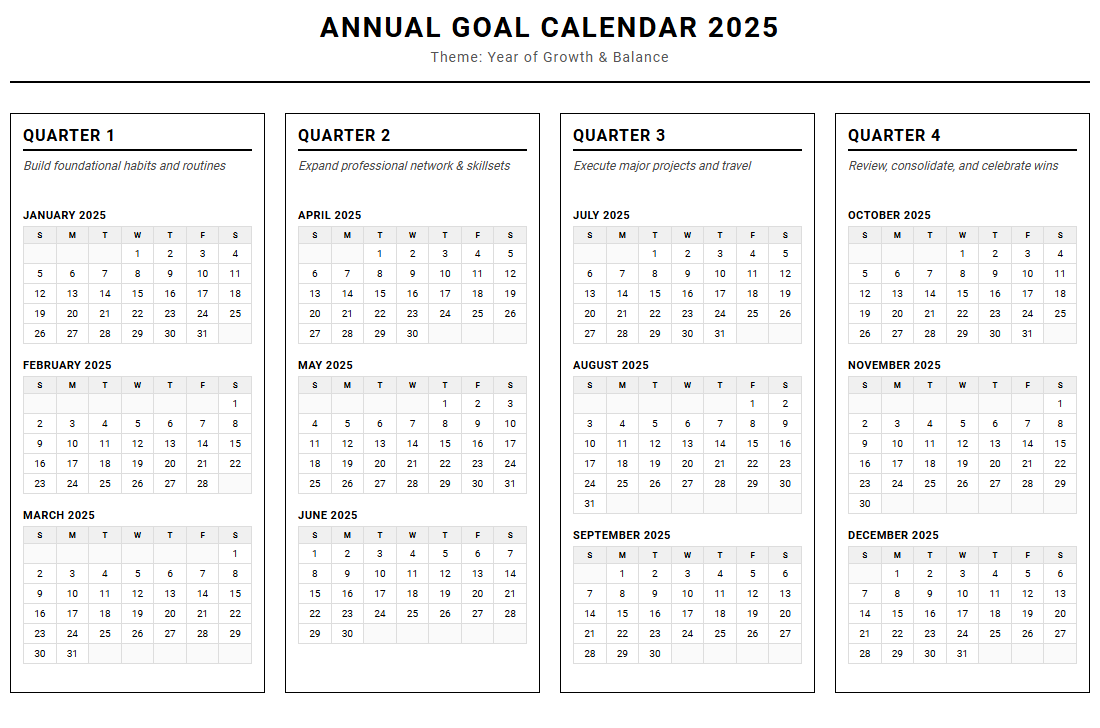
An intentional Annual Goal Setting Calendar grants you the structural framework needed to translate vision into execution. However, this tool requires disciplined weekly reviews to be effective. By utilizing proven frameworks like OKRs, you can systematically track progress. Below, we outline how to maximize this printable calendar for sustained productivity.
Create Your Annual Goal Setting Calendar
Done customizing?
Annual Goal Setting Calendar - Good to Know
12-Week Year
The 12-Week Year methodology redefines the traditional annual cycle by compressing the calendar year into twelve weeks. This system creates a heightened sense of urgency, eliminating the complacency often found in January when December seems distant. By treating each week as a month, individuals and organizations accelerate their execution cycle and maintain constant focus on critical objectives.
To implement this system successfully, execution must be measured daily and weekly. This framework relies on a highly structured plan that focuses on three primary pillars:
- Predictable Lead Indicators: Tracking inputs that directly influence success.
- Weekly Accountability: Reviewing progress with peer groups or coaches.
- Scorekeeping: Calculating the execution rate percentage each week.
Achieving a consistent execution rate of eighty percent or higher on weekly tactics almost guarantees the realization of your long-term aspirations within this shortened, highly productive timeframe.
OKR Framework
The Objectives and Key Results (OKR) framework is a powerful goal-setting methodology popularized by silicon valley giants to align organizational and personal efforts. Objectives define exactly what you want to achieve, acting as ambitious, qualitative, and action-oriented destinations. Key Results monitor how you get to the destination by establishing concrete, quantitative, and time-bound milestones that measure progress objectively.
When structuring OKRs, it is essential to follow specific guidelines to ensure clarity and impact:
- Limit your focus: Design design no more than three to five objectives.
- Ensure measurability: Every key result must contain a clear numerical target.
- Promote stretch goals: Set targets that push capabilities without causing burnout.
By implementing this structured approach, you bridge the gap between high-level strategy and daily execution, ensuring that every operational task directly supports your grandest ambitions.
Backward Mapping
Backward Mapping is a strategic planning technique that starts with your final objective and works in reverse to determine the necessary sequence of actions. Instead of asking what to do next from your current position, you project yourself to the successful completion of your goal and ask what immediate step preceded that triumph. This retrospective planning methodology minimizes wasted effort and exposes hidden dependencies.
This systematic process strips away non-essential tasks by focusing exclusively on critical path actions. By mapping backwards, you create a logical chain of cause-and-effect milestones that make complex, intimidating targets feel manageable. Crucial breakthroughs are identified early, allowing you to allocate resources efficiently and anticipate obstacles before they manifest. This sequence ensures that your daily schedule remains perfectly aligned with the desired end state, establishing a direct path to victory.
Vision Board Integration
A Vision Board Integration transcends mere aesthetic appeal by anchoring your subconscious mind to your long-term aspirations. By curating a structured collage of images, phrases, and symbols that represent your ideal future, you leverage cognitive priming to recognize opportunities that align with your targets. This visual externalization of goals serves as a constant daily reminder of your deeper motivations.
To maximize the cognitive benefits, combine your board with actionable triggers:
- Place the digital or physical board in your primary workspace.
- Associate specific images with your current 12-week targets.
- Spend five minutes each morning visualizing the process required to achieve these milestones.
This intentional practice bridges the gap between abstract desires and tangible daily efforts, reinforcing your commitment to the hard work required for success.
Quarterly Milestones
Setting Quarterly Milestones is a vital strategy for breaking down massive annual targets into bite-sized, executable phases. A ninety-day window provides the perfect balance of long-term vision and near-term execution, allowing you to pivot when circumstances change without losing overall momentum. These milestones act as navigational beacons, keeping you on course throughout the year.
"We overestimate what we can do in a day, but underestimate what we can achieve in ninety days."
During each quarter, your focus should remain locked on achieving three core milestones. This disciplined approach prevents the cognitive overload that often accompanies multi-year planning. By celebrating these frequent checkpoints, you build powerful psychological momentum, turning the arduous journey of long-term development into a series of predictable, repeatable victories.
Habit Loop Tracker
The Habit Loop Tracker is a behavioral science tool designed to wire positive routines into your daily life by dissecting actions into three distinct components: the cue, the routine, and the reward. By understanding how these loops function, you can systematically dismantle unproductive behaviors and replace them with empowering habits that fuel your primary objectives.
To optimize your daily performance, track these essential components in your journal:
- The Cue: The specific trigger that initiates the behavior, such as time or location.
- The Routine: The actual habit or action you perform.
- The Reward: The positive reinforcement that satisfies your brain.
By documenting this sequence daily, you gain conscious control over automatic behaviors, transforming positive habits into the default architecture of your lifestyle.
Notion Goal Dashboard
A customized Notion Goal Dashboard serves as the central command center for your personal and professional development. By centralizing your vision, metrics, and daily tasks within a single, interconnected digital workspace, you eliminate the friction of searching through multiple applications. This streamlined organization ensures absolute clarity regarding your current priorities.
Your digital architecture should ideally incorporate several dynamic elements to optimize workflow:
- Progress databases that calculate completion percentages automatically.
- Relational databases linking daily habits directly to high-level OKRs.
- Visual galleries displaying your integrated vision board.
Using these digital systems allows you to transform static goals into a living, breathing ecosystem that adapts alongside your daily progress, ensuring you remain focused on what matters most.
Time Blocking
Time Blocking is a productivity technique where you dedicate specific blocks of time to single, predetermined tasks. Unlike a generic to-do list, this method schedules your energy and attention, preventing multitasking and protecting your calendar from external distractions. By assigning a distinct purpose to every hour of the day, you regain control over your attention span.
To practice effective time blocking, divide your schedule into deep focus sessions, administrative blocks, and recovery periods. Deep work blocks should be scheduled during your peak cognitive hours, ensuring your most challenging objectives receive your best energy. This disciplined allocation of time forces you to confront the reality of your capacity, preventing overcommitment and ensuring that critical projects consistently receive the focused attention they require.
Wheel of Life Assessment
The Wheel of Life Assessment is a comprehensive diagnostic tool used to measure your current satisfaction across key dimensions of existence, including career, finance, health, relationships, and personal growth. By scoring each area from one to ten and plotting them on a circular diagram, you visually expose imbalances that threaten your overall well-being and long-term sustainability.
To maintain equilibrium, perform this evaluation at regular intervals:
- Assess your current satisfaction level in each segment honestly.
- Identify the areas with the lowest scores that are dragging down your overall quality of life.
- Design targeted objectives to restore balance in the upcoming cycle.
This holistic diagnostic ensures that your pursuit of professional milestones does not come at the expense of your health, relationships, or inner peace.
Monthly Reflection Review
A structured Monthly Reflection Review provides the necessary pause to evaluate performance, learn from experiences, and refine strategies. Without this intentional step back, it is easy to mistake motion for progress, continuing down an inefficient path. This review serves as your strategic alignment check, ensuring daily efforts still match long-term goals.
During this session, analyze what strategies worked well, what obstacles caused friction, and how your allocation of time matched your priorities. This process converts raw experience into actionable wisdom, enabling you to optimize your habits and systems for the upcoming month. Consistently engaging in this reflective practice develops self-awareness, deepens learning, and ensures that your path forward is informed by empirical data rather than mere guesswork.
Leave a comment