

Many professionals struggle to maintain daily momentum and prevent burnout. While standard professional development funding sources back external training, they often neglect daily behavioral habits. The Daily Achievement and Gratitude Calendar grants users immediate cognitive clarity, driving sustained performance. To maximize impact, this tool requires active daily engagement rather than sporadic use-a method proven by executives at leading firms. Below, we examine how this printable calendar optimizes your workflow.
Create Your Daily Achievement and Gratitude Calendar
Done customizing?
Daily Achievement and Gratitude Calendar - Good to Know
Win of the Day
In the relentless pursuit of long-term goals, we often overlook the immediate victories that shape our daily progress. Establishing a Win of the Day practice demands that you identify at least one successful outcome from your waking hours, no matter how minor it might initially appear. This cognitive shift retrains the brain to scan the environment for progress rather than focusing exclusively on stressors, shortcomings, or incomplete tasks.
By consciously acknowledging this daily triumph, you construct a psychological buffer against burnout. Consider implementing this routine during your evening wind-down process by writing down your win in a dedicated space. Your daily success could be:
- Completing a highly challenging technical report ahead of schedule.
- Managing a difficult conversation with patience and absolute clarity.
- Choosing a nourishing, home-cooked meal over convenient fast food.
Consistently recording these milestones reinforces your agency, proving that you possess the capability to influence your daily trajectory and overcome routine obstacles effectively.
Micro-achievements
Massive objectives can easily paralyze us with overwhelm, leading to procrastination and anxiety. Micro-achievements counteract this paralysis by breaking macro-goals down into atomic, highly manageable actions that require minimal initial activation energy. When you reduce a daunting project to its absolute smallest components, you make starting incredibly easy, which is often the most difficult part of any endeavor.
These bite-sized victories trigger immediate cognitive satisfaction, building the vital momentum needed to tackle subsequent phases of work. To effectively leverage this strategy, try utilizing the following structured approach:
- Define the macro-goal: Write an entire chapter of a book.
- Isolate the micro-step: Draft just one single, highly focused paragraph.
- Execute immediately: Complete the micro-step without self-judgment or editing.
Accumulating these tiny victories throughout your day establishes a powerful compounding effect, transforming major, intimidating milestones into inevitable outcomes of steady, incremental progress.
Gratitude prompts
Human psychology is naturally wired with a survival-based negativity bias, meaning we instinctively pay more attention to threats and problems than to positive circumstances. Utilizing targeted gratitude prompts acts as an intentional intervention to balance this cognitive bias, directing our focus toward the abundance already present in our lives. Rather than practicing generic thankfulness, specific prompts force deep, contextual reflection that yields genuine emotional resonance.
"Gratitude turns what we have into enough, and more." - Anonymous
Integrating structured prompts into your morning routine can radically shift your perspective for the remainder of the day. Excellent starting points include reflecting on a specific person who recently eased your workload, a modern convenience that saves you valuable time, or a past hardship that fostered your current resilience. This deliberate cognitive exercise cultivates sustained emotional intelligence and long-term mental clarity.
Dopamine menu
When mental fatigue sets in, our default response is often to reach for mindless, high-dopamine distractions like social media scrolling or emotional eating. A dopamine menu is a pre-planned, personalized list of healthy, energizing activities designed to rejuvenate your brain without sabotaging your productivity. Having this menu prepared in advance removes the decision fatigue associated with trying to find a constructive break activity when you are already feeling depleted.
To maximize its utility, categorize your dopamine menu by the amount of time and energy each activity requires:
- Appetizers (5 mins): Doing a quick physical stretch or stepping outside for fresh air.
- Entrées (20-30 mins): Reading a chapter of a book or taking a walk around the block.
- Desserts (Passive): Listening to an uplifting instrumental playlist while completing manual chores.
This structured approach ensures you always have a healthy, constructive way to recharge your cognitive batteries.
Habit stacking
Creating entirely new behaviors from scratch requires significant willpower, which is a highly finite daily resource. Habit stacking bypasses this limitation by anchoring your desired new routine directly onto an already established, deeply ingrained habit. By piggybacking on the neural pathways that your brain has already constructed, you drastically reduce the friction typically associated with behavioral modification and routine building.
The scientific formula for this methodology is elegant in its simplicity: "After I [Current Habit], I will [New Habit]." Consider how these powerful stacks function in everyday scenarios:
- Physical health: "After I pour my morning cup of coffee, I will take my daily vitamins."
- Mental clarity: "After I close my laptop at the end of the workday, I will meditate for five minutes."
- Organization: "After I brush my teeth at night, I will write down my top priority for tomorrow."
This systematic integration ensures your new habits quickly become automatic components of your daily rhythm.
Mindful reflection
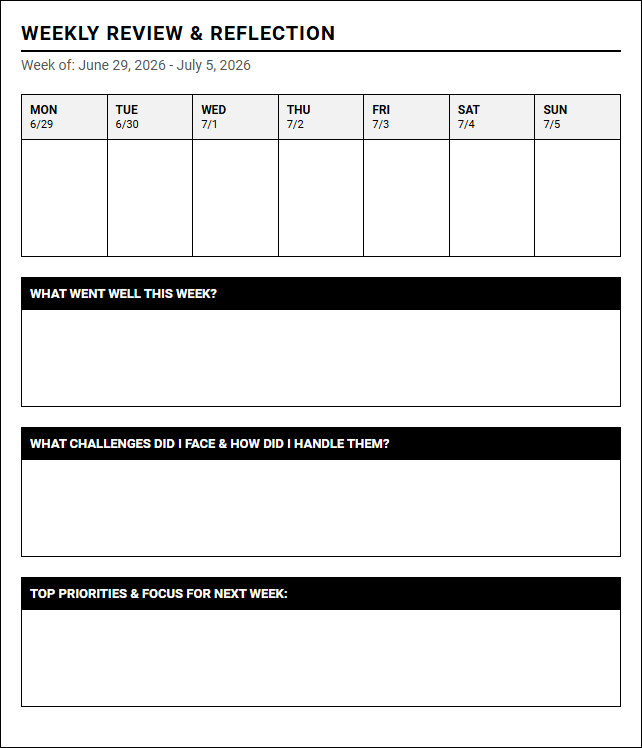
Operating on autopilot prevents us from identifying the behavioral patterns that hold us back from reaching our true potential. Mindful reflection is the intentional practice of stepping away from daily execution to objectively observe your thoughts, emotions, and reactions without judgment. This deliberate pause allows you to assess whether your current daily actions are truly aligned with your deeper, long-term personal values.
To implement this practice effectively, set aside ten minutes at the end of each week in a quiet, distraction-free environment. Ask yourself honest, open-ended questions regarding your energy levels, emotional triggers, and moments of deep alignment. By transforming raw experience into structured self-knowledge, you cultivate the clarity required to make conscious adjustments, rather than repeatedly falling victim to reactive habits and external demands.
Streak tracking
Maintaining long-term consistency is often more challenging than initiating a new behavior in the first place. Streak tracking leverages visual progress cues to maintain your momentum, turning your daily consistency into an engaging game that you naturally want to win. Seeing an unbroken chain of successful days creates a powerful psychological incentive to complete your daily habit, as the pain of breaking the streak begins to outweigh the effort required to maintain it.
Whether you choose to use a digital habit tracking application, a physical wall calendar with bold markers, or a simple bullet journal grid, the visual feedback is equally impactful. Every added mark acts as a tangible vote of confidence in your new identity. This simple visual cue reminds you of the investment you have already made, encouraging you to push through moments of low motivation.
Positive affirmations
The internal dialogue we maintain with ourselves constantly shapes our self-image, beliefs, and subsequent actions. Positive affirmations are structured, present-tense statements designed to consciously challenge and systematically overwrite self-limiting beliefs and negative self-talk. When practiced consistently, these statements help rewire neural pathways, gradually shifting your core subconscious assumptions about your capabilities and self-worth.
To ensure affirmations are truly effective rather than superficial, they must feel personally authentic and align closely with your actual goals. Consider utilizing these powerful examples as templates for your daily practice:
- "I possess the focus, resilience, and capability to navigate today's complex challenges."
- "My personal boundaries are valuable, and I honor them to protect my mental energy."
- "I learn rapidly from my setbacks and view them as essential data for my growth."
Repeating these statements daily reinforces a constructive mindset, priming you to act in accordance with your highest potential.
Success journaling
While standard journals often capture a broad spectrum of daily events, emotions, and complaints, a success journal is laser-focused on documenting your personal growth, overcome obstacles, and milestones. This specialized record serves as a highly personalized archive of capability. When you inevitably face periods of intense self-doubt, creative blocks, or professional stagnation, reviewing this journal provides empirical, undeniable evidence of your past resilience and achievements.
To maintain a highly impactful success journal, aim to record entries that go beyond mere lists of completed tasks. Detail the specific strategies you developed to solve complex problems, the internal fears you successfully managed, and the positive feedback you received from peers. This systematic documentation builds an unshakeable foundation of self-trust, proving that you have successfully navigated uncertainty before and possess the innate skills to do so again.
Intentional planning
Without a clear, proactive design for your day, your time will inevitably be claimed by the urgent demands, emails, and priorities of other people. Intentional planning is the strategic practice of defining your focus, boundaries, and key actions before the day begins, ensuring your finite time and energy are allocated to what truly matters. This process transforms you from a reactive participant in your life into an active, focused designer of your daily schedule.
Every evening or early morning, dedicate fifteen minutes to mapping out your upcoming day. Limit your primary focus to no more than three high-impact tasks, schedule specific time blocks for deep work, and intentionally carve out space for rest. By establishing these clear boundaries in advance, you eliminate decision fatigue, maximize cognitive efficiency, and ensure that your daily efforts directly support your broader, long-term vision.
Leave a comment