
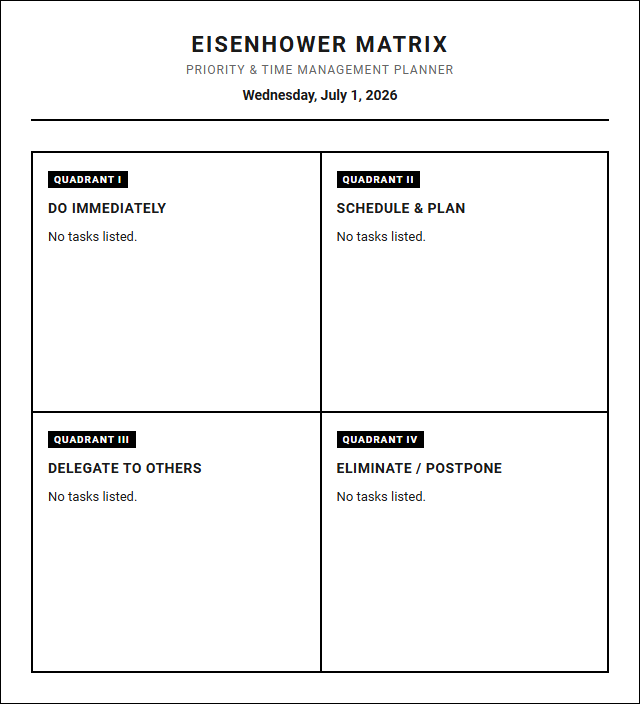
Many professionals struggle to distinguish urgent crises from truly important long-term goals, leading to chronic burnout. While standard daily planners track deadlines, they fail to categorize task value. The printable Eisenhower Matrix Priority Calendar solves this, transforming task lists into visual priority quadrants-provided users commit to daily categorization. For example, it clearly separates reactive fire-fighting from proactive strategic planning. Below, we outline how to leverage this framework to reclaim your productivity.
Create Your Eisenhower Matrix Priority Calendar
|
|
|
|
|
|
|
Quadrant I
Do Immediately
|
Quadrant II
Schedule & Plan
|
|
Quadrant III
Delegate to Others
|
Quadrant IV
Eliminate / Postpone
|
Done customizing?
Eisenhower Matrix Priority Calendar - Good to Know
Urgent-Important Matrix
The Urgent-Important Matrix serves as a foundational cognitive tool designed to help professionals segregate their daily tasks based on two critical parameters: urgency and importance. Urgency demands immediate attention, often associated with someone else's timeline or a pressing deadline. Importance, conversely, relates directly to long-term goals, core values, and strategic growth. By plotting activities along these two axes, individuals can systematically evaluate where their energy is best spent.
Using this matrix prevents professionals from falling into a reactive state of work, where they constantly put out fires instead of building sustainable systems. It encourages a proactive mindset, forcing a clear distinction between activities that yield genuine progress and those that merely generate noise. Incorporating this structured approach into daily planning sessions ensures that high-impact projects receive the dedicated resources they require to succeed over time.
The Four Quadrants
The conceptual framework of this prioritization system divides all tasks into Four Quadrants, each requiring a distinct behavioral response:
- Quadrant I (Do): High urgency and high importance. These are critical crises, pressing deadlines, and immediate problems that demand instant action.
- Quadrant II (Decide): Low urgency but high importance. This is the realm of strategic planning, relationship building, personal development, and preventative maintenance.
- Quadrant III (Delegate): High urgency but low importance. These tasks consist of interruptions, minor meetings, and external demands that can be handled by others.
- Quadrant IV (Delete): Low urgency and low importance. These represent time-wasting activities, trivial busywork, and excessive distractions.
Understanding these divisions allows individuals to map their daily schedules accurately, identifying where their time is being leaked into non-productive behaviors and aligning their efforts with actual strategic objectives.
Do Decide Delegate Delete
Often referred to as the 4Ds of productivity, the actionable translation of the quadrant matrix provides an immediate decision-making engine for incoming tasks. When a new obligation arises, you must rapidly filter it through four specific choices:
- Do: Resolve the task immediately if it is highly critical and cannot wait.
- Decide: Schedule a specific time on your calendar to address important, non-urgent matters.
- Delegate: Hand off urgent but low-value tasks to capable team members to free up your cognitive load.
- Delete: Ruthlessly eliminate activities that offer no measurable value to your goals or well-being.
Applying this operational filter prevents task accumulation and inbox paralysis. It empowers decision-makers to maintain a clean workflow, ensuring that priority projects are executed while administrative noise is minimized or entirely automated.
Time Blocking
To successfully execute a prioritized schedule, professionals rely on Time Blocking, a planning methodology where specific periods of the day are dedicated exclusively to distinct tasks or categories of work. Instead of working from an open-ended, reactive to-do list, you carve out dedicated time slots on your calendar for deep work, administrative duties, and meetings.
"By treating time as a finite, physical resource and pre-allocating it to high-value activities, you create a natural barrier against distractions and unexpected interruptions."
This practice is especially vital for scheduling Quadrant II activities, which are easily postponed because they lack pressing deadlines. When you block out time for strategic planning, creative design, or skill development, you protect those hours from being consumed by the urgent demands of others, leading to consistent incremental progress.
Covey Matrix
Popularized by Stephen Covey in his seminal work, the Covey Matrix elevates the concept of time management to a philosophy of personal leadership. Covey emphasized that effective people focus their efforts on opportunities rather than problems. The matrix encourages individuals to live in the space of preparation, prevention, and empowerment rather than crisis management.
By consciously shifting focus away from the deceptive urgency of everyday interruptions, users of this matrix cultivate a proactive lifestyle. This framework teaches that true productivity is not about doing more things faster, but about doing the right things at the right time. Aligning daily tasks with a clearly defined personal mission statement helps ensure that every action taken contributes directly to meaningful, long-term fulfillment and professional success.
Urgency Trap
The Urgency Trap is a psychological phenomenon where people prioritize time-sensitive tasks over those that are truly important, regardless of the actual long-term payoff. Humans are evolutionarily wired to respond to immediate stimuli, which translates in the modern workplace to instantly answering emails, responding to notifications, and solving minor, noisy issues that feel pressing.
This constant state of reaction creates a false sense of achievement; you feel exhausted and productive at the end of the day, yet your core goals remain untouched. Escaping this cognitive trap requires conscious effort and objective framework analysis. Recognizing that speed of completion does not equal value of output is the first critical step toward breaking the cycle of constant firefighting and reclaiming control over your professional trajectory.
Quadrant II Focus
Cultivating a sustained Quadrant II Focus is the ultimate objective of advanced time management. Because Quadrant II tasks-such as health maintenance, strategic thinking, system building, and education-do not scream for attention, they are easily neglected. However, investing time in these activities pays the highest long-term dividends by reducing the number of crises that arise in Quadrant I.
To foster this focus, organizations and individuals must establish clear boundaries and dedicated rituals. This can include:
- Setting aside Friday afternoons for weekly reviews and future planning.
- Scheduling uninterrupted deep-work blocks during peak cognitive hours.
- Developing automated systems to handle repetitive, low-value administrative tasks.
By consistently nurturing these non-urgent but highly important initiatives, you build capacity, prevent burnout, and foster continuous innovation.
Digital Eisenhower Board
Modern professionals translate theoretical frameworks into daily practice using a Digital Eisenhower Board. Built inside project management software like Trello, Notion, or Asana, this tool visualizes tasks in a dynamic four-quadrant grid. Users can drag and drop task cards between quadrants as priorities shift throughout the week.
Integrating your prioritizations digitally offers several distinct advantages over paper-based systems. You can attach relevant files, set automated reminders, and collaborate transparently with team members who need to see what is being delegated. A digital setup ensures that your strategic goals remain visible and integrated directly into the software you use to perform your daily work, keeping priority alignment top of mind.
Task Prioritization Framework
An effective Task Prioritization Framework acts as a universal operating system for personal and organizational productivity. Without a structured method to evaluate incoming requests, teams quickly succumb to chaos, prioritizing tasks based on who is asking the loudest or what was received most recently. A standardized framework establishes objective criteria for evaluating every project.
By scoring tasks based on predefined metrics like customer impact, effort required, and alignment with organizational key results, teams can bypass emotional arguments and make data-driven decisions. This systematic approach ensures that resources are allocated efficiently, bottlenecks are anticipated, and the entire organization moves in a unified direction toward its primary objectives.
Action Priority Matrix
The Action Priority Matrix is a variation of the classic prioritization grid that compares the effort required to complete a task against the impact it will have on your goals. This framework classifies tasks into four distinct categories: Quick Wins (high impact, low effort), Major Projects (high impact, high effort), Fill-Ins (low impact, low effort), and Thankless Tasks (low impact, high effort).
By mapping out your projects this way, you can easily identify low-hanging fruit to generate early momentum. It also helps you budget your cognitive energy, ensuring you do not commit valuable resources to difficult tasks that yield minimal rewards. This strategic evaluation optimizes your daily output and maximizes overall organizational efficiency.
Leave a comment