
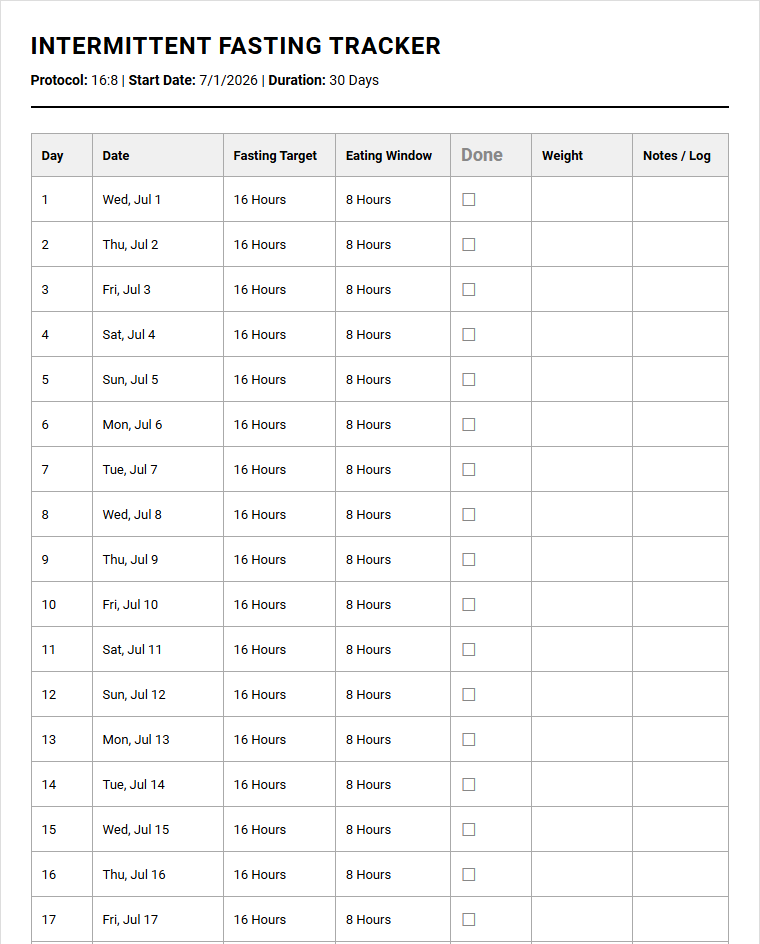
Staying consistent with intermittent fasting schedules can be incredibly frustrating for busy individuals. While many rely on standard tracking investments like paid digital apps to stay on course, our printable calendar grants immediate, tangible visual accountability. Crucially, its effectiveness is stipulated on your commitment to honest daily logging. Whether tracking a 16:8 protocol or occasional 24-hour fasts, this guide outlines how to leverage this tool to optimize your wellness routine.
Create Your Intermittent Fasting Calendar
Done customizing?
Intermittent Fasting Calendar - Good to Know
Fasting window tracker
A digital fasting window tracker serves as an essential instrument for individuals aiming to monitor their daily abstinence from caloric intake. By utilizing this tool, practitioners can precisely record the exact moment their fast begins and ends, eliminating guesswork and ensuring high accuracy. This precise temporal measurement is crucial for maintaining metabolic consistency and achieving desired physiological adaptations.
Implementing a structured tracking system offers several distinct advantages for long-term success:
- Real-time feedback: Instant visualization of current fasting progress.
- Data-driven adjustments: Ability to analyze weekly trends and modify fasting durations.
- Enhanced accountability: Maintaining a continuous digital record discourages premature breaking of the fast.
Whether utilizing a dedicated smartphone application or a simple paper journal, documenting these intervals establishes a strong psychological commitment, transforming a abstract temporal goal into a manageable, structured daily routine.
OMAD schedule
The OMAD schedule (One Meal A Day) represents an advanced form of intermittent fasting, condensing the daily nutrient intake into a single, highly concentrated eating interval. This protocol typically demands a strict 23-hour fasting period followed by a single 1-hour eating window. Managing this regimen successfully requires meticulous dietary planning to ensure that all essential macronutrients, vitamins, and minerals are consumed within this brief timeframe.
To optimize this demanding schedule, practitioners often structure their single meal around specific nutritional priorities:
- Prioritize high-quality, lean proteins to support muscle preservation.
- Incorporate healthy fats, such as avocados and olive oil, to sustain satiety.
- Consume abundant fibrous vegetables to assist with digestive health.
Due to the intense nature of this pattern, individuals must remain highly attuned to their bodily signals, ensuring they maintain proper hydration and electrolyte balance throughout the prolonged fasting period.
16:8 fasting log
The 16:8 protocol remains the most popular introductory method of intermittent fasting, requiring a 16-hour fast paired with an 8-hour eating window. Utilizing a 16:8 fasting log allows individuals to systematically document their adherence to this daily rhythm. This log serves as a practical mirror, reflecting patterns of success and highlighting potential obstacles, such as late-night snacking or premature breakfast consumption.
By diligently recording daily start and stop times, users can identify their optimal eating schedule-whether that involves skipping breakfast or enjoying an early dinner. A typical log entries might note the level of energy experienced, sleep quality, and hunger peaks. Over time, this cumulative data empowers practitioners to fine-tune their schedule, aligning their eating window with natural lifestyle demands and biological preferences for sustained adherence.
Autophagy timeline
Understanding the autophagy timeline is crucial for those fasting primarily for cellular rejuvenation. Autophagy is the evolutionary cellular self-cleaning mechanism whereby the body degrades and recycles damaged cellular components, organelles, and misfolded proteins. This vital physiological process is generally initiated as hepatic glycogen stores deplete, typically beginning around 16 to 18 hours of continuous fasting.
The intensity of cellular cleansing escalates as the fasting duration extends:
- 18 Hours: Mild autophagy begins; cellular cleanup processes are activated.
- 24 Hours: Autophagy increases significantly, particularly in brain cells.
- 48 Hours: Peak levels of autophagy are observed, promoting deep cellular repair and immune system resetting.
By mapping out this biological timeline, individuals can align their fasting durations with specific cellular health goals, maximizing the systemic benefits of physiological renewal.
Alternate day fasting planner
An Alternate Day Fasting (ADF) planner is an invaluable resource for organizing this rigorous dietary strategy. ADF involves alternating between 24-hour periods of normal eating and 24-hour periods of strict fasting or extreme caloric restriction (typically capped at 500 calories). Without structured planning, navigating this abrupt shifting pattern can lead to nutritional deficiencies or intense hunger pangs on fasting days.
Using a dedicated planner helps individuals map out their weekly meal prep, ensuring that eating days feature nutrient-dense whole foods that adequately fuel the body for the upcoming fast. Additionally, the planner can schedule lighter physical activities on fasting days and reserve high-intensity workouts for eating days. This strategic organization stabilizes energy levels, prevents metabolic adaptation, and ensures that the body receives adequate nourishment throughout the entire weekly cycle.
Circadian rhythm fasting calendar
A circadian rhythm fasting calendar aligns nutrient consumption with the natural movement of the sun, capitalizing on the body's internal biological clock. This method, often referred to as early time-restricted feeding, emphasizes consuming meals during daylight hours when insulin sensitivity is naturally at its peak. Typically, this calendar prescribes an eating window that opens at sunrise and closes before dusk, aligning with optimal metabolic efficiency.
By recording meal times on a circadian calendar, individuals can avoid eating during late-evening hours when melatonin levels rise and digestion slows. Studies indicate that aligning food intake with circadian biology enhances sleep quality, improves cardiovascular markers, and optimizes hormonal balance. Utilizing this specialized calendar encourages a deeper connection with natural environmental cues, fostering a harmonious state of metabolic health.
Fasting streak tracker
Consistency is the foundational pillar of any successful fasting lifestyle, and a fasting streak tracker leverages behavioral psychology to build long-term habits. By visually recording consecutive days of successfully meeting fasting goals, individuals create a powerful motivational chain. The desire to maintain a growing "streak" can serve as a potent psychological barrier against spontaneous cravings or social temptations that threaten to disrupt the established routine.
This tracking methodology emphasizes progress over perfection, allowing users to visualize their dedication over weeks, months, or even years. Many find that seeing a visual representation of their hard work reinforces their self-efficacy. As the streak accumulates, the fasting protocol transforms from a conscious effort into an automated, deeply ingrained lifestyle habit, facilitating effortless weight management and sustained metabolic wellness.
Eating window log
While tracking fasting hours is incredibly popular, maintaining an eating window log is equally vital for overall nutritional health. This log focuses entirely on the duration and quality of food consumption during the feeding phase. It is a common misconception that fasting permits unrestricted eating during the feeding window; a log helps prevent overeating and ensures nutritional adequacy.
A well-maintained log typically tracks several critical metrics:
- Macronutrient ratios: Balancing proteins, healthy carbohydrates, and essential fats.
- Hydration levels: Monitoring water intake during both eating and fasting periods.
- Satiety cues: Recording feelings of fullness to prevent binge-eating behaviors.
By documenting what, when, and how much is consumed, individuals can ensure they are properly nourishing their bodies, supporting the metabolic benefits initiated during their fasting periods.
Metabolic switching schedule
The core physiological objective of fasting is to induce the metabolic switch, transitioning the body's primary energy source from glucose to ketones. A metabolic switching schedule maps out this delicate transition, which typically occurs when liver glycogen stores are depleted, forcing the body to mobilize adipose tissue for fuel. This switch is not instantaneous; it requires a coordinated biological transition over several hours.
Understanding this transition helps practitioners anticipate physical sensations, such as the temporary fatigue that occasionally precedes the energetic clarity of ketosis. By scheduling fasting periods to deliberately trigger this metabolic pivot, individuals can optimize fat oxidation, enhance cognitive focus, and cultivate metabolic flexibility-the invaluable ability of the body to seamlessly alternate between burning carbohydrates and fats for energy.
5:2 fasting planner
The 5:2 fasting method is a highly flexible weekly protocol that involves five days of normal, unrestricted eating and two non-consecutive days of severe caloric restriction, where intake is limited to approximately 500 to 600 calories. A 5:2 fasting planner is essential for organizing these distinct phases, ensuring that the low-calorie days are strategically placed to minimize disruption to work, social commitments, and exercise routines.
This planner assists in designing high-volume, low-calorie meals for fasting days, utilizing ingredients like leafy greens, lean proteins, and broth-based soups to maximize satiety. By mapping out the week in advance, practitioners can successfully navigate the transition between feast and fast, enjoying social flexibility on normal eating days while maintaining the discipline required to achieve significant health benefits on restriction days.
Leave a comment