
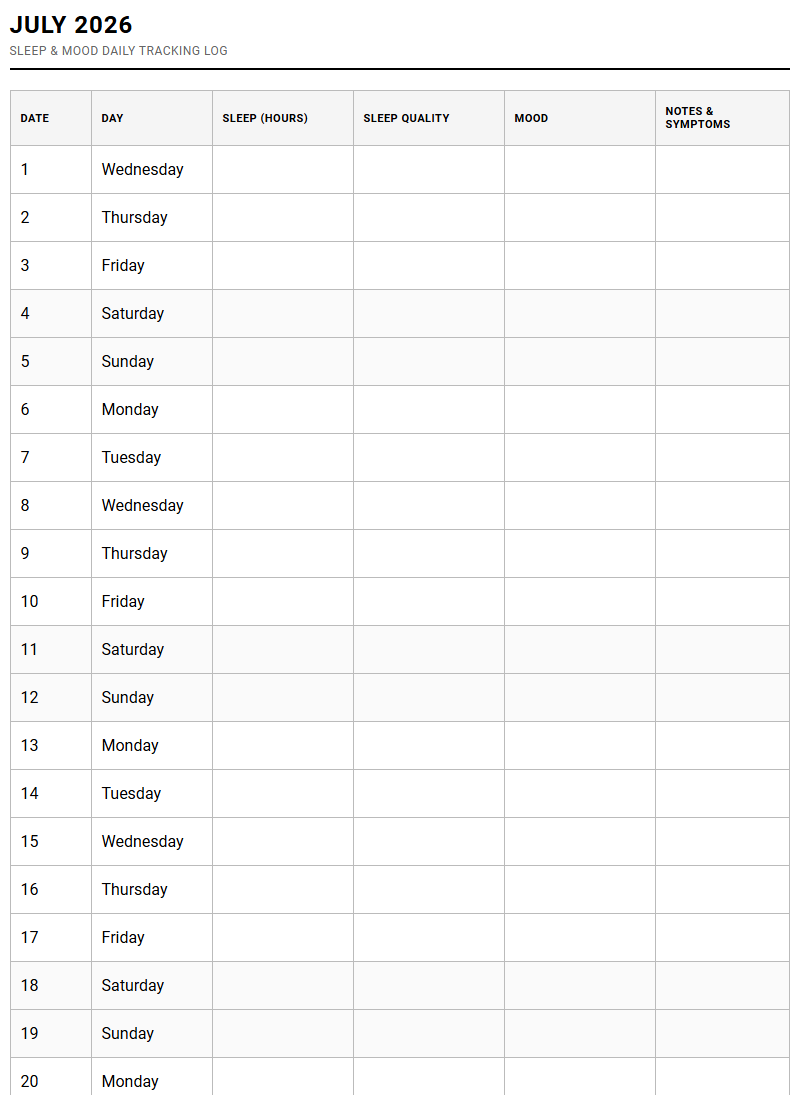
Pinpointing how poor sleep destabilizes daily emotional well-being remains a persistent struggle for many. While standard digital health apps track basic sleep hours, they often lack qualitative context. Our printable Sleep and Mood Calendar bridges this gap, granting users immediate, tangible clarity over their bio-rhythms. To be effective, this tool stipulates a commitment to honest daily manual entry-for instance, mapping late-night caffeine use against morning irritability. Below, we outline how to utilize this tracker to optimize your wellness routine.
Create Your Sleep and Mood Calendar
Done customizing?
Sleep and Mood Calendar - Good to Know
Circadian rhythm tracking
Monitoring your internal biological clock is fundamental to understanding your daily energy patterns. Circadian rhythm tracking involves documenting when you naturally feel alert versus when you experience energy slumps. By keeping a detailed log of your exposure to light, especially natural sunlight in the morning, you can identify how well your lifestyle aligns with your natural 24-hour cycle.
To optimize this process, consider tracking these key indicators daily:
- Core body temperature shifts: Recognizing when you feel naturally cold or warm.
- Natural waking windows: Recording the exact time you wake up without an alarm.
- Melatonin onset signals: Noting early signs of sleepiness, such as yawning or heavy eyelids.
Consistently capturing these data points helps you pinpoint your biological peak performance times, allowing you to schedule demanding cognitive tasks when your brain is naturally most receptive and alert.
Mood mapping
Investigating the intersection of emotional health and physical rest reveals powerful patterns. Mood mapping requires you to evaluate and log your emotional state at multiple intervals throughout the day. By assigning numerical values or descriptive tags to your feelings, you build a comprehensive dataset that highlights how sleep quality influences emotional resilience.
An effective daily mood mapping routine typically follows a structured sequence:
- Morning assessment: Note your baseline mood immediately upon waking.
- Midday check-in: Evaluate stress levels and focus during peak working hours.
- Evening reflection: Document your ability to wind down and release tension.
Over time, this practice exposes direct correlations between sleep disruption and mood instability. It empowers individuals to make proactive lifestyle adjustments before minor stress escalates into chronic burnout or emotional fatigue.
Chronotype alignment
Every individual possesses a unique genetic predisposition that dictates their preferred sleep and activity times, commonly referred to as a chronotype. Aligning your daily schedule with this biological profile-whether you are a morning lark, a night owl, or an intermediate type-is crucial for maximizing productivity and reducing systemic inflammation.
"Designing a life that honors your biological chronotype is one of the most effective, least invasive ways to improve overall cognitive function and physical well-being."
When you force your body to operate outside its natural timing, you experience social jetlag. Chronotype alignment helps you restructure your professional commitments, social life, and exercise routines. By respecting your natural peak hours, you achieve a harmonious balance that boosts your immune system and enhances sleep depth naturally.
Sleep debt log
Sleep debt represents the cumulative difference between the amount of sleep your body biologically requires and the actual amount you receive. Maintaining an accurate sleep debt log is essential for preventing long-term physical exhaustion. If your body requires eight hours of sleep but you only obtain six, you accumulate a deficit that cannot be easily resolved in a single weekend.
This tracking methodology calculates your cumulative deficit over a rolling seven-day period. By keeping a precise tally, you can strategically plan recovery periods. These recovery phases may include brief afternoon naps or slightly earlier bedtimes. Managing this balance sheet prevents chronic cognitive decline, protects cardiovascular health, and ensures your metabolic systems continue to function at their highest capacity.
Somatic state tracking
Your body constantly communicates its physiological state through physical sensations. Somatic state tracking is the mindful practice of scanning your physical body and documenting sensations like muscle tension, headaches, digestive comfort, and overall physical fatigue. These physical symptoms are often direct reflections of your nervous system's current state of arousal.
- Muscle tightness: Often indicates elevated daytime cortisol levels.
- Heart rate variability: Reflects your body's transition into parasympathetic recovery.
- Physical restlessness: Suggests an overstimulated nervous system struggling to calm down.
By connecting these somatic observations with your sleep metrics, you can identify hidden stressors. This enables you to implement targeted relaxation techniques, such as progressive muscle relaxation or deep breathing exercises, exactly when your body needs them most.
Sleep hygiene index
Developing optimal sleep habits requires systematic evaluation of your environmental and behavioral patterns. A sleep hygiene index serves as a structured checklist to score your daily habits. It monitors variables that directly influence your sleep onset latency and overall sleep efficiency.
To establish a robust index, evaluate the following parameters every evening:
- Caffeine timeline: Restricting stimulant intake at least eight hours before bed.
- Screen exposure: Eliminating blue light emitting devices one hour prior to sleep.
- Thermal environment: Maintaining a cool, dark, and quiet bedroom atmosphere.
By quantifiably tracking these habits, you demystify poor nights of sleep. Instead of attributing restless nights to random chance, you can trace them back to specific habits, allowing for precise, actionable adjustments to your evening routine.
Diurnal mood variation
Diurnal mood variation refers to the regular, predictable fluctuations in your emotional state that occur throughout a single day. Many people experience a distinct pattern, such as feeling lower in the morning and more optimistic as the afternoon progresses. Tracking these shifts provides profound insights into your underlying neurochemistry.
Understanding these fluctuations allows you to plan your day with greater self-compassion and efficiency. If your mood routinely dips in the late afternoon, you can schedule routine, low-stress administrative work during this window. Recognizing these predictable waves prevents you from misinterpreting temporary, biologically driven mood dips as permanent emotional setbacks, fostering greater mental resilience and stability.
CBT-I sleep diary
The Cognitive Behavioral Therapy for Insomnia (CBT-I) sleep diary is a clinically validated tool designed to reconstruct your relationship with sleep. Unlike casual trackers, a CBT-I diary focuses heavily on sleep efficiency. It records precise metrics such as time spent in bed versus actual time spent asleep.
Key metrics calculated in a standard CBT-I diary include:
- Sleep onset latency: The exact time it takes to transition from awake to asleep.
- Wake after sleep onset (WASO): The total minutes spent awake during the night.
- Total sleep efficiency: The percentage of time in bed spent asleep.
By analyzing these specific ratios, individuals can eliminate the anxiety of lying awake in bed. This targeted approach retrains the brain to associate the bed exclusively with deep, restful sleep rather than frustration.
Micro-journaling
Before sleep, an overactive mind can trigger a state of hyperarousal, making sleep transition difficult. Micro-journaling is a brief, highly focused writing practice designed to clear mental clutter in under five minutes. By externalizing your immediate thoughts, worries, or tomorrow's to-do list, you signal to your brain that it is safe to rest.
This structured practice often utilizes simple, brief prompts to prevent writing fatigue. You might note three things you are grateful for, list your top priority for the following day, or simply write down a single recurring thought. This rapid cognitive offloading lowers cognitive load, reduces pre-sleep anxiety, and prepares your mind for uninterrupted, restorative rest.
Sleep architecture mapping
Sleep is not a uniform state of unconsciousness but a complex cycle of distinct stages. Sleep architecture mapping involves analyzing the structure and pattern of your sleep cycles, including Light Sleep, Deep Sleep, and Rapid Eye Movement (REM) phases. Each stage serves a distinct biological purpose, from cellular repair to memory consolidation.
- Deep Sleep (N3): Vital for physical recovery, tissue repair, and immune system boost.
- REM Sleep: Crucial for emotional regulation, creative thinking, and cognitive processing.
- Light Sleep (N1 & N2): Serves as the transitional bridge between deeper cycles.
By monitoring the proportions and distribution of these stages, you gain a deeper understanding of your recovery. A night with sufficient duration but minimal deep sleep will still leave you feeling fatigued, highlighting the importance of prioritizing sleep quality over simple quantity.
Leave a comment