
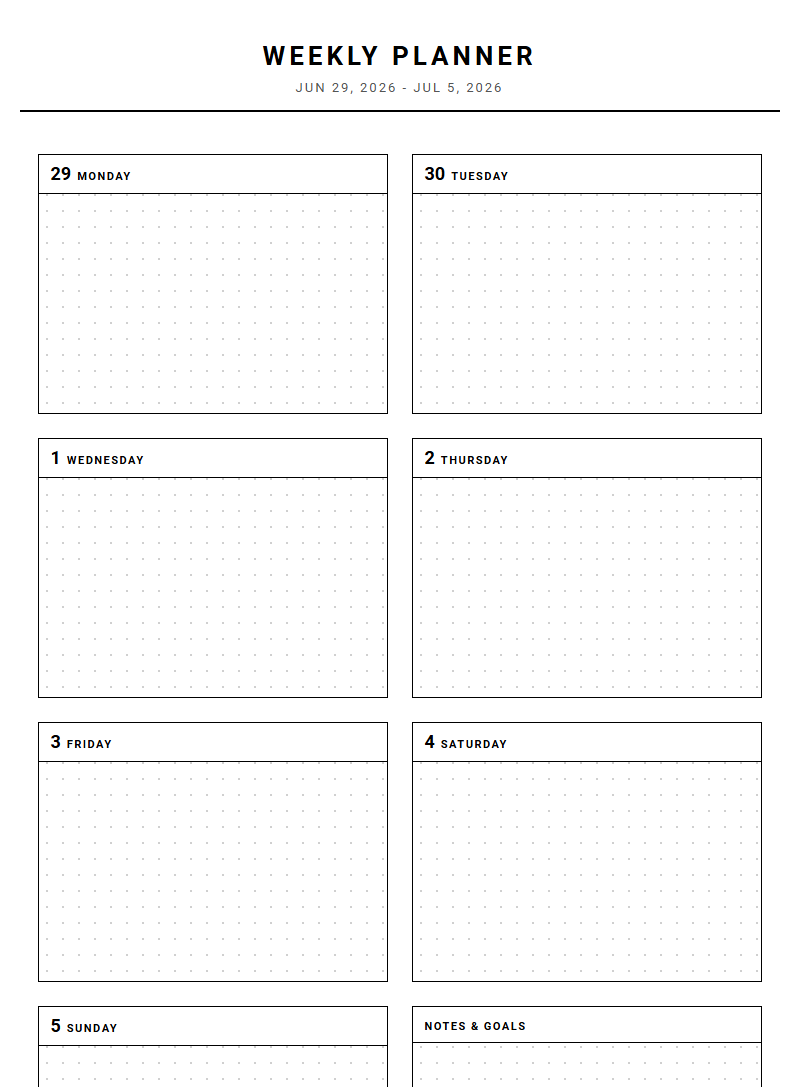
Many professionals struggle to find a productivity layout that adapts to shifting weekly priorities. While standard pre-printed planners offer basic scheduling frameworks, they often restrict custom workflows. Our printable Bullet Journal Style Weekly Layout grants you absolute spatial autonomy. However, this system stipulates a brief initial setup to align with your specific goals, seamlessly accommodating rapid logging and habit trackers. Below, we explore how to maximize this layout for peak weekly efficiency.
Create Your Bullet Journal Style Weekly Layout
Done customizing?
Bullet Journal Style Weekly Layout - Good to Know
Weekly Spread
A weekly spread serves as the operational heart of a bullet journal, offering a birds-eye view of the upcoming seven days. This layout synthesizes daily tasks, scheduled events, and overarching objectives into a cohesive, single- or double-page dashboard. Users rely on this structure to balance short-term demands with long-term goals without feeling overwhelmed by daily minutiae. It bridges the gap between the high-level monthly log and detailed daily rapid logging.
Key components of a weekly layout include:
- Daily Columns: Dedicated boxes or vertical lists for scheduling.
- Weekly Goals: A small sidebar highlighting primary milestones.
- Next Week Preview: A tiny container for forward planning.
By allocating tasks to specific days ahead of time, practitioners maintain a steady, organized workflow. This setup facilitates effortless prioritization and helps prevent scheduling conflicts, making it an indispensable tool for students, professionals, and busy creatives seeking structured productivity.
Dutch Door Layout
The Dutch door layout is a highly creative and functional modification that involves cutting or folding notebook pages to reveal underlying sections. By trimming a portion of one or more intermediate pages horizontally or vertically, you create a static background that remains visible while you flip through dynamic inner pages. This clever design maximizes usable space without sacrificing cohesive visual continuity across your journal.
Why choose a Dutch Door setup?
- Persistent Trackers: Keep habit logs or weekly goals visible all week long.
- Extended Planning: Expand a standard weekly layout into a multi-page hub.
- Visual Separation: Segregate project tasks from daily personal agendas.
Implementing this technique transforms a standard dot grid notebook into a dynamic, multi-layered planner. It allows for advanced customization, ensuring that your most critical reference lists and tracking metrics stay constantly in view as your daily entries progress.
Alastair Method
Invented by Alastair Johnston, the Alastair Method is an elegant, minimalist approach to managing future logs and complex task lists. Instead of confining tasks to rigid, pre-allocated daily slots, this technique utilizes a simple, column-based grid. Tasks are listed vertically on the left side of the page, while columns representing days of the week or months run parallel on the right.
To assign a task, you simply place a dot in the corresponding column. When the day arrives, you execute, migrate, or schedule the task, changing the dot to the appropriate bullet journal symbol. This method is incredibly fluid and eliminates the need to constantly rewrite tasks that drift across different days. It represents a highly efficient synthesis of scheduling and task management, perfect for those who appreciate clean, rapid, and flexible organization.
Rolling Weekly
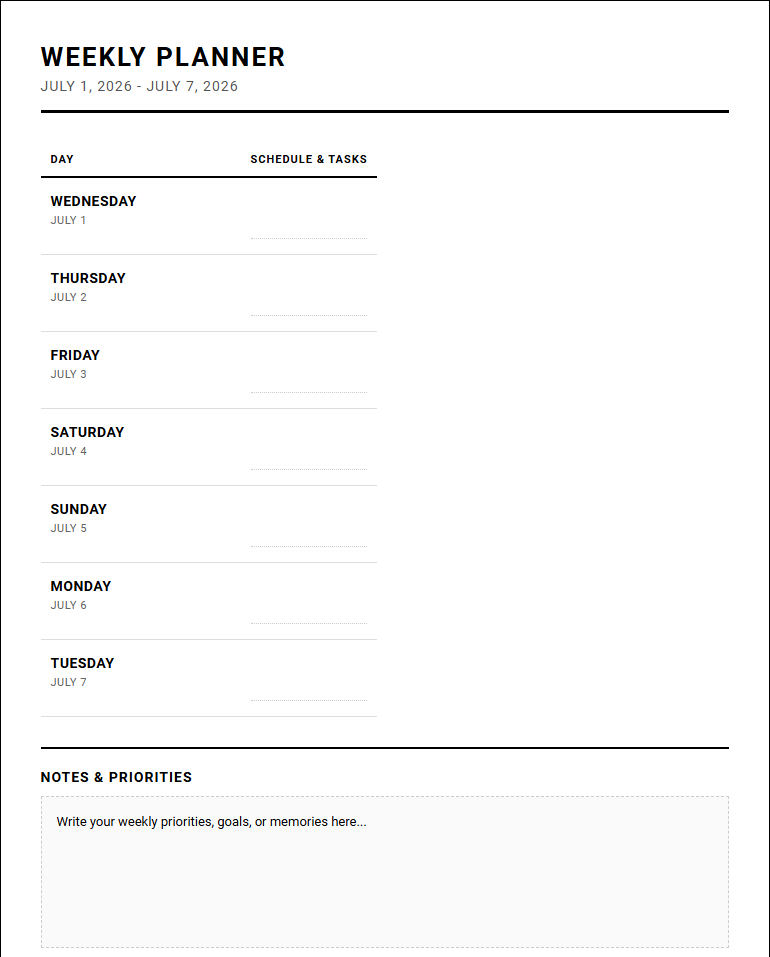
The rolling weekly layout is a hybrid planning system designed for individuals whose schedules fluctuate unpredictably. Rather than dividing the weekly spread into static, pre-defined daily boxes, this method features a continuous task list running alongside a compact weekly grid. This structure separates when a task must be done from what needs to be done during the week.
How to structure a rolling weekly:
- The Master List: A running inventory of tasks compiled at the start of the week.
- The Grid: Columns representing each day where tasks are scheduled or checked off.
- Daily Migrations: Moving unresolved tasks forward fluidly without messy rewrites.
This layout reduces the anxiety of assigning tasks to specific days prematurely. It accommodates natural shifts in daily energy and focus, ensuring your bullet journal remains a supportive tool rather than a rigid source of pressure.
Minimalist Bujo
A minimalist bullet journal, or "Bujo," strips away the artistic distractions of elaborate drawings, hand lettering, and colorful washi tape to focus entirely on pure utility. Inspired directly by Ryder Carroll's original methodology, this approach prioritizes rapid logging, functional index systems, and clean layouts. By using a single black pen and a simple notebook, users eliminate the preparation anxiety that often leads to journaling burnout.
The beauty of minimalism lies in its frictionless adaptability. Without the self-imposed pressure to create aesthetic masterpieces, practitioners find it much easier to maintain consistency. The clean white space of a minimalist page promotes mental clarity, allowing your brain to process information rapidly. It serves as a stark reminder that a bullet journal is first and foremost a tool for mindful productivity, self-reflection, and efficient task management, rather than an art portfolio.
Time Blocking Grid
A time blocking grid is a powerful visual scheduling tool that helps you reclaim control over your daily hours. By mapping out the day in hourly or half-hourly increments, you assign specific tasks or activities to dedicated time blocks. This technique discourages multitasking and encourages deep, focused work by establishing clear boundaries for your attention.
To implement this in your journal, draw a vertical or horizontal axis labeled with hours of the day. Fill these blocks with distinct color codes or subtle shading to categorize your activities, such as:
- Deep Work: High-focus cognitive tasks.
- Administrative Tasks: Email, meetings, and quick chores.
- Personal Time: Rest, exercise, and family activities.
Visualizing your day as a finite set of blocks prevents overcommitment and highlights exactly where your time is being spent, promoting realistic planning and heightened productivity.
Habit Tracker Integration
Integrating a habit tracker directly into your weekly or monthly layouts is an excellent way to cultivate positive routines and monitor personal growth. Instead of maintaining separate, isolated logs, embedding trackers within your active planning pages ensures daily visibility and higher accountability. You can track physical health metrics, mental wellness practices, or professional development milestones in a compact format.
Common integration styles:
- Mini-Grids: Tiny calendars placed in the corners of your weekly spread.
- Horizontal Lines: A simple grid row beneath each daily column.
- Dot-Matrix: Discrete dots that are colored in upon task completion.
By keeping these trackers visible alongside your daily tasks, you reinforce the connection between your habits and your daily schedule. This physical act of recording progress provides immediate positive reinforcement, keeping you motivated to maintain your streaks.
Two-Page Spread
The two-page spread is the quintessential canvas for comprehensive planning in the bullet journaling community. Spanning across two facing pages of an open notebook, this layout provides a panoramic workspace that easily accommodates complex weekly, monthly, or project plans. The sheer volume of surface area allows for a balanced blend of scheduling grids, task lists, notes, and trackers without crowding.
This format is particularly beneficial for those who manage multifaceted lives, such as working parents, students, or project managers. With everything visible at a single glance, you eliminate the cognitive load of flipping back and forth between pages. It provides a cohesive, unified space where you can synthesize various aspects of your life, ensuring that professional deadlines, personal errands, and wellness goals exist in harmonious alignment.
Brain Dump Section
A brain dump is a therapeutic and highly functional writing practice designed to declutter a crowded mind. When thoughts, anxieties, ideas, and tasks pile up, it can create cognitive paralysis. Dedicating a specific page in your journal to a structured brain dump allows you to externalize this mental noise, transferring it onto paper where it can be analyzed objectively.
To make a brain dump productive, write freely without worrying about order, neatness, or categorization. Once everything is down, use a simple indexing system to sort the chaos:
- To-Do: Urgent items to migrate immediately to your daily logs.
- Ideas: Creative concepts to file away for future exploration.
- Worries: Emotional stressors that require reflection or mindfulness exercises.
This practice restores focus, reduces stress, and transforms overwhelming mental clutter into an actionable, prioritized roadmap for productivity.
Rapid Logging
Rapid logging is the foundational syntax of the entire bullet journaling system. Designed by Ryder Carroll, it is a streamlined shorthand method that allows you to capture thoughts, tasks, and events in real-time with minimal effort. By utilizing a system of clean, distinct symbols, rapid logging eliminates the need for long-winded diary entries, saving valuable time and energy.
The core symbols of rapid logging:
•Task: An actionable item that requires execution.oEvent: A scheduled occurrence, meeting, or milestone.-Note: A fact, thought, or observation that requires recording.
This fast, intuitive notation system keeps pace with your busy day. It ensures that you capture critical information instantly, which can then be organized, cross-referenced, or migrated during your morning or evening reflection sessions.
Leave a comment