
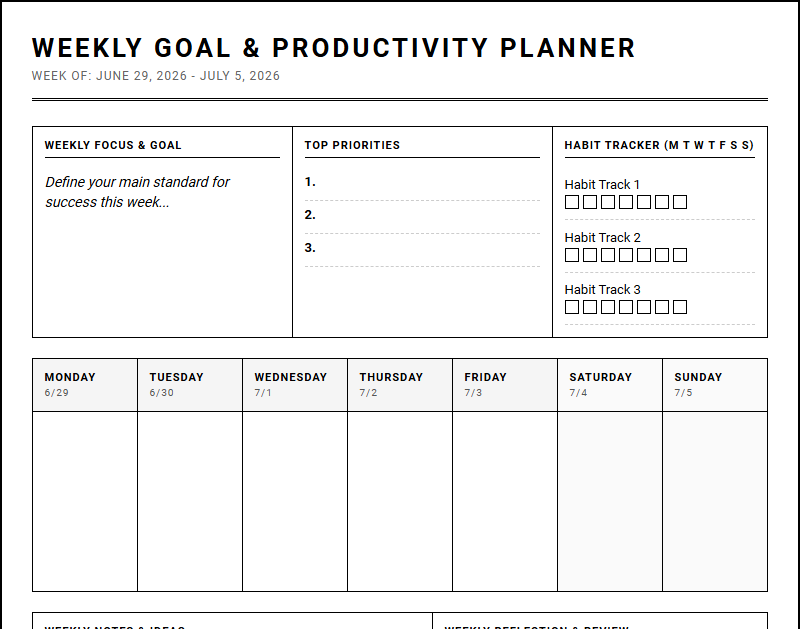
Staying focused amidst daily distractions often leaves professionals struggling to execute long-term goals. While standard digital calendars track appointments, they rarely align daily tasks with broader strategic objectives. A dedicated Productivity and Goal Weekly Planner bridges this gap, offering structured printable layouts-such as OKR tracking and time-blocking templates-that actively drive performance. Note that success requires consistent daily engagement rather than occasional use. Below, we explore how to leverage these printable tools to optimize your weekly workflow.
Create Your Productivity and Goal Weekly Planner
|
Weekly Focus & Goal
|
Top Priorities
1.
2.
3.
|
Habit Tracker (M T W T F S S)
|
| Monday | Tuesday | Wednesday | Thursday | Friday | Saturday | Sunday |
|---|---|---|---|---|---|---|
|
Weekly Notes & Ideas
|
Weekly Reflection & Review
|
Done customizing?
Productivity and Goal Weekly Planner - Good to Know
Time blocking
Time blocking is a highly effective productivity method where you divide your day into dedicated segments of time. Instead of keeping an open-ended to-do list, you actively commit specific hours to individual tasks or project categories. This approach helps minimize decision fatigue and prevents your schedule from being hijacked by reactive demands.
By scheduling your day in advance, you create a realistic blueprint of what can actually be achieved. To implement this strategy successfully, consider the following structural guidelines:
- Buffer Blocks: Allocate time between major tasks to handle unexpected disruptions.
- Reactive Blocks: Designate specific periods for checking emails and returning messages.
- Task Mapping: Assign high-priority creative work to your peak energy hours.
This disciplined structure ensures that your most vital objectives receive undivided attention before minor daily interruptions can derail your focus.
Habit tracking
Habit tracking serves as a visual and psychological anchor for behavioral change. By recording your daily progress, you create an immediate feedback loop that reinforces positive actions. Whether you use a digital application, a bullet journal, or a simple paper calendar, the act of checking off a completed task releases dopamine and builds powerful momentum.
Consistently logging your daily routines transforms abstract desires into concrete realities. Over time, these recorded actions build a chain of success that you naturally want to keep unbroken. Consider integrating these core principles into your routine:
- Keep it simple: Track only two or three critical habits at a time.
- Never miss twice: If you slip up one day, focus entirely on recovering the next.
- Make it visible: Place your tracker where you cannot ignore it.
Through consistent measurement, positive behaviors slowly transition from conscious effort into automatic daily routines.
Weekly review
The weekly review acts as a critical system reboot, bridging the gap between daily operations and long-term strategic vision. Every seven days, taking the time to pause and reflect allows you to assess what went well, what fell off course, and how to optimize the upcoming week. This practice prevents unresolved tasks from accumulating and causing chronic mental clutter.
During this reflective period, you should systematically clean your inbox, update project tracking boards, and realign your personal calendar. It is a moment of honest self-assessment. As productivity experts often suggest:
"A weekly review is the single most important habit you can cultivate to maintain control over your professional and personal life amid constant chaos."
Entering a new week with a clear mind and a precise plan ensures that your daily efforts remain aligned with your overarching goals.
Task batching
Task batching is the practice of grouping similar, low-cognitive activities together and completing them in a single dedicated session. This productivity technique minimizes the severe cognitive cost of context switching, which occurs when your brain repeatedly transitions between unrelated tasks. When you bounce from writing a report to answering an email, your focus fractures.
By batching, you maintain a steady cognitive flow state. You can categorize your daily responsibilities into distinct operational buckets to streamline your output. Highly effective categories include:
- Administrative tasks: Filing invoices, filling out timesheets, and organizing digital files.
- Communication tasks: Returning phone calls, responding to slack messages, and sending emails.
- Creative tasks: Writing copy, designing assets, and brainstorming new concepts.
Consolidating these activities allows you to complete routine work significantly faster, freeing up mental energy for deeper strategic projects.
Eisenhower matrix
The Eisenhower matrix is a classic decision-making framework that categorizes tasks based on their urgency and importance. This simple four-quadrant system helps you prioritize high-value activities while systematically eliminating or outsourcing low-value busywork that consumes valuable creative energy. It forces you to distinguish between what is merely pressing and what is truly impactful.
| Category | Urgent | Not Urgent |
|---|---|---|
| Important | Do immediately (Crises, tight deadlines) | Schedule for later (Planning, growth) |
| Not Important | Delegate to others (Certain emails, meetings) | Delete entirely (Distractions, time-wasters) |
Using this grid daily ensures you spend your time proactively building your future rather than reacting to immediate fires.
Deep work sessions
Deep work sessions are dedicated periods of distraction-free concentration where you push your cognitive capabilities to their absolute limit. Coined by author Cal Newport, this state of deep focus is essential for mastering complex skills and producing high-quality output. In our hyper-connected world, the ability to focus deeply has become a rare and valuable competitive advantage.
To cultivate this state, you must proactively eliminate all potential external interruptions. This means silencing notifications, closing unnecessary browser tabs, and communicating your unavailability to colleagues. True deep work requires uninterrupted cognitive flow.
Without these strict boundaries, your brain remains in a state of residual distraction. Committing to even ninety minutes of deep, uninterrupted focus daily can dramatically increase your creative output and accelerate your professional growth.
Micro-goals
Micro-goals involve breaking massive, intimidating projects down into the smallest possible actionable steps. When faced with a monumental objective, your brain often triggers procrastination as a defense mechanism against overwhelm. By reducing the scale of your immediate task, you bypass this psychological resistance and make starting incredibly easy.
Instead of aiming to write an entire chapter, your micro-goal might be to write a single sentence. This shift in focus prioritizes immediate momentum over total completion. Follow this simple path to progress:
- Define the broad, overarching final milestone.
- Isolate the very next physical action required to proceed.
- Reduce that action until it takes less than five minutes to complete.
These tiny victories build rapid momentum, easily transforming initial small actions into sustained creative flow.
Quarterly planning
Quarterly planning bridges the gap between grand annual visions and immediate weekly execution. Twelve months is often too long of a horizon for accurate forecasting, whereas a single month does not allow enough time to achieve substantial milestones. A ninety-day window provides the perfect sweet spot for strategic execution and adaptability.
Every quarter, you evaluate your progress and set three to five highly focused objectives. This cadence allows you to pivot when market conditions shift or when priorities naturally evolve. To optimize this process, keep these elements in mind:
- Review: Analyze quantitative data and qualitative lessons from the previous ninety days.
- Align: Ensure new quarterly targets directly support your yearly goals.
- Commit: Allocate resources and schedule milestone check-ins on your calendar.
This systematic planning rhythm keeps your business agile, focused, and consistently moving in the right direction.
Focus blocks
Focus blocks are structured, predefined periods within your daily schedule dedicated strictly to executing your most demanding intellectual work. Unlike general time blocks, focus blocks require absolute immersion in a single, high-priority objective. These blocks are protected fiercely from meetings, administrative check-ins, and casual social interruptions.
An optimal focus block typically lasts between sixty and ninety minutes, aligning naturally with human ultradian rhythms. During this time, your sole objective is to make progress on a critical deliverable. Protecting this time is essential for high-level creative problem-solving.
By scheduling these blocks when your energy levels are naturally at their peak, you maximize cognitive performance. Consistently protecting these focused intervals ensures that your most significant projects are steadily advanced every single day.
Goal cascading
Goal cascading is the organizational practice of aligning high-level, long-term strategic visions down to the daily actions of individual team members. This alignment ensures that every project, task, and daily checklist item directly supports the primary mission of the organization. When executed correctly, every employee understands how their daily work impacts the company's success.
This process demystifies high-level strategy and makes personal accountability highly visible. It creates a cohesive thread that runs through every layer of the organization:
- Company Vision: The long-term mission and multi-year trajectory.
- Departmental Objectives: Annual targets assigned to specific operational divisions.
- Individual Daily Actions: Specific tasks completed by team members each afternoon.
This unified approach eliminates redundant work and focuses organizational energy toward achieving collective, high-impact results.
Leave a comment