
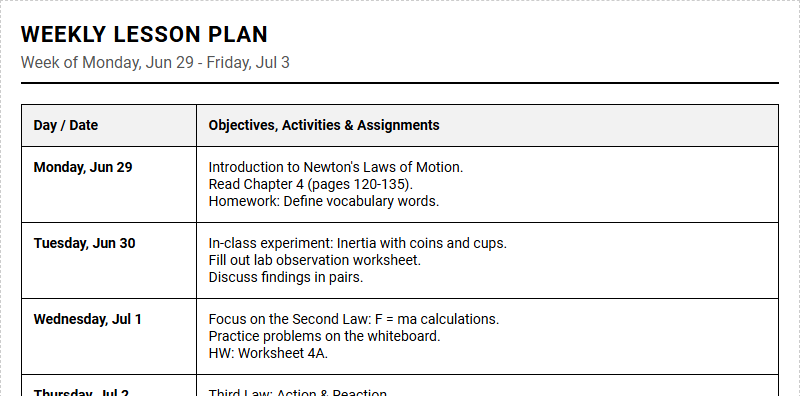
Managing shifting classroom schedules often leaves educators disorganized. While district professional development budgets typically fund complex software, these digital systems can feel overwhelming. Integrating a physical Daily Agendas printable calendar grants teachers instant, tangible control over their lesson flow. Note that these tools require active daily maintenance to be effective, such as updating our block-schedule template. Below, we outline how to utilize printable agendas to streamline your prep workflow.
Create Your Teacher Lesson Plan Agenda
Done customizing?
Teacher Lesson Plan Agenda - Good to Know
Learning Targets
Learning targets serve as the navigational beacon for both educators and students during the instructional cycle. By clearly defining what students should know, understand, and be able to do by the end of a lesson, these targets demystify the academic journey. When educators articulate explicit, student-friendly goals, they transform abstract curriculum standards into actionable milestones. This clarity fosters student agency, allowing learners to self-assess their progress and take ownership of their educational outcomes. Research shows that sharing learning intentions significantly enhances student motivation and achievement. To maximize their impact, these targets should be visible throughout the entire lesson, referenced during transitions, and aligned directly with assessment strategies.
- Student-Centered: Written in "I can" statements that emphasize accessibility.
- Measurable: Linked to observable actions and clear success criteria.
- Standards-Aligned: Directly mapped to district, state, or national requirements.
Bell Ringer
A bell ringer is a brief, purposeful activity designed to engage students immediately upon entering the classroom. This routine establishes an efficient learning environment, signaling that instructional time begins the moment the bell rings. Effective bell ringers require minimal explanation, allowing the teacher to complete essential administrative duties like attendance while students focus on the task. These activities can review previous content, preview upcoming concepts, or provoke critical thinking. By initiating a structured routine, teachers minimize behavioral disruptions and maximize academic engagement.
- Recall questions focusing on the prior day's lesson to reinforce retention.
- Conceptual prompts that bridge personal experience to new classroom topics.
- Skill drills designed to reinforce foundational mechanics and critical operations.
- Scaffolded Content: Breaking complex skills into manageable segments.
- Explicit Modeling: Demonstrating skills with clear, verbalized rationales.
- Active Engagement: Interspersing checks for understanding to prevent cognitive overload.
- Frequent Feedback: Offering real-time corrections and validation.
- Scaffolded Support: Gradually reducing assistance as student competency increases.
- Collaborative Peer Work: Encouraging structured academic dialogue among peers.
- Aligned directly to the learning targets and assessments.
- Appropriately challenging but achievable without teacher assistance.
- Differentiated to accommodate varying learner profiles and paces.
- Summarizing the main concept in one sentence.
- Solving a single, high-leverage application problem.
- Identifying a lingering area of confusion.
- Fist-to-Five: Self-assessment of comprehension levels using finger signals.
- Whiteboard Responses: Individual slates showing immediate work.
- Cold Calling: Systematically engaging all students to gauge class-wide grasp.
- Brain Dumps: Writing down everything remembered about a topic in two minutes.
- Flashcards: Utilizing spaced repetition for key vocabulary terms.
- Concept Mapping: Drawing connections between ideas from memory.
- Tiered assignments that offer varying levels of complexity.
- Flexible grouping strategies based on real-time formative data.
- Choice boards allowing students to select their path of demonstration.
Integrating these short activities ensures that every second of classroom time is optimized for intellectual growth and student readiness.
Anticipatory Set
The anticipatory set, often referred to as the hook, is a brief activity that captures students' attention and activates prior knowledge before introducing new content. This phase of the lesson prepares the mind for learning by creating a cognitive bridge between familiar experiences and unfamiliar concepts. An engaging hook stimulates curiosity, establishes relevance, and motivates students to participate actively. Whether through a provocative question, a short video, a physical demonstration, or a real-world scenario, the anticipatory set focuses student attention on the upcoming instructional objective.
"The hook is not merely entertainment; it is the cognitive scaffolding upon which new schema is built."
By generating enthusiasm and contextualizing the lesson, teachers create a welcoming entry point for diverse learners. This strategic introduction ensures that subsequent instruction is met with an receptive, intellectually primed audience.
Direct Instruction
Direct instruction represents the teacher-directed phase where new information, skills, and concepts are explicitly modeled and explained. Far from passive lecturing, modern direct instruction is interactive, chunked, and responsive to student needs. Educators use clear explanations, visual aids, and step-by-step demonstrations to convey complex materials. During this time, teachers often employ the "I Do" phase of learning, externalizing their thinking processes through think-alouds. This cognitive modeling helps students understand not just what to do, but why and how to do it.
Key components of effective explicit delivery include:
This structured approach minimizes misconceptions and builds a solid foundation of procedural knowledge.
Guided Practice
Guided practice is the collaborative transition phase, often conceptualized as the "We Do" step of the gradual release model. Here, students attempt the new skill or apply the new knowledge with active teacher support and peer collaboration. This phase provides a safe environment to practice and make mistakes under the watchful eye of the educator, who offers immediate corrective feedback. By working through problems together, students build confidence and refine their understanding. Teachers can use this time to address misconceptions before they become deeply ingrained habits.
During guided practice, teachers should focus on:
This collaborative effort ensures a smooth transition to independent mastery.
Independent Practice
Independent practice represents the "You Do" phase of learning, where students demonstrate individual mastery of the lesson objective without direct assistance. This critical step solidifies memory pathways and builds fluency in the target skill. It allows learners to apply their knowledge to new contexts, reinforcing academic self-reliance. While students work autonomously, the teacher's role shifts to that of an observer and facilitator, monitoring progress and identifying individuals who may require targeted intervention.
Characteristics of effective independent tasks:
Successful independent practice builds competence and empowers students to internalize their new skills.
Exit Ticket
An exit ticket is a powerful formative assessment tool administered at the conclusion of a lesson to gauge individual student understanding. Typically taking five minutes or less, this brief activity requires students to answer a targeted question, solve a problem, or summarize their learning. The resulting data provides immediate, actionable feedback for the teacher, highlighting which concepts were mastered and which require remediation.
"Exit tickets act as a daily temperature check, guiding the trajectory of subsequent instruction."
By analyzing these quick responses, educators can plan targeted interventions, design tomorrow's bell ringers, and adjust teaching strategies. Common exit ticket prompts include:
Check for Understanding
Checking for understanding is a continuous, formative process that occurs throughout the entire instructional period. Rather than waiting for a summative exam, proactive educators consistently monitor student comprehension to make real-time instructional adjustments. This ongoing assessment prevents misconceptions from taking root and ensures that no student is left behind as the lesson progresses. Effective checks are diverse, ranging from quick non-verbal cues to strategic questioning techniques.
Common strategies for real-time monitoring include:
Integrating these strategies allows teachers to pivot lessons dynamically, ensuring high levels of academic success.
Retrieval Practice
Retrieval practice is an evidence-based learning strategy that involves deliberately recalling information from memory. This cognitive exercise strengthens neural pathways, making long-term retention far more robust than passive re-reading or highlight-based studying. By forcing the brain to work to retrieve a concept, teachers help students build durable mental models. Retrieval practice should be low-stakes to reduce anxiety and encourage risk-taking.
Key implementation strategies include:
Incorporating regular, low-stakes retrieval opportunities transforms learning from a fleeting classroom experience into deeply integrated knowledge.
Differentiated Activities
Differentiated activities ensure that all students, regardless of their starting point, can access and master the academic content. Recognizing that classrooms are diverse ecosystems, teachers adjust the content, process, product, or environment to match students' readiness levels, interests, and learning profiles. This approach honors individuality while maintaining high standards for everyone. It prevents frustration in struggling learners and avoids boredom in advanced students.
Practical ways to implement differentiation:
This inclusive design guarantees equity, allowing every learner to thrive at their optimal level of challenge.
Leave a comment