
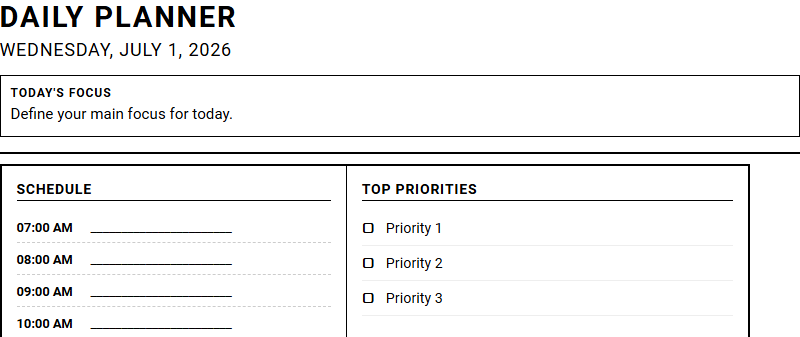
Managing daily operational chaos often leaves professional teams struggling to align execution with long-term strategy. While scaling successfully typically requires securing standard funding sources, capital alone cannot resolve daily productivity leaks. Implementing a specialized printable tracker grants organizations the strategic clarity needed to bridge this gap. However, these tools require active daily engagement to yield results, as seen in agile sprint planning. Below, we examine how the Daily Task and Priority Planner transforms workflow chaos into structured, high-yield execution.
Create Your Daily Task and Priority Planner
Done customizing?
Daily Task and Priority Planner - Good to Know
Eisenhower Matrix
The Eisenhower Matrix is a powerful decision-making framework designed to help you prioritize tasks by analyzing their urgency and importance. Originally conceptualized by President Dwight D. Eisenhower and later popularized by Stephen Covey, this productivity tool divides your daily to-do list into four distinct, highly actionable quadrants:
- Quadrant 1 (Do First): Tasks that are both urgent and important, requiring immediate attention.
- Quadrant 2 (Schedule): Crucial tasks that are not urgent, allowing you to plan them for later.
- Quadrant 3 (Delegate): Urgent but unimportant activities that can be handed off to others.
- Quadrant 4 (Eliminate): Tasks that are neither urgent nor important, which should be discarded.
By systematically filtering your workload through this matrix, you can easily distinguish between busywork and actual progress. This method ensures you spend your valuable energy on high-impact goals rather than constantly reacting to minor, superficial crises.
Time Blocking
Time Blocking is a highly structured time management methodology where you divide your entire day into distinct, dedicated segments of time. Instead of working from an open-ended, overwhelming to-do list, you assign specific tasks or categories of work to designated hours of the day, leaving no gap unscheduled.
To implement this technique effectively, you should categorize your daily responsibilities into manageable chunks:
- Deep Work Blocks: Reserved for high-focus, cognitively demanding projects.
- Shallow Work Blocks: Set aside for routine administrative tasks, such as answering emails.
- Buffer Blocks: Flexible windows designed to accommodate unexpected delays or brief rest.
This disciplined approach minimizes the costly cognitive friction of multitasking. It forces you to respect your biological limits and establish clear, realistic boundaries around your limited daily capacity.
Eat the Frog
Derived from a classic Mark Twain quote and popularized by self-improvement expert Brian Tracy, the Eat the Frog technique advocates for tackling your most difficult, complicated, or unpleasant task first thing in the morning. This single, dreaded task is your "frog," and resolving it early prevents it from hanging over your head like a dark cloud.
"If it's your job to eat a frog, it's best to do it first thing in the morning. And If it's your job to eat two frogs, it's best to eat the biggest one first."
By conquering this major obstacle before dealing with minor interruptions, you build immense momentum and boost your confidence for the rest of the day. This proactive habit drastically reduces chronic procrastination, ensuring that your energy levels are directed toward your most critical priorities when your focus is at its peak.
Most Important Tasks
The Most Important Tasks (MITs) methodology is a targeted productivity strategy focusing on extreme simplicity and daily intention. Rather than drowning in an endless list of low-value chores, you identify exactly one to three crucial objectives that you absolutely must accomplish by the end of your working day.
To implement this minimalist strategy, consider these guidelines:
- Select tasks that directly align with your long-term professional or personal goals.
- Write your MITs down the night before to prepare your subconscious mind for action.
- Establish that completing these core items defines your day as an absolute success.
By narrowing your focus to just a few critical goals, you protect yourself from the paralysis of choice. This intentional clarity ensures steady, measurable progress on significant projects, regardless of how chaotic your surrounding environment becomes.
Time Boxing
Time Boxing is an efficient, goal-oriented productivity strategy where you allocate a strict, predetermined limit of time to a specific task. Unlike open-ended time blocks, a time box introduces a hard stop, meaning you must cease working on that particular task as soon as the designated timer rings.
- Soft Time Box:
- A flexible boundary where you can wrap up your current train of thought before moving on.
- Hard Time Box:
- An absolute boundary requiring you to stop working immediately, regardless of your progress.
This technique leverages Parkinson's Law, which states that work expands to fill the time available for its completion. By introducing artificial constraints, you curb perfectionism, maintain high concentration, and quickly push through tasks that would otherwise drag on indefinitely.
Task Batching
Task Batching is a highly effective cognitive management technique that involves grouping similar, low-effort activities together to execute them in a single, dedicated session. This strategy is specifically designed to combat the immense productivity drain caused by frequent context switching and mental fragmentation.
Common examples of batching include the following operational clusters:
- Communication: Processing all emails, Slack messages, and phone calls at designated intervals.
- Finance: Reviewing invoices, submitting expense reports, and budgeting once a week.
- Content Creation: Writing multiple articles or recording several videos in one focused block.
Grouping identical mental processes allows your brain to maintain a steady state of flow. By reducing the energy required to constantly pivot between disparate tasks, you complete routine work much faster and with significantly fewer errors.
Ivy Lee Method
The Ivy Lee Method is a century-old daily routine developed by productivity consultant Ivy Lee to help Bethlehem Steel executives maximize their efficiency. This remarkably straightforward strategy requires only a few minutes at the end of each workday to set up your entire agenda for the following morning:
- Write down the six most important tasks you need to accomplish tomorrow.
- Rank those six items strictly in order of their true importance.
- Focus solely on the first task until it is fully completed before moving to the second.
- Move any unfinished tasks to a new list of six for the following day.
This elegant system eliminates decision fatigue by planning your morning before it even begins. It forces a singular, hyper-focused attention on one objective at a time, which is the perfect antidote to modern multitasking habits.
Habit Stacking
Habit Stacking is an innovative behavioral science technique popularized by James Clear in his bestselling book, Atomic Habits. Instead of trying to build a new routine out of thin air, you anchor your desired habit to an established, highly consistent behavior that you already perform automatically every single day.
The basic formula for this cognitive conditioning strategy relies on a simple trigger mechanism:
"After I [Current Habit], I will [New Habit]."
For example, if you want to practice daily mindfulness, you can stack it onto your morning routine: "After I pour my first cup of coffee, I will meditate for two minutes." By piggybacking on the neural pathways already deeply wired into your brain, you drastically lower the activation energy required to adopt positive, long-lasting productivity routines.
Kanban Method
The Kanban Method is a highly visual workflow management system originally developed by Taiichi Ohno for Toyota automotive manufacturing. By translating abstract, overwhelming tasks into physical or digital cards arranged on a structured board, Kanban makes your entire workflow instantly visible and highly intuitive.
A classic Kanban board is divided into several progressive columns:
- Backlog: A comprehensive list of all future ideas and pending tasks.
- To Do: Selected tasks prioritized for immediate execution.
- In Progress: Active tasks currently being worked on by the individual or team.
- Done: Fully completed tasks that are archived for review.
By enforcing strict "Work-in-Progress" limits, Kanban prevents you from taking on too many responsibilities at once. This visual feedback loop exposes operational bottlenecks early, streamlining your workflow and maximizing your overall output.
Brain Dump
A Brain Dump is a rapid cognitive decluttering exercise designed to relieve mental exhaustion, anxiety, and overwhelm. When your working memory is overloaded with unorganized thoughts, obligations, and random ideas, you systematically transfer everything out of your head and onto a physical or digital canvas.
To perform an effective brain dump, follow these sequential steps:
- Write down absolutely everything occupying your mind without editing or self-censorship.
- Categorize the raw data into actionable tasks, immediate projects, and future ideas.
- Discard irrelevant worries and translate valid tasks directly into your calendar.
This therapeutic process frees up immense cognitive bandwidth by externalizing your mental load. By translating abstract stress into structured, actionable items, you regain complete control over your focus, allowing you to approach your work with a calm, organized mindset.
Leave a comment