
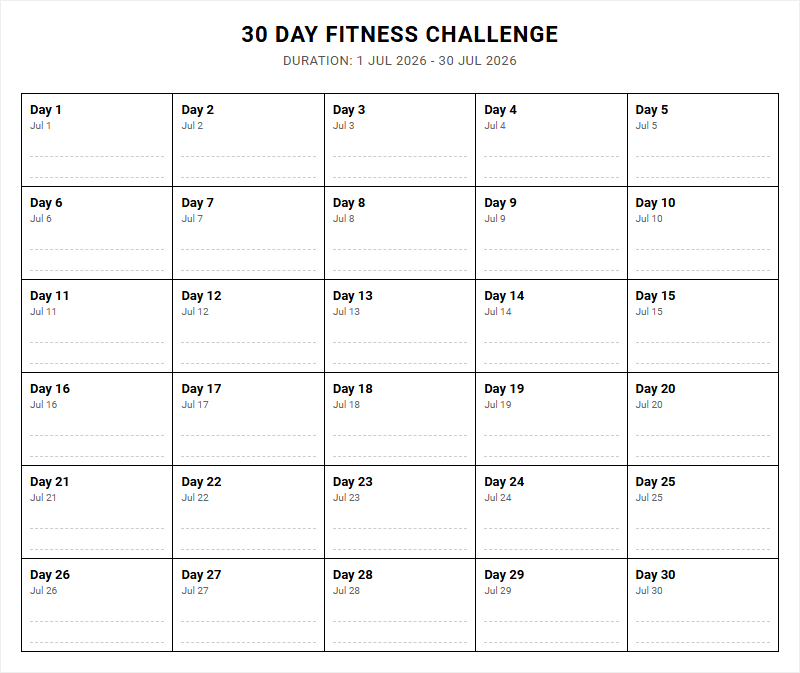
Staying committed to a new fitness routine is notoriously difficult. While many invest heavily in expensive gym memberships or digital subscriptions to secure accountability, our printable calendar grants you a tangible, visual framework to lock in your daily progress. Under the stipulation that you actively log your metrics, this system ensures lasting behavioral change. Tools like our Thirty Day Fitness Challenge tracker demonstrate how visual milestones drive success. Below, we outline how to utilize this calendar to maximize your physical transformation.
Create Your Thirty Day Fitness Challenge
Done customizing?
Thirty Day Fitness Challenge - Good to Know
Wall Pilates
Wall Pilates has emerged as a powerhouse trend in the low-impact fitness space, adapting traditional mat exercises to leverage the resistance and support of a vertical wall. By pressing your feet, back, or hands against the wall, you create a unique anchoring system that enhances spinal alignment and isolates core muscle groups. This modality is highly effective for improving posture, increasing flexibility, and developing deep stabilizing muscles without putting excess pressure on your joints.
Practitioners often utilize the wall to deepen stretches and intensify core engagement through precise movements. Key benefits of integrating this practice into your weekly routine include:
- Enhanced proprioception and body awareness.
- Targeted pelvic floor and transverse abdominis activation.
- Scalable resistance levels suitable for beginners and advanced athletes alike.
By utilizing gravity and static resistance, this accessible workout style provides a challenging yet restorative session that fortifies the body from the inside out, making it an excellent option for home workouts.
Progressive Overload
The cornerstone of strength training and muscle hypertrophy is the principle of progressive overload. This fundamental physiological law dictates that for a muscle to grow and adapt, it must be continuously subjected to a stimulus greater than what it is currently accustomed to. Simply repeating the same workout routine with the same weights indefinitely will lead to plateaus in strength, endurance, and physical conditioning.
To successfully implement this methodology in your fitness regimen, you can manipulate several training variables systematically over time. Consider these primary pathways to ensure continuous adaptation:
- Resistance: Incrementally increasing the weight or load being lifted.
- Volume: Adding more total repetitions or sets to a specific exercise.
- Frequency: Increasing the number of times you train a muscle group each week.
- Intensity: Reducing rest periods between sets to heighten metabolic stress.
By keeping a detailed training log, you can make calculated, incremental adjustments that safely challenge your musculoskeletal system, driving sustained performance gains and preventing physical stagnation.
Active Recovery
Optimizing athletic performance requires a delicate balance between intense physical exertion and structured rest. Active recovery involves performing low-intensity, non-strenuous physical movement on scheduled rest days to facilitate physiological healing. Unlike passive rest, which involves complete inactivity, light movement increases systemic circulation, which delivers vital nutrients and oxygen to damaged muscle tissues while accelerating the removal of metabolic waste products like lactic acid.
"Movement is medicine. Gentle physical activity stimulates blood flow, reduces residual muscle soreness, and maintains joint mobility during critical healing phases."
Excellent modalities for active recovery include steady-state walking, leisurely cycling, dynamic mobility flows, and gentle swimming. These activities should keep your heart rate below 50% of your maximum capacity, ensuring that the central nervous system can recover. Incorporating these lighter sessions preserves your athletic momentum, keeps your joints lubricated, and prepares your body both mentally and physically for your next high-intensity training session.
Bodyweight Calisthenics
Bodyweight calisthenics represents the art of using your own body mass as resistance to build strength, agility, and motor control. From fundamental movements like push-ups and squats to advanced gymnastics-inspired feats like handstands and muscle-ups, calisthenics emphasizes functional movement patterns. This training philosophy requires minimal equipment, making it highly versatile for those who prefer to exercise outdoors, at home, or while traveling.
Calisthenics is highly regarded for developing relative strength-the amount of strength an individual possesses relative to their body weight. The compound nature of these exercises ensures that multiple muscle groups and joints work in unison. Some of the most valuable foundational exercises include:
- Pull-ups: Excellent for developing back, shoulder, and grip strength.
- Dips: An outstanding movement for targeting the triceps, chest, and anterior deltoids.
- Pistol Squats: A challenging single-leg exercise that demands immense balance, mobility, and leg strength.
By mastering your body in space, you cultivate spatial awareness and build a resilient, athletic physique.
Habit Stacking
Building a consistent fitness routine often depends more on behavioral psychology than raw willpower. Habit stacking is a powerful cognitive strategy that anchors a new, desired behavior to an existing, deeply ingrained daily routine. By identifying a habit you already perform automatically every day and pairing it with a new fitness or wellness action, you bypass the friction of decision fatigue and establish a seamless lifestyle shift.
The structural formula for this behavior design methodology is simple and highly effective:
"After I [Current Habit], I will [New Habit]."
For example, you might commit to performing ten bodyweight squats immediately after your morning coffee finishes brewing, or foam rolling for five minutes right after you brush your teeth at night. Over time, the neural pathways associated with the established habit automatically trigger the initiation of the new behavior. This systematic approach transforms sporadic efforts into sustainable, automatic routines that foster long-term health and physical vitality.
Cozy Cardio
Reframing the traditional, often intimidating narrative of high-intensity aerobic exercise, cozy cardio has emerged as a gentle, sustainable approach to cardiovascular health. This movement prioritizes comfort, low stress, and psychological enjoyment over grueling, high-pressure workouts. Typically practiced in a warm, inviting home environment, cozy cardio encourages individuals to move their bodies at a comfortable pace while engaging in relaxing leisure activities.
A typical session might involve walking on a under-desk treadmill pad while wearing pajamas, watching a favorite movie, and sipping a warm beverage. The primary objective is to lower the barrier to entry for daily movement. Benefits of this accessible fitness trend include:
- Significant reduction in exercise-induced anxiety and performance pressure.
- Consistently elevated daily step counts without physical exhaustion.
- Improved cardiovascular circulation and low-impact joint mobilization.
By prioritizing sensory comfort and mental relaxation, cozy cardio fosters a healthy, positive relationship with daily physical movement, especially during colder seasons or high-stress periods.
HIIT Micro-workouts
For individuals balancing demanding personal and professional schedules, HIIT micro-workouts offer an incredibly efficient solution to maintaining physical fitness. These short, high-intensity interval training sessions compress the physiological benefits of traditional workouts into time frames of just four to fifteen minutes. By alternating brief periods of maximal effort with short recovery intervals, you rapidly elevate your heart rate and trigger positive cardiovascular adaptations.
Scientific research indicates that these short bursts of intense activity can stimulate mitochondrial biogenesis and improve insulin sensitivity. To structure an effective micro-workout, you can perform a rapid circuit consisting of:
- Thirty seconds of explosive kettlebell swings or burpees.
- Fifteen seconds of complete rest or active recovery.
- Repeating this cycle for several rounds with maximum focus and physical output.
This concentrated training method optimizes the post-exercise oxygen consumption effect, keeping your metabolic rate elevated long after the quick workout is completed.
Somatic Exercise
Unlike traditional workouts that focus almost exclusively on external aesthetic results or performance metrics, somatic exercise emphasizes internal physical sensation and the mind-body connection. Originating from neuromuscular re-education principles, these gentle, slow movements are designed to release chronic tension held within the body. By moving mindfully and tuning into sensory feedback, you learn to identify and correct habitual muscle holding patterns often caused by chronic stress or trauma.
"Somatic movement helps us reprogram our nervous system, releasing muscular contraction from the inside out to restore ease and fluid mobility."
These exercises often involve slow, repetitive, and conscious actions that prioritize alignment, breath, and ease over effort. Practitioners frequently experience a marked decrease in physical pain, enhanced joint mobility, and a profound reduction in systemic stress. By calming the sympathetic nervous system and activating parasympathetic pathways, somatic movement acts as a restorative therapy for both physical longevity and mental well-being.
Digital Fitness Tracker
The integration of the digital fitness tracker into daily life has revolutionized how we monitor, analyze, and optimize our personal health metrics. These sophisticated wearable devices collect real-time physiological data, providing valuable insights into our daily physical activity, cardiovascular strain, and sleep architecture. By continuously tracking metrics such as resting heart rate, heart rate variability, sleep quality, and active calorie expenditure, users gain a comprehensive overview of their health status.
Modern wearables also offer customized biometrics that help prevent overtraining and optimize daily performance. Key metrics tracked by these advanced devices include:
- Sleep staging to assess recovery and deep sleep cycles.
- Heart Rate Variability (HRV) as a direct indicator of nervous system readiness.
- Daily step goals and sedentary reminders to encourage consistent movement.
Equipped with this objective personal data, you can make informed adjustments to your exercise intensity, nutritional intake, and recovery habits to align with your overall wellness goals.
Zone 2 Endurance
Building a robust cardiovascular foundation requires a deep understanding of energy systems, and Zone 2 endurance training stands at the center of aerobic efficiency. This training intensity corresponds to a pace where your body primarily utilizes fat oxidation rather than carbohydrates for fuel. Typically maintained at 60% to 70% of your maximum heart rate, Zone 2 exercise is a sustainable effort level where you can easily hold a conversation without gasping for breath.
Training consistently in this metabolic zone stimulates mitochondrial growth and efficiency, enhancing your body's ability to produce energy over long periods. It increases capillary density, improves stroke volume of the heart, and speeds up recovery from high-intensity training sessions. Incorporating steady-state activities like jogging, cycling, or rowing at this moderate intensity is vital for athletes looking to build a resilient aerobic engine, offering profound, long-term cardiovascular protection and metabolic health benefits.
Leave a comment