
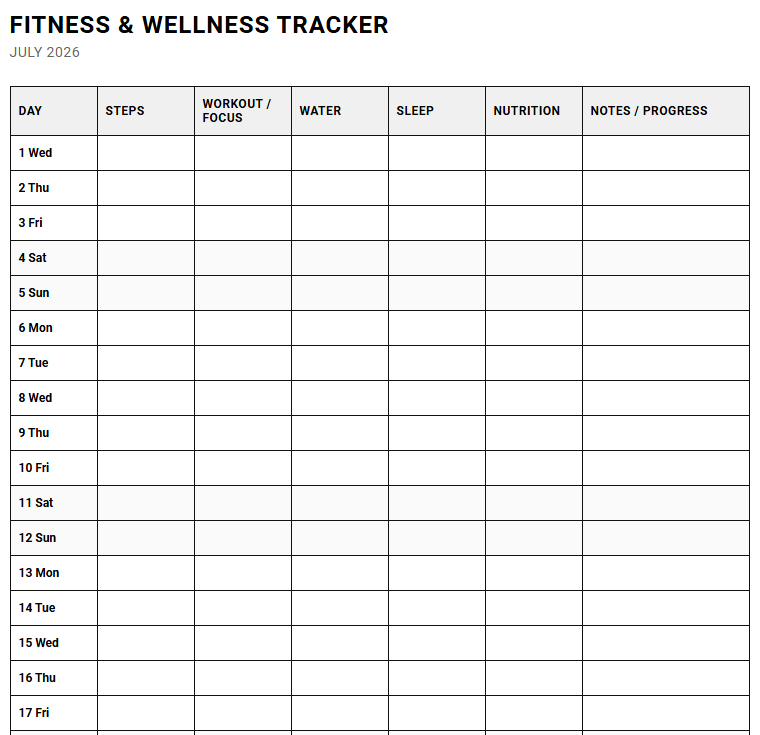
Sustaining long-term fitness consistency often feels like an uphill battle. While wearable smartwatches and digital apps serve as standard tracking tools, they frequently introduce screen fatigue. Customizable printable calendars grant users a tangible, distraction-free visual space to reclaim focus. Naturally, utilizing these templates effectively carries the stipulation of consistent, daily manual input. By physically tracking concrete habits like weekly cardio runs or daily hydration goals, you reinforce cognitive accountability. Below, we analyze the top customizable printable layouts designed to structure your routine.
Create Your Fitness Tracker Calendar
Done customizing?
Fitness Tracker Calendar - Good to Know
Workout Planner
Designing a structured path to physical excellence requires a meticulous Workout Planner. This foundational tool empowers athletes to map out target muscle groups, select specific exercises, and define precise set-and-rep schemes. By organizing your fitness routine beforehand, you eliminate gym floor hesitation and ensure every session has a clear purpose. A well-designed planner balances progressive overload with adequate variation, preventing plateaus and minimizing injury risks.
Whether you focus on hypertrophy, raw strength, or cardiovascular endurance, your planning phase dictates your execution phase. Consider these core components when building your plan:
- Targeted Muscle Splits: Dedicate specific days to push, pull, or leg variations.
- Progressive Load Milestones: Systematically increase weight volume over time.
- Rest Interval Parameters: Define recovery times between sets to optimize energy systems.
Through deliberate planning, fitness enthusiasts transform sporadic gym visits into a streamlined journey toward peak physical conditioning.
Activity Log
Keeping an accurate Activity Log serves as an objective mirror for your physical journey. Unlike relying on memory, which can be subjective and flawed, a digital log captures real-time biometric metrics, completed repetitions, and actual weights lifted. This historical database allows you to analyze patterns, identify plateaus, and make data-driven adjustments to your regimen.
By detailing how you felt during specific lifts, your sleep quality, and energy levels, you construct a comprehensive view of your physiological adaptation. To maximize the utility of your activity log, ensure you systematically capture these vital data points:
- Exact Resistance and Volume: Record every pound lifted and every completed rep.
- Duration and Intensity: Note the total active time and Rate of Perceived Exertion (RPE).
- Environmental Variables: Track sleep duration, nutrition state, and stress levels.
This continuous feedback loop provides invaluable insights, turning raw effort into measurable progress.
Habit Tracker
True fitness is built on the foundation of daily behaviors, which is why a Habit Tracker is indispensable for long-term health. While intense workouts occur a few hours a week, micro-habits-such as hydration, sleep hygiene, and mobility work-happen around the clock. By visualizing these daily actions, you reinforce positive behavioral loops and build momentum. Tracking small victories daily fosters the self-discipline required to sustain healthy lifestyles over several decades.
Consistent repetition of these minor actions eventually transforms conscious effort into automatic behavior. Consider tracking these essential daily habits to accelerate your fitness evolution:
- Hydration Targets: Consuming a set volume of water daily to support cellular function.
- Sleep Hygiene: Securing seven to nine hours of quality rest for muscular recovery.
- Daily Movement: Achieving a baseline step count to promote active circulation.
Nurturing these daily rituals ensures your lifestyle aligns seamlessly with your overarching physical ambitions.
Training Calendar
A comprehensive Training Calendar provides a high-level macroscopic view of your fitness journey over weeks and months. It bridges the gap between daily workouts and long-term athletic goals, allowing you to visualize upcoming phases, holidays, and testing days. By mapping your program onto a calendar, you gain a realistic perspective on commitment levels and time allocation.
This visual timeline aids in preventing overtraining by clearly displaying rest days and lighter deload weeks alongside high-intensity cycles. Maintaining a visual calendar helps organize life commitments around training, ensuring consistency remains high. Key calendar events should always include:
- Assessment Days: Scheduled benchmarks to test strength, speed, or endurance.
- Deload Phases: Programmed weeks of reduced volume to facilitate deep recovery.
- Program Transitions: Clear markers indicating when a training block ends and another begins.
This organized timeline ensures you remain focused on the grand horizon while executing daily tasks.
Exercise Schedule
Managing your time effectively is made simple through a structured Exercise Schedule. This tool designates specific time slots within your busy week dedicated solely to physical activity, turning abstract intentions into concrete appointments. By treating your workouts with the same respect as professional meetings, you drastically reduce the likelihood of skipping sessions.
A balanced schedule distributes different training stimuli throughout the week, ensuring cardiovascular training and resistance work do not interfere with one another. When building your weekly routine, optimize your scheduling by prioritizing these critical elements:
- Consistent Time Blocks: Train at similar times daily to regulate circadian rhythms.
- Flexibility Windows: Allow buffer zones for unexpected life events and busy workdays.
- Balanced Distribution: Space high-intensity sessions evenly to facilitate systemic recovery.
Establishing a predictable rhythm removes decision fatigue, making regular exercise an integrated, non-negotiable component of your weekly routine.
Streak Tracker
Psychological momentum is a powerful force in fitness, and a Streak Tracker leverages this to build unbreakable consistency. By visually charting consecutive days of training, clean eating, or healthy habits, you gamify your self-improvement process. The psychological desire to "not break the chain" acts as a strong motivator on days when intrinsic motivation runs low.
This simple visual cue reinforces your identity as a disciplined individual, shifting your mindset from obligation to pride. However, streaks should be managed healthily to avoid burnout. Effective streak tracking focuses on:
- Consistency Over Intensity: Celebrating the act of showing up, regardless of workout scale.
- Customizable Parameters: Defining what constitutes an active streak day (e.g., stretching counts).
- Resilience Strategies: Establishing a "never miss twice" rule to quickly bounce back from breaks.
Harnessing this psychological tool transforms daily choices into a compounding wave of positive behavioral momentum.
Macro Tracking Calendar
Physical training is only half the battle; fueling your body correctly requires a structured Macro Tracking Calendar. This specialized tracking system maps out daily macronutrient targets-proteins, carbohydrates, and fats-alongside your training demands. By aligning nutritional intake with workout intensity, you optimize muscle protein synthesis, glycogen replenishment, and fat oxidation.
A calendar view helps identify dietary trends, such as weekend calorie spikes or chronic under-fueling on high-exertion days. This systematic approach demystifies nutrition, converting dietary habits into a precise science. To master your nutritional planning, track these key metrics:
- Daily Protein Milestones: Consuming adequate amino acids to repair and rebuild muscle tissue.
- Carbohydrate Cycling: Adjusting carb intake based on low-intensity versus high-intensity training days.
- Healthy Fat Allocation: Ensuring essential fatty acids are consumed for optimal hormonal regulation.
Refining your nutritional intake according to your training demands unlocks peak performance and accelerated physical transformation.
Active Recovery Schedule
Muscle tissue does not grow during workouts; it recovers and adapts during rest, making an Active Recovery Schedule vital. Rather than passive lounging, active recovery involves low-intensity movement that promotes blood flow, clears metabolic waste, and reduces muscle soreness. Scheduling these sessions ensures they are prioritized rather than forgotten.
Activities like yoga, light swimming, mobility flows, or steady-state walking facilitate joint lubrication and parasympathetic nervous system dominance. By dedicating specific days to regeneration, you return to high-intensity training with restored energy and reduced injury risk. Your active recovery plan should feature:
- Low-Impact Aerobic Work: Keeping heart rate in zone one or two to promote circulation.
- Targeted Mobility Drills: Improving range of motion and releasing chronic myofascial tension.
- Mindfulness and Breathing: Utilizing deep diaphragmatic breathing to down-regulate stress hormones.
Integrating structured recovery into your weekly rotation safeguards your body against chronic fatigue and overuse injuries.
Fitness Dashboard
A centralized Fitness Dashboard aggregates data from all tracking systems, presenting a unified view of your health metrics. By combining workout logs, sleep metrics, nutritional data, and body composition changes onto a single interface, you gain holistic insights into your physiological state. This high-level overview helps you identify correlations, such as how sleep quality directly impacts lifting performance or how caloric deficits alter recovery times.
Modern fitness dashboards utilize charts and progress bars to make complex biological data easily digestible and actionable. For a truly optimized dashboard, ensure integration of these crucial telemetry feeds:
- Performance Trajectories: Graphs depicting strength gains or endurance pace improvements.
- Recovery Metrics: Heart Rate Variability (HRV) and resting pulse trends.
- Body Composition Charts: Long-term trends in lean muscle mass and fat percentages.
Consolidating this data empowers you to make informed, scientific adjustments to your training program.
Periodization Planner
Elite athletic development requires a sophisticated Periodization Planner to systematically cycle training phases throughout the year. By breaking your training down into macrocycles, mesocycles, and microcycles, you can peak for specific events while avoiding chronic overtraining. This planning method alternates focus between hypertrophy, maximum strength, power development, and active transition phases.
This scientific variation challenges neuromuscular pathways while allowing systemic organs and joints time to adapt to heavy loads. Structured periodization prevents stagnation and ensures long-term progression without physical breakdown. Ensure your periodization plan accounts for:
- Hypertrophy Phases: Building muscle volume and structural integrity with higher reps.
- Strength Blocks: Increasing neurological efficiency with heavier resistance and lower reps.
- Peaking Cycles: Maximizing power output and specificity for targeted events.
This methodical progression elevates your athletic capabilities, turning random workouts into a masterfully orchestrated journey.
Leave a comment