
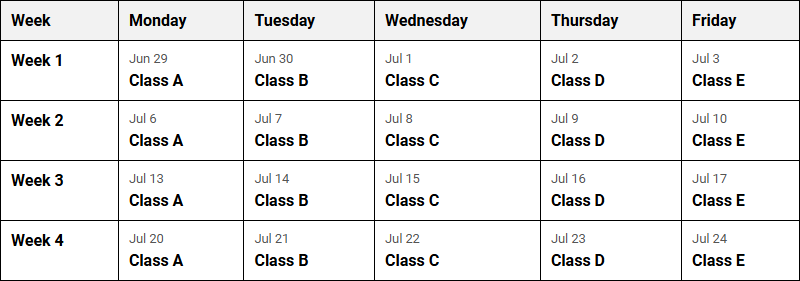
Managing complex class rotation schedules often leaves educators and students overwhelmed by administrative confusion. While schools typically rely on district technology budgets or departmental funding for costly enterprise software, simpler alternatives exist. Our printable academic calendars grant immediate scheduling clarity without the premium price tag. Though these templates require manual customization, they offer unmatched daily flexibility-as seen in highly successful A-B block schedule rollouts. Below, we outline how to select and implement the ideal rotation calendar for your classroom.
Create Your Class Rotation Schedule
Done customizing?
Class Rotation Schedule - Good to Know
Block Scheduling
Block scheduling reorganizes the traditional school day into longer, more concentrated class periods. Instead of attending six to eight short classes daily, students typically participate in fewer, extended sessions lasting 80 to 120 minutes. This structure allows educators to delve deeper into complex topics, conduct comprehensive science labs, and facilitate interactive group projects without the frequent disruption of class transitions.
Key advantages of this framework include:
- Decreased daily transitions, reducing hallway congestion and administrative overhead.
- Deeper student-teacher relationships developed through extended, focused daily interactions.
- More time for cooperative learning, individualized instruction, and immediate formative assessment.
By reducing the mental gear-shifting required of students, this structure fosters a calmer, more productive academic environment conducive to critical thinking and sustained cognitive focus.
Drop-Rotation Schedule
The drop-rotation schedule offers a dynamic variation of traditional formatting by cycling a larger pool of classes through a limited number of daily periods. In a typical configuration, a school might have seven total courses, but only five meet on any given day. The remaining two classes are "dropped" for that day, rotating back into the schedule on subsequent days. This constant shifting prevents the monotony of static daily routines.
The rotation cycle ensures key benefits:
- Classes meet at different times of the day, balancing students' peak energy levels.
- Student fatigue is minimized during historically challenging afternoon blocks.
- Educators gain a broader perspective on student performance across various times.
This approach strikes an ideal balance between variety and consistency, ensuring that every academic subject receives equitable time and energy from both students and faculty throughout the school year.
Flex-Mod Scheduling
Flex-mod, or flexible modular scheduling, breaks the school day into small, highly adaptable increments called mods, usually lasting 15 to 20 minutes. Educators combine these mods to build customized learning experiences, varying class lengths depending on the day's instructional needs. For instance, a lecture might require a 40-minute block, while a laboratory experiment could span an 80-minute session. This system closely mirrors a collegiate environment, promoting self-directed learning and time management skills.
The modular framework is characterized by:
- Customizable module lengths tailored to specific subject requirements.
- Dedicated open labs and resource centers for independent study.
- Opportunities for structured peer collaboration and one-on-one teacher consultations.
This highly personalized structure accommodates diverse learning paces, preparing high school students for the autonomy and responsibility of post-secondary education.
A/B Block Schedule
The A/B block schedule, commonly referred to as an alternating day schedule, divides a student's full course load across two distinct days. On "A" days, students attend half of their classes for extended periods, and on "B" days, they attend the remaining half. This system allows schools to offer a wider array of elective courses and advanced placement classes without overwhelming the daily student workload.
By spreading eight courses over forty-eight hours, students experience:
- A manageable nightly homework load, focusing on only three or four subjects at a time.
- Sustained academic engagement with multiple disciplines over an entire school year.
- Adequate prep time between consecutive sessions of the same class.
This alternating cycle provides the dual benefit of intensive, long-form learning and consistent, year-long exposure to essential academic disciplines.
Waterfall Rotation
A waterfall rotation schedule is a specialized sequential system where classes cascade through the daily schedule in a predetermined, fluid order. Each day, the sequence shifts downward, causing the class that began the previous day to drop to the bottom or rotate out entirely. This cascading effect creates a highly predictable yet dynamic flow of academic subjects.
Key operational steps include:
- Sequential shifting of all periods by one slot every day.
- Periodic exclusion of specific courses to maintain balanced contact hours.
- Systematic rotation of morning and afternoon classes.
This organizational structure ensures that no single subject is permanently relegated to the early morning or late afternoon, when student alertness levels might fluctuate. It provides an equitable distribution of prime learning times across all academic departments.
Cohort Rotation
Cohort rotation groups students into fixed, collaborative units-or cohorts-that move through their academic schedules together. Rather than individual students navigating unique paths, the entire group transitions from class to class as a single entity. This model is exceptionally popular in middle schools, vocational programs, and medical academies where integrated, team-based learning is paramount.
Benefits of cohort-based scheduling include:
- Enhanced peer support systems and stronger social-emotional connections among students.
- Simplified logistical planning for administrators and academic advisors.
- Seamless interdisciplinary teaching, as teachers coordinate projects for the same group of students.
This community-oriented structure minimizes the anxiety associated with navigating complex school environments, fostering a collaborative culture where students feel supported by a consistent peer network.
Six-Day Cycle
The six-day cycle replaces the traditional Monday-through-Friday academic week with a numbered rotation from Day 1 through Day 6. If school is closed for a holiday or inclement weather on a Wednesday, the rotation simply pauses and resumes with the next scheduled day when classes return. This clever mechanism completely eliminates the common problem of Monday or Friday classes losing disproportionate instructional time due to holidays.
The benefits of this system are clear:
- Perfect equity in instructional time for all subjects regardless of calendar disruptions.
- Seamless integration of specialized resources like physical education, art, and music.
- Elimination of scheduling disruptions caused by unexpected school closures.
By decoupling the academic calendar from the standard five-day week, educational institutions achieve a highly consistent distribution of course hours, ensuring curriculum parity across all disciplines.
Matrix Scheduling
Matrix scheduling relies on a multi-dimensional grid system to coordinate complex educational requirements, often incorporating variable class sizes, co-teaching models, and interdisciplinary instruction. This system plots students, teachers, physical spaces, and time slots along intersecting axes, allowing administrators to optimize resources in real-time. It is highly valued in modern, open-concept schools that prioritize flexible, team-based teaching methodologies.
This intricate organizational design facilitates:
- Fluid grouping and regrouping of students based on immediate diagnostic data.
- Shared planning periods for co-teachers to align their instructional strategies.
- Maximum utilization of specialized facilities, such as media centers and science labs.
By breaking down the rigid walls of traditional scheduling, matrix systems offer a highly responsive framework that adapts to the immediate instructional needs of a diverse student population.
Modular Rotation
Modular rotation blends the principles of flex-mod scheduling with systematic course rotations, dividing the academic calendar into brief, high-intensity modules or "terms." Instead of studying six subjects simultaneously over nine months, students might focus intensively on two or three modules for a shorter, six-week duration before rotating to the next set. This immersive approach allows for deep cognitive focus and rapid skill acquisition.
The primary advantages of modular cycles are:
- Reduced cognitive load from balancing too many academic subjects at once.
- Faster recovery options, allowing students to retake specific failed modules quickly.
- Opportunities for intensive, immersive field studies and real-world internships.
This format helps students master complex material by eliminating competing academic distractions, providing a clear pathway toward academic proficiency through deep, concentrated periods of study.
Rolling Schedule
A rolling schedule is a fluid, continuous rotation system where the sequence of classes rolls over seamlessly from one day to the next, entirely independent of the calendar date or day of the week. If a school runs periods one through four on Monday, Tuesday begins with period five and rolls back to period one. This eliminates the concept of static weekly routines, ensuring that classes meet at different hours each day.
Key features of this scheduling model include:
- Constant variation in the daily academic sequence, maintaining high student engagement.
- Mitigation of the negative impact of external disruptions on specific class periods.
- Equal distribution of peak learning hours across the entire academic curriculum.
This continuous progression keeps the school day dynamic and unpredictable in an engaging way, preventing the stagnation that often accompanies rigid, repeating weekly schedules.
Leave a comment