
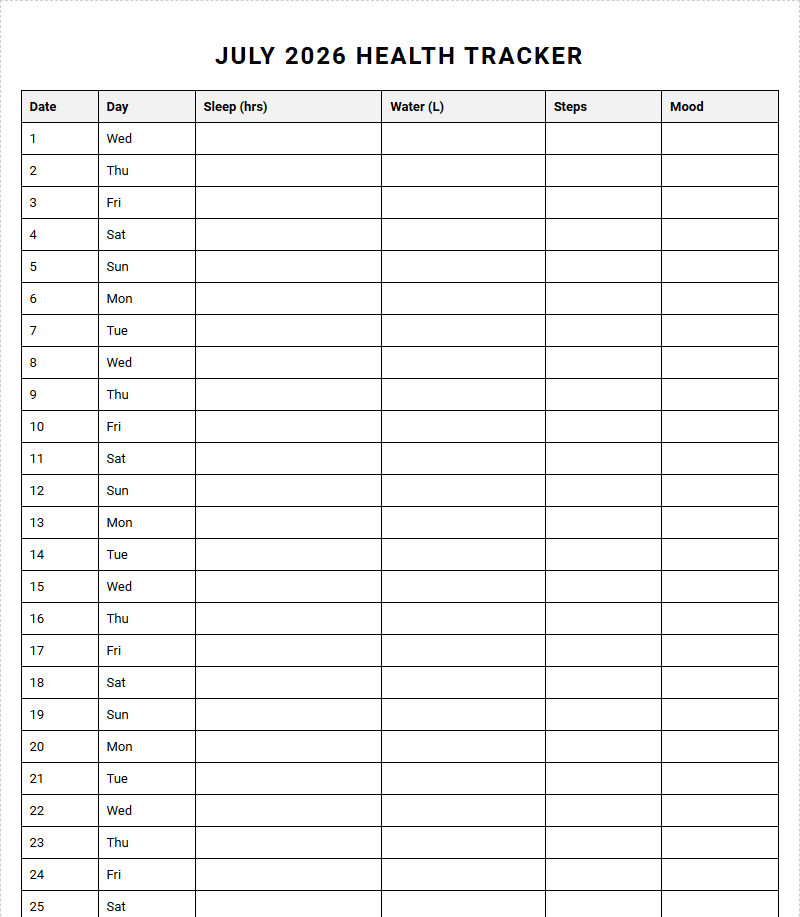
Managing daily wellness metrics often feels overwhelming. While digital portals and paid apps offer tracking, they frequently overcomplicate personal data. A dedicated monthly printable calendar grants users immediate, offline visual clarity over their routines. Crucially, while these tools cannot replace professional clinical advice, they establish vital wellness baselines. Concrete examples, such as daily blood pressure logs, demonstrate their practical utility. Below, we outline how to effectively implement your health tracker.
Create Your Monthly Health Tracker Calendar
Done customizing?
Monthly Health Tracker Calendar - Good to Know
Habit tracker
A habit tracker serves as the foundational framework for personal development and behavioral modification. By systematically documenting your daily routines, you construct a visual feedback loop that reinforces positive behaviors while identifying detrimental patterns. Maintaining a consistent record helps bridge the gap between setting ambitious goals and establishing sustainable, automated daily actions.
To optimize your routine, consider tracking these core behavioral categories:
- Intellectual growth: Reading, writing, or learning a new language.
- Physical wellness: Daily stretching, strength training, or steps.
- Mindfulness: Meditation, deep breathing exercises, or daily journaling.
Accumulating consecutive successful days creates psychological momentum, rendering it far easier to sustain long-term discipline. By analyzing this empirical data, you gain precise insights into your personal productivity cycles, allowing you to optimize your schedule for peak performance and cognitive efficiency throughout the week.
Symptom log
A structured symptom log is an indispensable clinical tool for mapping your physiological well-being and identifying underlying health anomalies. By recording physical discomfort, allergic reactions, or cognitive fatigue in real-time, you compile an objective dataset that eliminates recall bias during medical consultations. This systematic approach allows healthcare providers to diagnose complex conditions with greater accuracy and speed.
When documenting your physical state, ensure you record these vital data points:
- Severity: Rate the discomfort on a standardized scale from one to ten.
- Duration: Note the exact onset time and when the symptoms finally subside.
- Triggers: Document environmental factors, dietary intake, or recent physical exertion.
Correlating these acute physical episodes with external environmental variables reveals hidden sensitivities. Consequently, this detailed record empowers you to make proactive lifestyle modifications and advocate effectively for your personal healthcare needs.
Cycle syncing
The practice of cycle syncing involves aligning your dietary choices, exercise intensity, and cognitive workloads with the distinct phases of the menstrual cycle. By adjusting your lifestyle to accommodate fluctuating hormonal profiles, you can naturally optimize your energy levels, mitigate premenstrual symptoms, and enhance overall reproductive health.
- Follicular Phase
- Characterized by rising estrogen; ideal for high-intensity interval training, creative brainstorming, and initiating complex new projects.
- Luteal Phase
- Marked by progesterone dominance; favors restorative strength training, detailed analytical work, and nutrient-dense, complex carbohydrates.
Honoring these biological transitions prevents systemic burnout and reduces chronic stress. Integrating this natural biological rhythm into your professional and personal scheduling fosters a sustainable lifestyle that leverages your body's natural physiological fluctuations rather than fighting against them.
Sleep hygiene log
An exhaustive sleep hygiene log is essential for diagnosing sleep architecture disruptions and cultivating deep, restorative rest. Because sleep quality dictates cognitive function, emotional resilience, and metabolic health, tracking nocturnal variables is a paramount self-care practice. This log monitors both pre-sleep behaviors and sleep metrics to identify what disrupts your circadian rhythm.
Consider monitoring these essential environmental and behavioral metrics daily:
- Caffeine curfew: The exact hour you consumed your final stimulant of the day.
- Digital blackout: Screen exposure duration within two hours of sleep.
- Ambient environment: Optimal room temperature, humidity, and total darkness levels.
Reviewing these variables alongside morning alertness ratings exposes subtle sleep disruptors. Adjusting your evening wind-down routine based on these personalized observations ensures consistent entry into deep, restorative slow-wave sleep phases.
Mood tracker
Maintaining a digital or analog mood tracker assists in developing superior emotional intelligence and psychological resilience. By cataloging emotional states throughout the day, you begin to decouple immediate emotional reactions from external stimuli. This practice transforms vague feelings into structured, observable data, revealing the underlying catalysts of anxiety, joy, or apathy.
To capture a comprehensive emotional landscape, categorize your entries using these criteria:
- Primary emotion: Identify the core feeling, such as anxiety, contentment, or frustration.
- Social context: Note the individuals present during the observed emotional shift.
- Physiological state: Document concurrent factors like hunger, fatigue, or physical pain.
Recognizing these emotional trends prevents minor stressors from escalating into prolonged depressive states. Over time, self-reflection yields actionable insights, allowing you to establish protective boundaries and prioritize activities that foster emotional equilibrium.
Medication tracker
A meticulous medication tracker is paramount for maintaining patient safety and ensuring strict therapeutic compliance. Managing complex pharmaceutical regimens or basic supplement stacks requires a foolproof system to prevent missed doses, double dosing, or dangerous drug interactions. Keeping an accurate log provides peace of mind and reinforces the efficacy of your prescribed treatment plan.
Your tracking protocol should clearly organize the following critical metrics:
- Dosage and administration: Specify exact measurements and whether to take with food.
- Timing protocols: Align intake with circadian biology or specific intervals.
- Adverse reactions: Log any immediate side effects or physiological changes.
Having this information readily accessible is incredibly beneficial during emergency medical situations. This disciplined approach guarantees that pharmacological and therapeutic interventions yield maximum health benefits with minimal physiological risk.
Water intake log
A dedicated water intake log is a simple yet transformative tool for optimizing cellular hydration and metabolic function. Mild dehydration often masquerades as cognitive fatigue, hunger pangs, or physical lethargy, leading individuals to consume unnecessary calories or stimulants. Systematically monitoring your fluid consumption ensures your body retains the ideal fluid balance necessary for peak physical performance.
To maximize the utility of your hydration logging, trace these specific variables:
- Volume targets: Strive for consistent, measured hourly consumption rather than bulk drinking.
- Electrolyte balance: Note the addition of trace minerals or sodium to your water.
- Exertion compensation: Increase fluid targets to match sweat loss during intense exercise.
Maintaining optimal hydration enhances joint lubrication, accelerates muscle recovery, and improves skin elasticity. Consistent logging transforms hydration from an afterthought into a deliberate, health-promoting habit.
Vital signs tracker
A comprehensive vital signs tracker offers a window into your cardiovascular health and autonomic nervous system function. By recording core biometrics over extended periods, you establish a highly personalized physiological baseline. This baseline makes it remarkably easy to detect early indicators of systemic illness, cardiovascular strain, or overtraining syndrome long before physical symptoms manifest.
Key metrics that require diligent, standardized observation include:
- Resting Heart Rate (RHR): An excellent indicator of cardiovascular fitness and recovery.
- Blood Pressure (BP): Critical for monitoring arterial health and systemic stress.
- Oxygen Saturation (SpO2): Essential for assessing respiratory efficiency and sleep apnea risks.
Sharing these trends with your primary care physician facilitates highly customized preventative medicine. Consistent biometric tracking bridges the gap between subjective physical feelings and objective medical realities.
Biohacking dashboard
An advanced biohacking dashboard consolidates data from wearable devices, lab work, and lifestyle trackers into a centralized command center. This integration allows self-quantifiers to run controlled experiments on their own biology, measuring the direct impact of specific interventions on longevity and performance. It translates raw biometric data into actionable lifestyle adjustments.
A typical high-performance dashboard monitors several sophisticated inputs:
- Heart Rate Variability (HRV): The definitive metric for nervous system recovery.
- Glucose fluctuations: Continuous glucose monitor data showing glycemic responses to foods.
- Sleep architecture: Exact ratios of deep, REM, and light sleep cycles.
Analyzing these synergistic metrics allows you to fine-tune your supplement stacks, fasting windows, and photobiomodulation therapies. This empirical approach to wellness replaces generic health advice with precise, data-driven self-optimization protocols.
Somatic tracker
A somatic tracker focuses on the mind-body connection by documenting physical sensations, muscle tension, and nervous system states. Unlike cognitive journaling, somatic tracking encourages you to drop out of analytical thinking and tune into the raw physical sensations within your body. This practice is crucial for processing trauma, managing chronic stress, and reducing somatic symptom disorders.
When conducting a somatic assessment, try categorizing your internal sensations:
- Constriction: Note tightness in the chest, throat, jaw, or shoulders.
- Temperature: Identify localized sensations of heat, cold, or sudden flushing.
- Respiration: Observe the depth, speed, and ease of your natural breathing pattern.
Tracking these physical indicators allows you to discharge stored stress through somatic experiencing techniques. Cultivating this deep somatic awareness restores balance to an overstimulated nervous system, fostering genuine physiological peace.
Leave a comment