
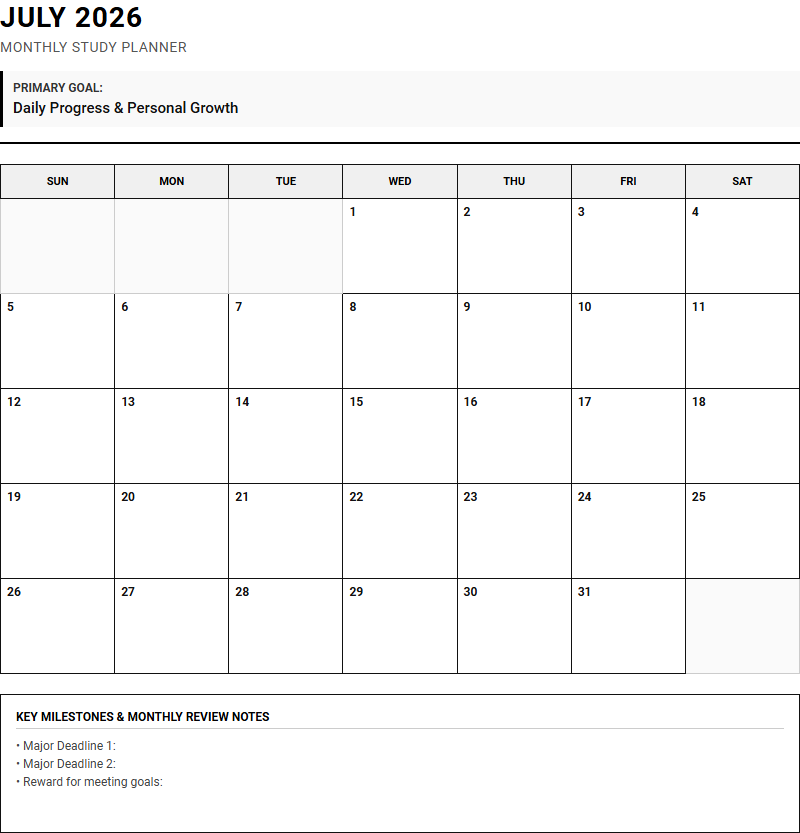
Balancing complex coursework often leaves students feeling overwhelmed. While securing academic funding sources like institutional grants supports your enrollment, true academic success requires structured time management. A printable Monthly Study Planner Calendar grants students the ultimate control over their schedules, provided they maintain consistent daily updates. Trusted by top-performing university cohorts, this tool transforms chaotic semesters into manageable milestones. Below, we explore how to effectively integrate this resource into your routine.
Create Your Monthly Study Planner Calendar
Done customizing?
Monthly Study Planner Calendar - Good to Know
Notion study dashboard
A Notion study dashboard serves as the central nervous system for your academic journey. By consolidating your lecture notes, assignment deadlines, and exam schedules into a single, cohesive workspace, you eliminate the cognitive friction of searching through scattered files. Utilizing relational databases allows you to link your courses to specific tasks, ensuring that every piece of information is contextualized.
To maximize the utility of your dashboard, consider incorporating the following elements:
- Quick Action Buttons: For rapid note-taking during lectures.
- Master Task List: Sorted by urgency and level of effort.
- Resource Hub: Storing PDF textbooks, web bookmarks, and syllabus documents.
This digital workspace adapts to your changing academic needs throughout the semester, providing a visual overview of your progress and helping you maintain long-term organization without manual upkeep.
Spaced repetition tracker
Implementing a spaced repetition tracker is essential for shifting information from short-term to long-term memory. Instead of cramming, this systematic approach prompts you to review material at expanding intervals, exploiting the psychological spacing effect. By rating your recall accuracy after each review, you can dynamically schedule the next study session.
- Day 1: Initial exposure and active encoding of the material.
- Day 3: First review to disrupt the forgetting curve.
- Day 7: Second review, strengthening synaptic connections.
- Day 14: Third review, solidifying core concepts.
- Day 30: Final review before permanent retention is achieved.
By leveraging this algorithm, you spend less time reviewing concepts you already know well and dedicate precious cognitive energy to the challenging topics that require additional reinforcement.
Active recall schedule
An active recall schedule forces your brain to retrieve information without looking at your notes, which is scientifically proven to enhance retention. Instead of passively re-reading highlighted textbooks, you test yourself using targeted questions, flashcards, or blank-sheet brain dumps. This practice identifies critical gaps in your understanding before high-stakes exams arrive.
"Do not try to remember; try to retrieve." This fundamental shift in mindset transforms passive consumers of information into active scholars who can apply knowledge under pressure.
By scheduling these retrieval sessions at strategic intervals, you build robust neural pathways. This structured routine ensures you remain engaged with the material, turning abstract theories into deeply understood practical concepts that are easily recalled during examinations.
Time blocking calendar
A time blocking calendar transforms your vague to-do list into a concrete, visual action plan. By dividing your day into dedicated time blocks, you assign a specific purpose to every hour. This method prevents the paralysis of choice and protects your schedule from external distractions and insidious procrastination.
Consider structuring your daily calendar with these specialized blocks:
- Deep Work Blocks: 90 to 120 minutes of uninterrupted focus on complex tasks.
- Admin Blocks: 30 minutes for answering emails, organizing files, and planning.
- Buffer Blocks: Flexible periods designed to absorb unexpected delays or overruns.
Treating these scheduled blocks as non-negotiable appointments with yourself fosters deep focus, allowing you to complete high-priority academic work in less time with significantly reduced stress levels.
Syllabus mapping
Syllabus mapping is the strategic process of deconstructing your course outlines and translating them into actionable milestones. Rather than viewing each syllabus as a passive reference document, you dissect the grading rubrics, reading lists, and major project requirements to build a comprehensive academic roadmap at the start of the semester.
| Course Component | Weight | Strategic Action Plan |
|---|---|---|
| Weekly Readings | 10% | Pre-read and generate active recall questions. |
| Midterm Exams | 40% | Initiate spaced repetition protocols 14 days prior. |
| Term Paper | 50% | Break down into research, drafting, and editing phases. |
This proactive mapping ensures that conflicting deadlines across different modules never catch you off guard, allowing for balanced preparation and consistent performance.
GoodNotes study planner
A GoodNotes study planner bridges the gap between traditional handwriting and modern digital convenience. Writing by hand stimulates the brain's reticular activating system, which aids in deeper cognitive processing and conceptual understanding. Using a digital tablet allows you to reorganize, search, and backup your handwritten notes instantly.
To optimize your GoodNotes system, utilize these design practices:
- Color-Coded Notebooks: Assign a signature color to each academic discipline.
- Hyperlinked Indexing: Create quick navigation to monthly, weekly, and daily spreads.
- Custom Sticker Templates: Standardize priority flags, deadline markers, and habit trackers.
This highly visual, tactile planning method provides a creative outlet while maintaining the meticulous organization required to manage demanding, multi-faceted academic workloads successfully.
Pomodoro tracker
A Pomodoro tracker is an excellent tool for sustaining high concentration levels while systematically preventing mental fatigue. By working in focused intervals separated by short breaks, you train your brain to focus intensely for manageable periods. This rhythm discourages multitasking and builds momentum over long study sessions.
- Focus Interval: Work diligently on a single task for 25 minutes.
- Short Break: Step away, stretch, or hydrate for 5 minutes.
- Repeat: Complete four consecutive intervals.
- Long Break: Rest for 15 to 30 minutes to fully recharge your cognitive battery.
Tracking these intervals provides tangible proof of your productivity, helping you estimate future tasks accurately and balance intensive study sessions with essential recovery periods.
Academic habit loop
The academic habit loop relies on behavioral psychology to automate your daily routines. By identifying the cues, routines, and rewards that govern your study behavior, you can intentionally design positive habits that stick. Over time, these routines require less willpower to initiate, making academic consistency effortless.
Understanding the three key components of the loop allows you to optimize your behavior:
- The Cue: A consistent trigger, such as arriving at your desk with a warm cup of tea.
- The Routine: The actual study behavior, like executing a 45-minute writing block.
- The Reward: A satisfying reinforcer, such as five minutes of guilt-free relaxation.
Deliberately engineering these loops replaces chaotic bursts of motivation with predictable, sustainable academic routines that support your long-term goals throughout the school year.
Exam countdown log
An exam countdown log acts as a visual reality check that prevents procrastination by displaying the exact time remaining before major assessments. This tracker keeps you aware of approaching deadlines, prompting you to pace your study efforts rather than resorting to stressful, last-minute cramming sessions.
| Upcoming Exam | Days Remaining | Preparation Status |
|---|---|---|
| Organic Chemistry | 12 Days | Reviewing weak flashcard decks. |
| Macroeconomics | 24 Days | Summarizing lecture notes and case studies. |
Updating this log regularly creates a healthy sense of urgency, encouraging you to distribute your revision workload evenly and enter the examination room with quiet confidence.
ADHD-friendly study layout
An ADHD-friendly study layout is deliberately engineered to minimize sensory overload, visual clutter, and executive dysfunction. Standard academic planners can feel overwhelming due to rigid structures and dense fields. An adaptable, low-friction design supports cognitive flexibility and maintains motivation through novel stimuli.
Consider implementing the following design adjustments to create a supportive environment:
- Visual Progress Bars: Using simple progress rings instead of daunting, binary checkboxes.
- Brain Dump Zones: Large, unruled sections to capture intrusive thoughts immediately.
- High-Contrast Accents: Bold colors that draw focus directly to the most critical tasks.
This accommodating setup reduces executive fatigue, turning a potentially stressful workspace into a structured, supportive environment that welcomes focus and accommodates varying energy levels.
Leave a comment